AI product management sits at the intersection of business strategy, technology, and customer experience. As companies integrate artificial intelligence into their products, they need professionals who can identify where AI adds value, assess its technical feasibility, and translate business requirements into product decisions.
For professionals considering this career path, choosing the right MBA involves looking beyond the degree or specialization name. So, what should you look for in an MBA if AI product management is your career goal? Prioritize a curriculum that combines AI and Machine Learning fundamentals, Product Strategy, Business Analytics, hands-on projects, and leadership development. An online MBA can be particularly beneficial for working professionals, allowing them to pursue management education alongside their existing jobs.
Advance your career with SRMIST's UGC-entitled Online MBA. Choose from 11 industry-focused specializations including Finance, Marketing, HR, AI & Data Science, Healthcare & Hospital Management and more.
What Should an MBA Cover for Aspiring AI Product Managers?
When evaluating an MBA for an AI product management career, consider these six areas:
1. Artificial Intelligence and Machine Learning Fundamentals
An AI product manager must understand how Artificial Intelligence, Machine Learning, and Generative AI work, even without building models themselves. Look for an MBA curriculum that covers AI applications, Machine Learning fundamentals, Generative AI, and emerging technologies.
This knowledge helps product managers assess whether an AI solution can address a business problem, evaluate its limitations, and communicate technical requirements to development teams. Familiarity with large language models (LLMs), automation, and AI-powered applications is also valuable.
For professionals looking to develop these capabilities alongside business management skills, the Online MBA in AI from SRMIST offers a relevant learning pathway. Its curriculum covers areas such as Machine Learning, Deep Learning, Natural Language Processing, and Business Intelligence, helping learners understand how data and AI can be applied to business problems.
SRMIST Online MBA in Data Science & AI
Advance your career with SRMIST's UGC-entitled Online MBA in Data Science and Artificial Intelligence. Master machine learning, data visualization, and business analytics to drive data-centric decisions.
2. Product Strategy and Management
Product strategy is central to an AI product manager's responsibilities. Look for subjects covering product lifecycle management, market research, product roadmaps, customer discovery, and product-market fit.
These concepts help professionals identify customer requirements, prioritize product features, and determine where AI can improve a product's functionality. They also develop the ability to balance customer expectations, technical feasibility, and business objectives when making product decisions.
For AI-powered products, this also involves deciding whether a problem requires an AI-based solution, which features should be prioritized, and how the product should evolve based on user feedback and model performance.
3. Business Analytics and Data-Driven Decision-Making
AI product managers rely on data to understand customer behavior, evaluate product performance, and identify opportunities for improvement. An MBA should therefore include business analytics, data visualization, predictive analytics, and business intelligence.
Look for exposure to key performance indicators (KPIs), A/B testing, and data interpretation. These skills help product managers measure feature adoption, evaluate AI-generated outcomes, and make informed decisions about product improvements.
AI products also require specific performance measures, such as model accuracy, response time, output reliability, and cost per AI-generated response. Understanding these metrics helps product managers assess whether an AI feature is delivering value to users and the business.
4. Hands-On Projects and Practical AI Exposure
Theoretical knowledge alone may not prepare professionals to manage AI products in business environments. Look for an MBA that includes industry projects, business simulations, and case studies involving AI implementation.
Practical assignments should provide opportunities to:
- Identify business problems that AI can address.
- Develop product concepts and prioritize AI-powered features.
- Evaluate AI tools and their business applications.
- Assess product performance using relevant metrics.
For example, a project involving an AI-powered customer support platform could require learners to identify customer pain points, evaluate chatbot capabilities, define success metrics, and assess when human intervention is necessary.
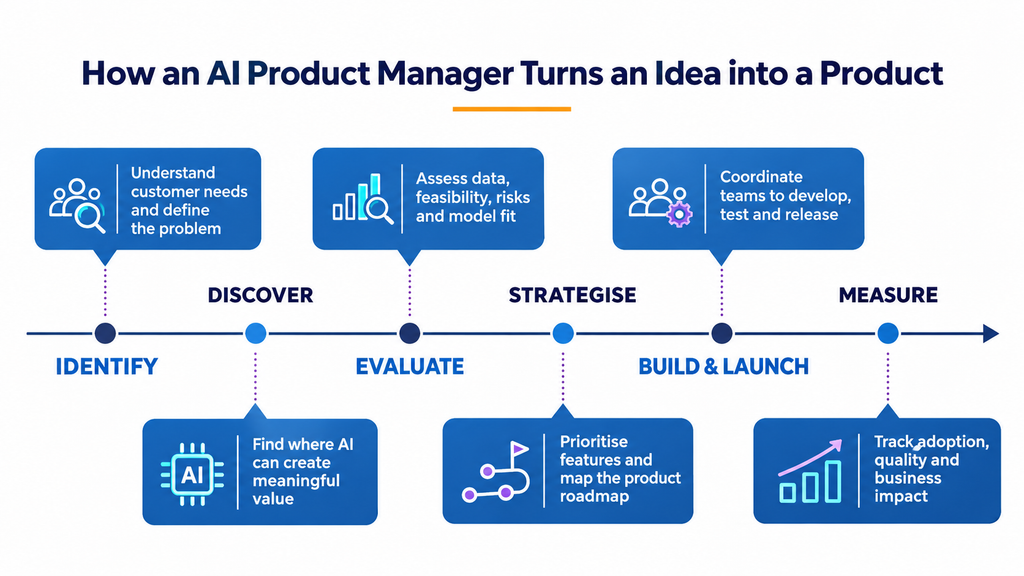
This exposure helps learners understand the challenges of moving an AI solution from an initial concept to a usable product.
5. Leadership and Cross-Functional Collaboration
AI product managers work with engineers, data scientists, designers, marketing teams, and business stakeholders. An MBA should develop skills in stakeholder management, strategic communication, negotiation, and team leadership.
These capabilities help professionals translate business requirements into technical specifications, communicate product priorities, and coordinate teams throughout the product development lifecycle.
6. Industry Exposure and Networking Opportunities
Evaluate whether the MBA provides access to industry practitioners, experienced faculty, mentorship, and peer networking. Guest sessions, industry projects, and practical case studies can help learners understand how organizations approach AI adoption and product development.
Look for opportunities to engage with professionals from technology, consulting, financial services, and other sectors where AI-powered products are being developed.
Why Are These MBA Skills Becoming More Relevant in India's AI Industry?
The growing demand for AI talent in India makes a combination of technical understanding and business management skills increasingly valuable. As AI adoption expands across industries, organizations need professionals who can evaluate technology investments, identify business opportunities, and align AI initiatives with organizational goals.
According to Deloitte India's State of AI in the Enterprise 2026 report, 62% of Indian enterprises reported at-scale AI deployment in product development. This makes the ability to connect AI capabilities with product requirements and business outcomes an important competency for aspiring AI product managers.
The talent landscape also points to sustained demand for AI-related expertise. According to NASSCOM estimates cited by the government, India's AI talent pool stood at approximately 600,000 - 650,000 professionals in 2024, while the country's AI talent requirement is projected to exceed 1.25 million by 2027.
These figures represent overall AI talent requirements, not AI product management vacancies. However, they highlight the growing importance of professionals who can combine technical understanding with business, analytical, and implementation capabilities.
Who Should Consider an MBA for an AI Product Management Career?
Professionals from business, technology, and analytical backgrounds can explore AI product management, provided they develop the necessary product and AI knowledge.
- Business analysts: Can build on their analytical experience to identify AI use cases and contribute to product strategy.
- Technology professionals: Can develop business and leadership skills to transition from technical roles into product management.
- Aspiring product managers: Can strengthen their understanding of AI applications, product development, and business strategy.
- Business and marketing professionals: Can learn to manage AI-powered customer experiences and data-driven products.
Frequently Asked Questions About an MBA for AI Product Management
Which MBA specialization is best for becoming an AI product manager?
An MBA in Product Management, Business Analytics, or Technology Management can provide relevant skills for an AI product management career. The most suitable choice depends on the curriculum. Look for programs that combine AI fundamentals, product strategy, data analytics, and practical technology applications.
Can you become an AI product manager after an MBA without a technical background?
Yes. A technical degree or coding experience is not mandatory for every AI product management role. However, professionals should understand AI concepts, APIs, data workflows, and machine learning capabilities to collaborate effectively with technical teams, evaluate product feasibility, and make informed product decisions.
What skills should an AI product manager develop beyond an MBA?
AI product managers should develop AI literacy, product discovery, data interpretation, model evaluation, responsible AI practices, and stakeholder management skills. They should also understand AI-specific product metrics, such as model accuracy, output reliability, response latency, and feature adoption, to evaluate product performance.
What tools should an AI product manager learn?
AI product managers can benefit from familiarity with product management platforms such as Jira and Figma, analytics tools such as Power BI and Tableau, and AI platforms such as ChatGPT, Microsoft Azure AI, and Google Vertex AI. The specific tools required depend on the organization and product.