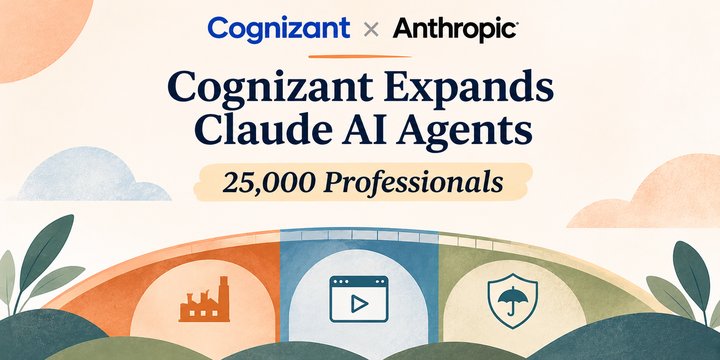
Cognizant is expanding its partnership with Anthropic, dedicating more than 25,000 professionals to Claude-powered enterprise AI and introducing managed services to build and operate AI agents for businesses.
The November 10, 2026 announcement includes three notable customer results:
- Pharmaceutical manufacturing: Equipment downtime reduced by 35%, with troubleshooting time falling from 90–120 minutes to 10–15 minutes.
- Media and entertainment: Requirements documentation reduced from three to four weeks to approximately 15 minutes.
- Insurance: Campaign preparation and retirement-plan support workflows completed 40–60% faster.
These are Cognizant-reported results. The company has not disclosed detailed measurement methodologies or independent validation.
The announcement also reports more than 44,000 associates trained or certified on Claude and over 26,000 certifications.
What is Changing in Enterprise AI?
A maintenance engineer investigating an equipment failure might spend hours searching technical manuals, reviewing previous incidents and checking maintenance records.
An AI agent connected to those information sources might retrieve relevant procedures, compare historical failures and help identify the next diagnostic step.
The same architecture applies to insurance claims, financial research and enterprise document processing.
The underlying technologies include Retrieval-Augmented Generation (RAG), APIs, tool calling and agent orchestration. These allow language models to work with business information and applications instead of relying exclusively on their training data.
For software developers and AI engineers, learning these technologies is increasingly relevant to building enterprise applications.
The IIT Bombay Certificate in Agentic AI focuses on these technical capabilities through RAG, MCP, LangGraph, CrewAI and multi-agent systems.
Its practical projects include customer-support agents, financial-news research agents and multi-agent software engineering workflows.
For developers familiar with Python and APIs, the program offers a structured route into building applications where AI models retrieve information, interact with tools and coordinate tasks.
Three Industry Applications Worth Understanding
Manufacturing: Faster Troubleshooting
Cognizant’s pharmaceutical manufacturing example highlights the potential of connecting AI agents with technical documentation and operational records.
A useful troubleshooting agent needs access to accurate information, appropriate tools and procedures for escalating uncertain recommendations.
For manufacturing technology teams, the engineering requirements involve data integration, retrieval accuracy and operational safeguards.
The reported 35% reduction in downtime is promising, although the public announcement does not establish whether similar results are achievable across other manufacturing environments.
Media: Automating Requirements Documentation
The reported reduction from weeks to minutes in requirements-document preparation illustrates an application relevant to business analysts, product managers and engineering teams.
AI agents might help collect information, identify missing requirements and prepare structured documents.
The business value depends on the accuracy of the information and the amount of review still required.
For product teams, the challenge is identifying suitable processes and measuring the complete workflow, rather than document-generation speed alone.
Insurance: Faster Financial Workflows
Cognizant’s insurance example involves campaign preparation and retirement-plan support.
These processes require access to customer information, financial-product documentation and business rules.
AI agents might assist with information retrieval and documentation, while sensitive decisions remain subject to appropriate human review.
Professionals working in banking, insurance or financial operations will find related applications in Great Learning’s Agentic AI in Finance guide, covering underwriting, compliance, investment research and risk monitoring.
Building AI Agents Is Only Part of the Challenge
Cognizant is also introducing managed services for operating Claude-powered systems after deployment.
Enterprise agents depend on APIs, databases, models and external services. Failures in any component might affect the complete workflow.
An agent processing insurance information, for example, needs to handle unavailable services, outdated documents and requests requiring human approval.
Production engineering therefore involves monitoring, evaluation, security, deployment and operational reliability.
These responsibilities are particularly relevant to experienced software engineers, DevOps professionals and cloud architects.
The Johns Hopkins AI and Agentic AI Engineering program addresses production-oriented capabilities, including MLOps, LLMOps, cloud deployment, monitoring and AI security.
For professionals already building software or managing infrastructure, the learning opportunity extends beyond creating an AI prototype to understanding how enterprise AI systems operate under real workloads.
Which Agentic AI Skills Matter for Your Role?
| Professional | Relevant application | Learning priority |
|---|---|---|
| Software developer | Customer-support and workflow agents | RAG, APIs, LangGraph, MCP |
| AI/ML engineer | Multi-agent applications | Orchestration, evaluation, tool calling |
| Solution architect | Enterprise AI integration | Architecture, security, system connectivity |
| DevOps/cloud engineer | Production AI systems | MLOps, LLMOps, monitoring |
| Product manager | AI-enabled business processes | Use-case selection, workflow evaluation |
| Banking/insurance professional | Financial operations and research | Financial AI applications, governance |
Professionals comparing technical and business-oriented pathways should review the Great Learning Agentic AI course catalogue alongside program prerequisites and project requirements.
What Does Cognizant’s Announcement Mean for AI Careers?
Cognizant’s investment demonstrates how a major technology-services company is organizing its enterprise AI delivery capabilities.
The announcement does not quantify new job creation or establish industry-wide productivity improvements.
The reported applications nevertheless illustrate the range of work involved in enterprise AI adoption, from building agents and integrating business systems to evaluating outputs and maintaining production applications.
For technology professionals, the useful distinction is between learning to use AI tools, developing AI agents and operating AI systems in production.
Each requires different capabilities, and understanding those differences provides a clearer basis for choosing relevant training.