- TL;DR
- What Happened in the SBI Data Leak of 2026?
- Why Leaked Customer Data Matters Even When Accounts Are Safe
- How Do API Security Weaknesses Put Banks at Risk?
- How Is AI Changing Banking Cybersecurity?
- What Can Banks Do to Strengthen Cybersecurity?
- The Cybersecurity Skills Behind Safer Financial Systems
- Frequently Asked Questions
When news of a bank data breach breaks, the first concern is usually whether customers have lost money.
But what happens when no financial loss is reported, yet thousands of customer records appear on the dark web?
The recent State Bank of India (SBI) data exposure raises this question. It also points to a wider cybersecurity challenge for financial institutions: protecting customer information, digital identities, and the interconnected systems behind banking transactions.
The risk does not always begin with stolen funds. Sometimes, it begins with information an attacker might exploit weeks or months later.
TL;DR
The SBI data leak of October 2026 highlights why banking cybersecurity goes beyond protecting customer funds. While SBI reported no financial loss, the suspected exposure of customer information raises risks of phishing, impersonation, and identity misuse. Separate API attacks and emerging AI-related threats highlight the need for stronger data protection, access controls, and threat detection.
What Happened in the SBI Data Leak of 2026?
On October 21, 2026, SBI disclosed a suspected data exposure involving customer records found on the dark web.
According to the bank's disclosure reported by Reuters, a preliminary examination of approximately 375,000 records identified 3,897 containing personally identifiable information.
The exposed information reportedly included customer names, registered mobile numbers, dates of birth, email addresses, residential addresses, customer identifiers, and loan-related records.
SBI reported that its core banking operations remained unaffected and customer balances were safe. The bank appointed an independent cybersecurity agency to investigate the authenticity, source, and extent of the exposure.
The investigation had not established the full scope of the incident. The disclosure also does not establish that banking credentials were compromised or that unauthorized transactions occurred.
Why Leaked Customer Data Matters Even When Accounts Are Safe
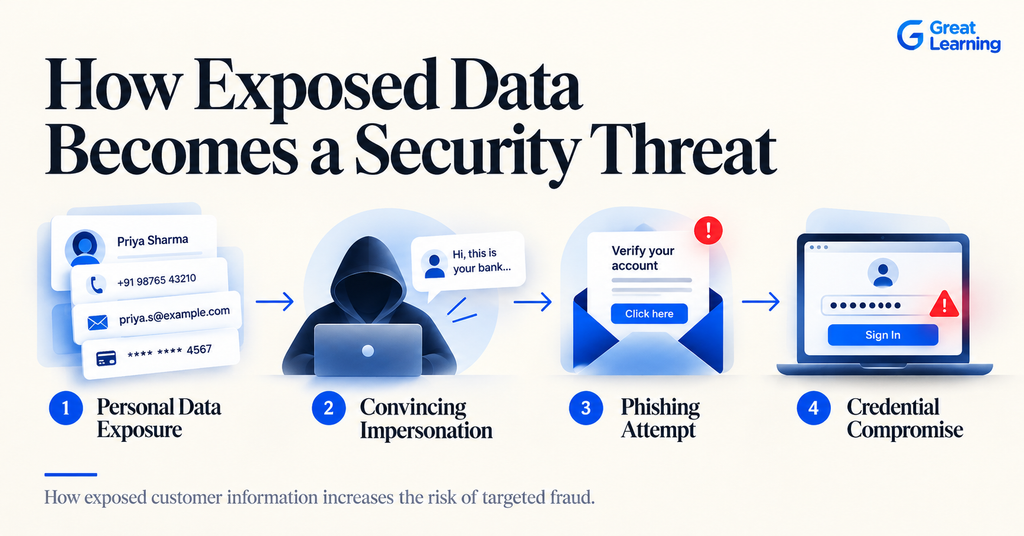
Leaked customer data increases the risk of phishing, identity impersonation, and social engineering even when bank accounts remain secure. Attackers might use personal information such as names, phone numbers, addresses, and loan details to make fraudulent communication appear legitimate and persuade customers to disclose credentials or approve unauthorized actions.
Consider a hypothetical situation.
You receive a call from someone claiming to represent your bank. The caller knows your full name, registered phone number, home address, and details related to a recent loan inquiry.
The person asks you to complete an urgent verification step.
Ordinarily, you might question an unexpected banking call. But when someone already possesses accurate personal information, the conversation appears more credible.
This is one reason customer data exposure creates security risks beyond the initial breach.
The financial implications extend beyond individual customers.
According to IBM's 2026 Cost of a Data Breach Report, phishing, including voice and SMS phishing, accounted for 19% of initial attack vectors in the Indian organizations studied.
The report also found:
- The average organizational cost of a data breach in India reached ₹25.5 crore in 2026, a 15.9% increase from 2025.
- Financial services recorded the highest average breach cost among the Indian industries studied, at ₹40.9 crore.
Note: These are industry-wide research findings, not costs attributed to the SBI incident. They illustrate why organizations must consider investigation, recovery, disruption, and other consequences when assessing cybersecurity risk.
How Do API Security Weaknesses Put Banks at Risk?
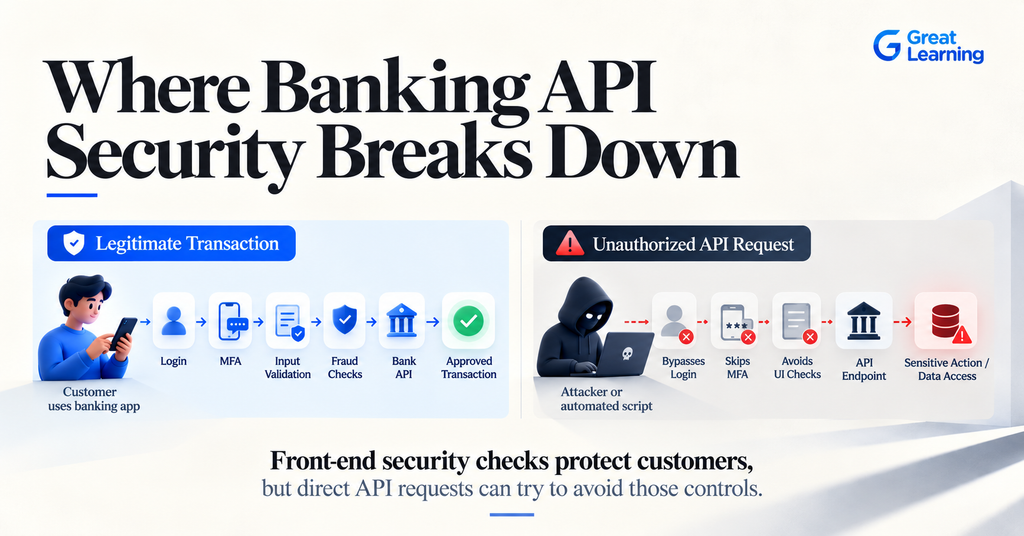
API security weaknesses put banks at risk by allowing attackers to bypass application-level safeguards, access sensitive information, or initiate unauthorized transactions. Weak authentication, exposed credentials, and missing authorization checks can leave payment and lending systems vulnerable.
In October 2026, the Indian Computer Emergency Response Team (CERT-In) and CSIRT-Fin issued a critical advisory on attacks targeting payment and disbursement APIs describing attacks on payment and disbursement APIs used by digital lenders, fintech platforms, and payment providers. Attackers reportedly compromised internet-facing applications, obtained API credentials, and bypassed controls for loan approvals, beneficiary verification, and transaction limits.
These attacks are separate from the SBI data exposure, with no established evidence linking the incidents. However, both highlight the need to secure customer information and the systems that process financial transactions.
Banks can reduce these risks through strong API authentication, transaction-level authorization, secure credential management, and continuous monitoring.
Also Read: Cybersecurity in Financial Services: 8 Proven Strategies to Stay Protected
How Is AI Changing Banking Cybersecurity?
AI is changing banking cybersecurity by helping security teams detect threats while enabling attackers to automate reconnaissance and exploit vulnerabilities at greater speed and scale.
CERT-In's October 2026 advisory identified the possible use of AI-assisted offensive tooling in attacks targeting financial infrastructure. Its findings suggested shorter intervals between initial compromise and fraudulent transfers in recent incidents.
However, this does not establish that every such attack relied on autonomous AI agents. Nor does AI replace the need for attackers to exploit a security weakness.
IBM's 2026 research offers another perspective. Organizations in India with extensive AI and security automation reported an average breach cost of ₹21.3 crore, compared with ₹31.6 crore among organizations without such automation.
The figures reflect an association across the organizations studied, rather than proof that AI automation alone produced the difference.
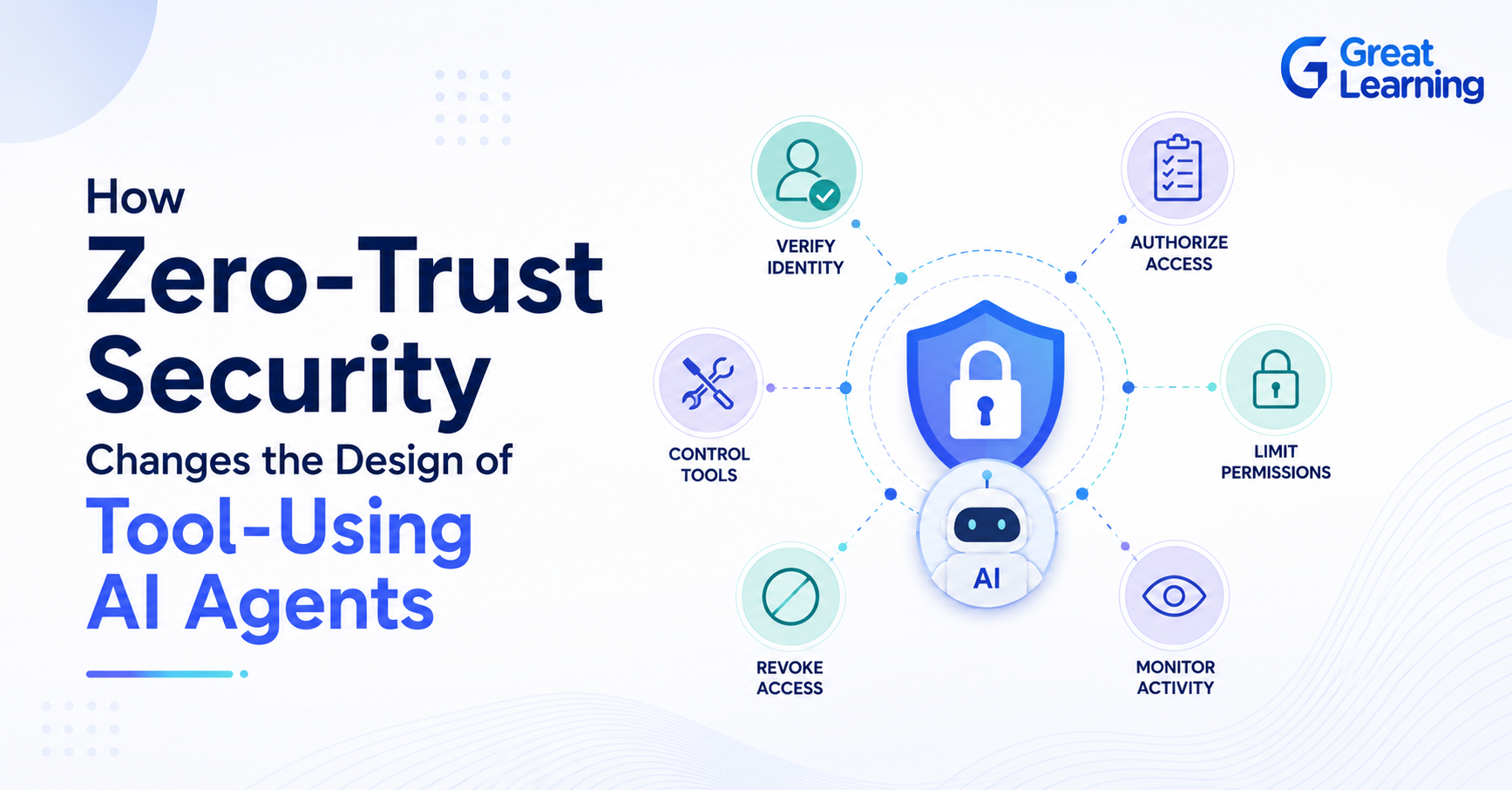
The security challenge becomes more complex when AI agents receive access to external tools, APIs, and sensitive systems. Even without malicious intent, an agent operating with excessive permissions might perform actions beyond its authorized task. Recent incidents involving AI agents taking unauthorized actions illustrate why access controls, monitoring, and human oversight matter as organizations introduce more autonomous systems.
For security teams, the practical question is no longer simply whether to adopt AI.
It is where automation improves threat detection, which actions require human approval, and how to prevent automated systems from introducing new security risks.
Professionals looking to develop relevant cybersecurity expertise can explore with the Cyber Security course from Johns Hopkins University, delivered in collaboration with Great Learning.
JHU Cybersecurity Certificate Course
Build in-demand cybersecurity skills with JHU experts. Learn AI, cloud, and network security. Hands-on projects. Flexible online format.
What Can Banks Do to Strengthen Cybersecurity?
The Reserve Bank of India reportedly issued guidance on October 19, 2026, asking regulated financial entities to strengthen controls across their own and third-party technology environments.
According to The Economic Times, the measures included stronger administrative authentication, credential reviews, restricted access, and the removal of unused APIs.
Financial institutions can strengthen their defenses through four priorities:
- Map sensitive data flows. Track how customer information moves across banking systems, cloud services, lending platforms, and third-party providers.
- Secure APIs at the transaction level. Enforce authentication, beneficiary verification, authorization checks, and transaction limits across every relevant API.
- Monitor trusted systems. Detect unusual access patterns, bulk data extraction, suspicious transfers, and misuse of valid credentials.
- Validate recovery after an incident. Preserve forensic evidence, rotate compromised credentials, investigate affected systems, and verify that remediation is effective before restoring trust.
These measures require coordination across cybersecurity, software engineering, operations, compliance, and external technology partners.
The Cybersecurity Skills Behind Safer Financial Systems
The growing complexity of financial infrastructure is also changing the expertise security teams need.
Traditional network protection and incident response remain essential. But connected financial systems increasingly demand professionals who understand API security, cloud infrastructure, identity management, threat intelligence, and automated detection.
AI security adds another responsibility: understanding how AI systems interact with sensitive information, use tools, access infrastructure, and behave when given permissions.
For cybersecurity professionals, the important shift is from protecting individual applications to understanding how an entire system might be exploited.
A security assessment must examine more than whether unauthorized users were prevented from logging in. It must also consider stolen credentials, compromised third-party services, exposed customer information, and weaknesses in the systems connecting them.
Addressing these risks requires expertise across incident response, cloud security, identity and access management, risk assessment, and AI-assisted threat detection. These areas are also covered in the Cyber Security program, delivered in collaboration with Great Learning. The program combines cybersecurity fundamentals, modern security practices, and applications of AI in cyber defense.
The SBI data exposure highlights a central challenge for banking cybersecurity: protecting customer funds is only one part of securing financial systems. Customer information, digital identities, APIs, and connected infrastructure also require protection. For financial institutions, effective security depends on detecting misuse, limiting access, and containing threats before exposed information or compromised systems lead to greater harm.
Frequently Asked Questions
What is the difference between a bank data leak and a bank account hack?
A bank data leak involves the unauthorized exposure of information, such as names, addresses, or customer identifiers. A bank account compromise involves unauthorized access to an individual's banking account. A data leak does not automatically mean attackers gained account access or transferred funds.
What customer information was exposed in the SBI data breach?
The reported exposure involved personal information including customer names, mobile numbers, dates of birth, email addresses, residential addresses, customer identifiers, and loan-related records. The exact source and full extent of the exposure were subject to further investigation.
Was customer money stolen in the SBI data leak?
SBI stated that customer funds were safe and its core banking operations remained unaffected. The reported exposure concerned customer information rather than confirmed unauthorized financial transactions. A data exposure does not necessarily mean banking credentials were compromised or funds were stolen.
What should SBI customers do after the reported data leak?
SBI customers should watch for suspicious banking calls, messages, and verification requests. Avoid sharing OTPs, passwords, or banking credentials. Verify unexpected communication through official SBI channels, monitor account activity, and report suspicious transactions immediately.
How do cybercriminals use leaked banking information?
Cybercriminals might use exposed personal information for targeted phishing, identity impersonation, and social engineering. For example, someone knowing a customer's name, phone number, and loan details might impersonate a bank representative to request credentials or persuade the customer to authorize a fraudulent transaction.
How do API vulnerabilities threaten banking cybersecurity?
API vulnerabilities might expose financial systems to unauthorized access, data theft, or fraudulent transactions. Weak authentication, stolen credentials, and insufficient authorization checks might allow attackers to bypass safeguards implemented within customer-facing applications. These are broader banking cybersecurity risks, not confirmed causes of the SBI exposure.
What skills do professionals need to prevent cybersecurity threats in banking?
Banking cybersecurity professionals need skills in threat detection, incident response, identity and access management, cloud security, API security, and risk assessment. As financial systems adopt AI, understanding AI-assisted threat detection and emerging security risks is also becoming important.