
- What Is Prompt Engineering?
- Why Prompt Engineering Alone Isn't Enough
- What Is Loop Engineering?
- What Is Graph Engineering?
- Prompt Engineering vs. Loop Engineering vs. Graph Engineering
- How Prompt, Loop, and Graph Engineering Work Together
- Best Practices for Prompt, Loop, and Graph Engineering
- Common Mistakes Developers Make
- The Future of AI Engineering
- Final Thoughts
- Frequently Asked Questions
Modern AI applications are no longer limited to generating text or answering questions. They can plan tasks, use tools, retrieve information, and execute complex workflows autonomously, as demonstrated by AI systems such as Claude and OpenAI Codex.
As Artificial Intelligence adoption accelerates, developers are moving beyond simple prompt design to build intelligent systems that can reason and act.
According to McKinsey's 2025 State of AI report, 88% of organizations now use AI in at least one business function, highlighting how quickly AI has moved from experimentation to mainstream adoption. As businesses increasingly deploy AI in production, building reliable, scalable, and maintainable AI systems has become more important than ever.
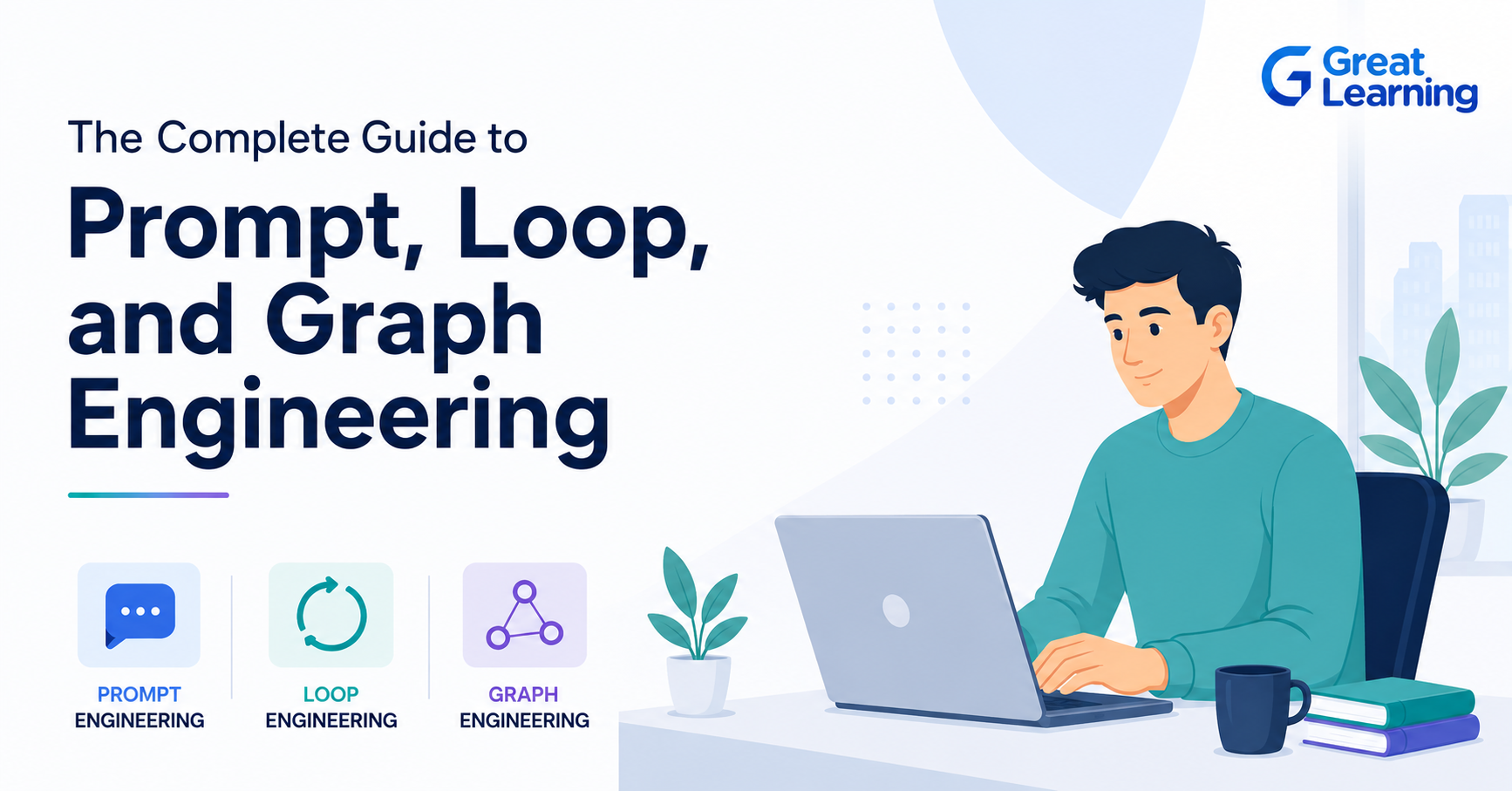
This is where Prompt Engineering, Loop Engineering, and Graph Engineering come in. These three disciplines form the foundation of modern AI development, enabling developers to build accurate, scalable, and production-ready AI agents and applications.
In this guide, you'll learn what Prompt Engineering, Loop Engineering, and Graph Engineering are, how they differ, how they work together, and the best practices and frameworks for building modern AI applications.
What Is Prompt Engineering?
Prompt Engineering is the process of writing clear and effective instructions that help large language models (LLMs) generate accurate, relevant, and well-structured responses. Since AI models rely on their input, a well-crafted prompt directly improves the quality of the output.
An effective prompt provides the right context, defines the task, and specifies the expected output. This enables AI models to perform tasks such as content generation, code writing, summarization, and data extraction without additional training.
Prompt Engineering is a fundamental skill for AI developers, forming the foundation of modern AI applications.
Key Components of an Effective Prompt
Although prompt design varies depending on the task, most effective prompts include the following elements:
- Clear instructions: Define exactly what the model should accomplish.
- Relevant context: Provide background information that improves understanding.
- Role definition: Assign the model a role such as software engineer or cybersecurity analyst when domain expertise is required.
- Constraints: Specify tone, length, formatting, or other requirements.
- Expected output: Describe how the response should be presented, such as a table, JSON object, Markdown, or step-by-step explanation.
Combining these elements significantly improves response quality and consistency across different use cases.
Common Prompting Techniques
Developers use different prompting strategies depending on the complexity of the task:
- Zero-shot prompting asks the model to complete a task using only the instruction.
- Few-shot prompting includes examples to demonstrate the expected response pattern.
- Role prompting assigns the model a professional identity to improve domain-specific outputs.
- Chain-of-thought prompting encourages step-by-step reasoning for complex analytical or logical tasks.
Choosing the right prompting technique often depends on the problem being solved, and experienced AI developers frequently combine multiple techniques to achieve the best results.
Why Prompt Engineering Alone Isn't Enough
Prompt Engineering is the starting point for building AI applications, but a single prompt has limitations when handling complex, multi-step tasks.
While they work well for content generation, summarization, and code completion, modern AI systems often need to plan tasks, use external tools, validate results, and adapt to new information.
For example, an AI research assistant may need to search multiple sources, verify facts, compare findings, and generate a report. Similarly, a coding assistant might analyze errors, update code, run tests, and refine its solution before delivering the final output.
These workflows require continuous reasoning that a single prompt cannot provide.
To overcome these limitations, developers use Loop Engineering, which enables AI agents to repeatedly plan, execute, evaluate, and improve until the task is complete.
What Is Loop Engineering?
Loop Engineering is the practice of designing iterative AI workflows that allow agents to repeatedly reason, take action, evaluate results, and refine their outputs until they complete a task.
Unlike Prompt Engineering, which focuses on generating a single response, Loop Engineering enables AI agents to continuously plan, use tools, and improve their outputs until they achieve the desired objective.
Instead of producing a single response and stopping, the AI continuously assesses its progress and decides what to do next.
A typical AI loop follows six simple steps:
- Understand the task by identifying the user's goal and required outcome.
- Create a plan by breaking the problem into smaller, manageable steps.
- Use external tools such as web search, APIs, databases, or code interpreters when additional information or computation is required.
- Evaluate the results to check whether the objective has been met or if further work is needed.
- Refine the output by correcting errors, gathering more information, or improving previous responses.
- Stop or repeat based on predefined conditions such as task completion, confidence level, or maximum iterations.
Want to build AI agents that go beyond prompts? The Agentic AI course by Johns Hopkins University teaches Prompt Engineering, Agentic RAG, ReAct workflows, multi-agent systems, and hands-on development with modern frameworks through real-world projects.
Certificate Program in Agentic AI
Learn the architecture of intelligent agentic systems. Build agents that perceive, plan, learn, and act using Python-based projects and cutting-edge agentic architectures.
For example, if an AI agent is asked to summarize the latest AI trends, it doesn't simply generate an answer from memory. It first searches trusted sources, compares information, removes duplicates, verifies important facts, and only then produces a concise summary. If key information is missing, it repeats the process until the result is complete.
This iterative approach makes AI systems more accurate, reliable, and capable of handling complex tasks such as software debugging, research automation, customer support, and enterprise workflows.
However, even well-designed loops have limitations. As workflows grow more complex—with multiple tools, memory systems, conditional decisions, and parallel tasks—managing everything through a single execution loop becomes difficult. This is where Graph Engineering provides a more scalable solution.
What Is Graph Engineering?
Graph Engineering is the practice of designing AI workflows as interconnected graphs, where each node represents a specific operation, such as planning, reasoning, memory retrieval, tool execution, or validation, while edges define how the workflow moves between those nodes.
Modern AI agents rarely perform just one task at a time. They often need to retrieve information, access memory, call external tools, validate results, and coordinate multiple reasoning steps before generating a final response.
As these workflows become more complex, managing them within a single loop becomes difficult, making Graph Engineering essential for building scalable, production-ready AI systems.
This growing complexity is reflected in enterprise adoption trends. Gartner predicts that by 2026, 40% of enterprise applications will include task-specific AI agents, up from less than 5% in 2025. As organizations deploy increasingly sophisticated AI systems, they need architectures that can efficiently orchestrate multiple tools, reasoning steps, and workflows.
Graph Engineering solves this problem by organizing AI workflows as interconnected graphs instead of fixed, linear sequences.
In a graph, each node represents a specific operation—such as planning, reasoning, memory retrieval, tool execution, or validation—while edges define how the workflow moves between those nodes.
Unlike traditional workflows that follow the same sequence every time, graph-based systems dynamically choose the most appropriate execution path based on the task, intermediate results, or predefined conditions.
Ready to build production-ready AI systems? The Agentic AI engineering course by Johns Hopkins University covers LangGraph, LangChain, RAG, LLMOps, MLOps, AI observability, governance, and cloud deployment to help you design, deploy, and scale enterprise AI applications.
JHU Certificate Program in AI and Agentic AI Engineering
Designed for software developers, data and AI professionals seeking hands-on technical expertise in building, deploying, and scaling AI and Agentic AI systems using MLOps, LLMOps, and cloud platforms.
Linear Workflow vs. Graph Workflow
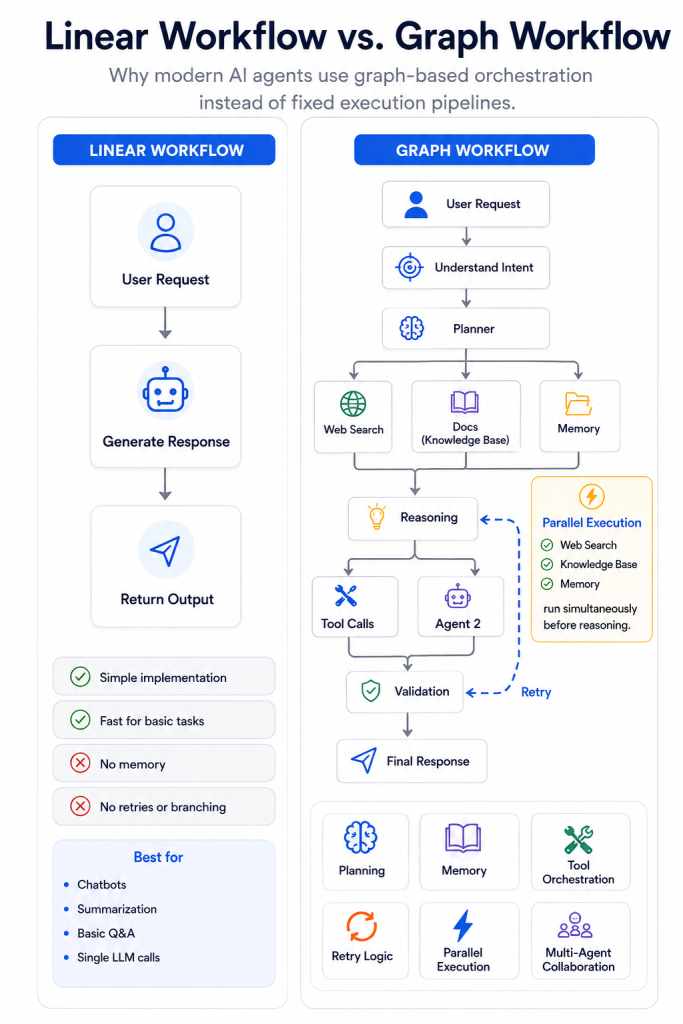
A traditional AI workflow is linear:
User Request → Generate Response → Return Output
This approach works well for simple tasks but struggles when the AI needs to make decisions, retry failed operations, or coordinate multiple tools.
A graph-based workflow is more flexible:
User Request → Understand Intent → Retrieve Memory / Search Knowledge → Reason → Use Tools → Validate Results → Generate Response
Because each step is modular, the AI can skip unnecessary actions, retry failed nodes, or execute independent tasks simultaneously.
For example, a research agent can search the web, retrieve internal documents, and query a database in parallel before combining the findings into a single response.
Core Components of Graph Engineering
Although implementations vary across frameworks, most graph-based AI systems include a few essential building blocks:
- Input nodes receive and interpret the user's request.
- Planning nodes determine the execution strategy and identify the tools or knowledge required.
- Tool nodes connect the AI to external resources such as APIs, databases, search engines, or code interpreters.
- Memory nodes retrieve relevant information from previous interactions or knowledge bases.
- Reasoning nodes analyze data, compare options, and generate insights.
- Validation nodes verify outputs before the workflow continues.
- Output nodes assemble and deliver the final response.
Keeping these responsibilities separate makes workflows easier to maintain, test, and expand as applications become more sophisticated.
Why Graph Engineering Matters
Graph Engineering has become the foundation of modern AI agents because it supports capabilities that traditional workflows cannot provide.
It enables dynamic decision-making, allowing agents to choose different execution paths based on the task. Its modular architecture makes it easy to replace or improve individual components without redesigning the entire system.
Graph-based workflows also support parallel execution, reducing latency by running independent tasks simultaneously, and provide better error recovery through retries, fallback routes, or human approval when needed.
As organizations deploy increasingly autonomous AI systems, Graph Engineering is becoming a critical skill for developers building scalable, production-ready applications that can orchestrate tools, memory, reasoning, and multiple AI agents within a single workflow.
Prompt Engineering vs. Loop Engineering vs. Graph Engineering
Prompt Engineering, Loop Engineering, and Graph Engineering each play a distinct role in modern AI development.
While Prompt Engineering focuses on creating effective prompts, Loop Engineering enables iterative reasoning, and Graph Engineering orchestrates complex AI workflows. Together, they help developers build more intelligent, scalable, and autonomous AI applications.
| Feature | Prompt Engineering | Loop Engineering | Graph Engineering |
| Primary Focus | Writing effective prompts | Designing iterative workflows | Building AI workflow architectures |
| Execution | Single interaction | Repeated reasoning cycles | Dynamic graph-based execution |
| Best Suited For | Chatbots, content generation, summarization | AI agents, coding assistants, automation | Enterprise AI, multi-agent systems, complex workflows |
| Tool Usage | Basic | Multiple tool calls | Advanced orchestration |
| Memory | Limited to prompt context | Workflow memory | Shared and persistent memory |
| Workflow Complexity | Low | Medium | High |
Each approach builds on the previous one. Prompt Engineering defines the task, Loop Engineering enables the AI to reason and refine its work, and Graph Engineering coordinates tools, memory, and decision-making across complex workflows. Modern AI applications often combine all three to create reliable, production-ready AI systems.
How Prompt, Loop, and Graph Engineering Work Together
Modern AI applications combine Prompt Engineering, Loop Engineering, and Graph Engineering to create intelligent systems capable of understanding requests, reasoning through tasks, and executing complex workflows.
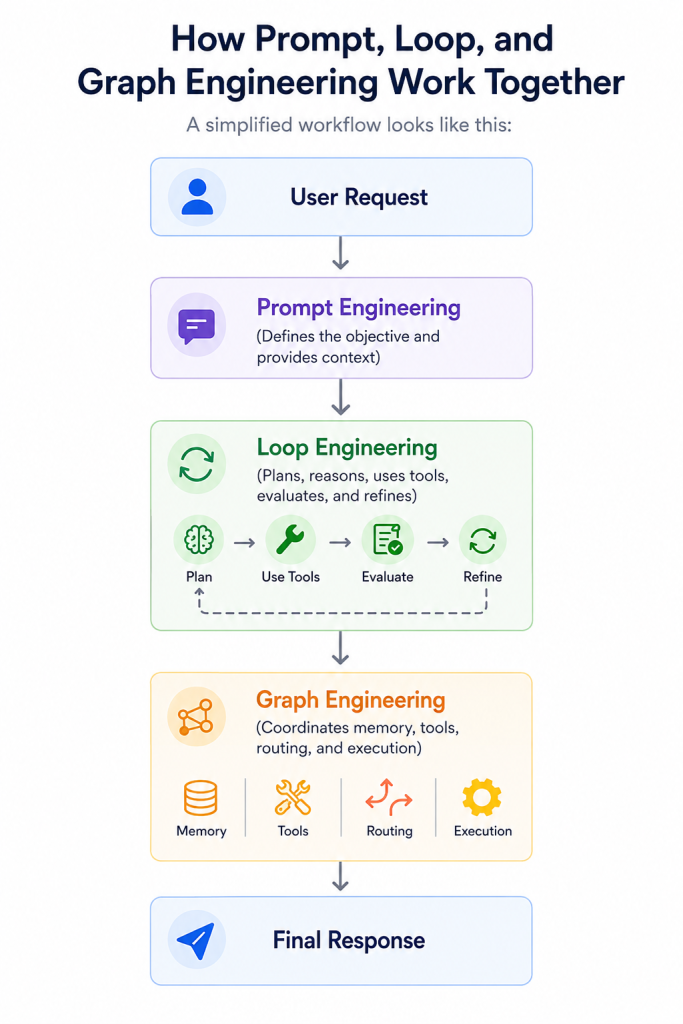
Each layer has a specific role. Prompt Engineering helps the AI understand the task, Loop Engineering enables iterative reasoning and refinement, and Graph Engineering orchestrates tools, memory, and decision-making across the workflow.
For example, an AI technical support agent first interprets the user's issue through a prompt, then iteratively analyzes logs and validates potential solutions using loops.
Finally, a graph coordinates tool calls, knowledge retrieval, and response generation to deliver the most accurate result.
Together, these three approaches enable developers to build AI applications that are more reliable, scalable, and production-ready.
Best Practices for Prompt, Loop, and Graph Engineering
Following proven best practices helps developers build AI applications that are accurate, scalable, and easier to maintain.
While each engineering approach serves a different purpose, applying the right practices improves performance and reliability across the entire AI workflow.
Prompt Engineering Best Practices
- Write clear and specific prompts with a single objective.
- Provide sufficient context to reduce ambiguity.
- Assign a role when domain expertise is required.
- Define the expected output format (JSON, Markdown, table, etc.).
- Test prompts with different inputs to ensure consistent results.
Loop Engineering Best Practices
- Define a clear objective before execution begins.
- Set stopping conditions to prevent infinite loops.
- Validate outputs after each critical step.
- Use external tools only when they add value.
- Include retry mechanisms for temporary failures.
Graph Engineering Best Practices
- Design modular workflows with one responsibility per node.
- Use conditional routing to optimize execution paths.
- Manage memory efficiently and retrieve only relevant context.
- Log workflow execution for monitoring and debugging.
- Build reusable graph components that scale as applications grow.
Common Mistakes Developers Make
Avoid these common mistakes to build more reliable and scalable AI applications.
Treating Prompt Engineering as the Complete Solution
- Prompts alone cannot handle complex AI workflows.
- Combine Prompt, Loop, and Graph Engineering for tasks that involve planning, memory, and tool use.
Overcomplicating Prompts
- Avoid long or overly detailed prompts.
- Break complex tasks into smaller prompts or structured workflows for better accuracy.
Missing Exit Conditions
- Define clear stopping criteria, such as task completion or a maximum number of iterations.
- This prevents infinite loops and reduces unnecessary costs.
Poor Workflow Design
- Keep graph workflows modular and assign one responsibility per node.
- Use clear routing and validation to improve scalability, debugging, and maintenance.
The Future of AI Engineering
AI development is rapidly shifting from building prompt-based applications to designing intelligent, autonomous systems.
Future AI agents will increasingly combine reasoning, long-term memory, external tools, and collaboration with other specialized agents to complete complex tasks with minimal human intervention.
As this transition continues, Graph Engineering will become the foundation for orchestrating these workflows, while Loop Engineering will enable continuous reasoning and refinement.
At the same time, developers will place greater emphasis on observability, governance, security, and human-in-the-loop decision-making to build trustworthy production AI systems.
Final Thoughts
Prompt Engineering, Loop Engineering, and Graph Engineering represent the natural evolution of modern AI development.
Prompt Engineering enables developers to communicate effectively with large language models, Loop Engineering introduces iterative reasoning and execution, and Graph Engineering provides the architecture to coordinate complex workflows involving tools, memory, and decision-making.
Rather than viewing these disciplines as separate approaches, developers should see them as complementary layers of an intelligent AI system.
Together, they provide the foundation for building reliable, scalable, and production-ready applications that can move beyond simple text generation to autonomously solve real-world problems.
Frequently Asked Questions
What is the difference between Prompt, Loop, and Graph Engineering?
Prompt Engineering focuses on writing effective instructions for AI models. Loop Engineering manages iterative execution and self-improvement, while Graph Engineering designs the overall workflow architecture that connects reasoning, tools, memory, and decision-making into a scalable system.
Which frameworks support Prompt, Loop, and Graph Engineering?
Popular frameworks include LangChain for prompt workflows, LangGraph for graph-based orchestration, CrewAI for multi-agent collaboration, LlamaIndex for Retrieval-Augmented Generation (RAG), the OpenAI Agents SDK for production AI agents, and Microsoft Agent Framework for enterprise AI applications and multi-agent workflows.
Is Prompt Engineering enough to build AI agents?
Prompt Engineering is the starting point, but most autonomous AI agents also require iterative reasoning, memory management, tool integration, and workflow orchestration. These capabilities are typically implemented through Loop Engineering and Graph Engineering.
When should developers use Graph Engineering?
Graph Engineering is most useful for applications involving multiple tools, branching logic, memory retrieval, parallel execution, or collaboration between AI agents. It provides the flexibility and scalability needed for production-grade AI workflows.
What skills should AI developers learn in 2026?
In addition to Prompt, Loop, and Graph Engineering, developers should understand AI agents, Retrieval-Augmented Generation (RAG), vector databases, model evaluation, AI security, and modern frameworks such as LangChain, LangGraph, CrewAI, and the OpenAI Agents SDK to build scalable AI applications.
Is Graph Engineering the same as LangGraph?
No. Graph Engineering is a design approach to building graph-based AI workflows, while LangGraph is a framework that helps developers implement them. LangGraph is one of several tools that support Graph Engineering.
How do AI agent loops stop?
AI agent loops stop when predefined exit conditions are met, such as task completion, reaching a confidence threshold, hitting the maximum number of iterations, or exceeding a time or resource limit. Clear stopping conditions prevent infinite execution and unnecessary costs.
How are AI agent loops and graph workflows evaluated?
Developers evaluate AI agent workflows by monitoring task success, response quality, tool execution, latency, and resource usage. Logging, validation, and observability tools help identify errors, optimize performance, and improve workflow reliability.