
- What Are AI Agents?
- Why Traditional Software Jobs Are Changing
- Which Software Jobs Are Most Likely to Change?
- The Software Jobs AI Cannot Replace
- Skills You Should Learn to Stay Relevant
- AI Tools Every Developer Should Know
- Will AI Replace Software Engineers Completely?
- Final Thoughts
- Frequently Asked Questions(FAQ’s)
Artificial intelligence is changing software development faster than ever before. What started as AI-powered code suggestions has evolved into AI agents that can write code, fix bugs, run tests, deploy applications, and even monitor software with very little human input.
This shift is already happening. According to the 2025 Stack Overflow Developer Survey, 84% of developers either use or plan to use AI tools, and 51% of professional developers use AI in their daily work. AI is no longer a tool for early adopters—it has become part of the modern software development process.
As AI agents continue to improve, many developers are asking the same question: Will AI replace software jobs, or will it change what software engineers do?
The answer is more nuanced than a simple yes or no. AI agents are unlikely to eliminate software engineering as a profession, but they are transforming the nature of software development.
Roles focused on repetitive coding and predictable tasks are becoming increasingly automated, while demand is growing for engineers who can design systems, solve complex problems, and collaborate effectively with AI.
Instead of fearing this shift, developers should prepare for it. Those who embrace AI as a productivity partner and develop future-ready skills will remain highly valuable in the years ahead.
What Are AI Agents?
Unlike traditional coding assistants that respond only when prompted, AI agents can work toward a goal with minimal supervision.
They don't just generate code—they can plan tasks, make decisions, use development tools, execute workflows, evaluate results, and refine their work until an objective is achieved.
For example, if you ask an AI coding assistant to create a login page, it may generate the required code. An AI agent, however, can go much further.
It can analyze the project structure, generate backend APIs, connect the frontend to the database, write automated tests, fix compilation errors, update documentation, and prepare the application for deployment.
This ability to execute multiple connected tasks makes AI agents fundamentally different from earlier AI tools.
As organizations adopt autonomous software development workflows, developers will increasingly collaborate with AI agents instead of writing every line of code manually.
Why Traditional Software Jobs Are Changing
For years, software engineering involved a significant amount of repetitive work. Developers spent hours writing boilerplate code, debugging common issues, updating documentation, creating unit tests, reviewing pull requests, and maintaining existing applications.
AI agents are especially good at repetitive development tasks. They can generate code, fix common bugs, write tests, review pull requests, update documentation, and automate deployments much faster than humans.
Companies are already seeing the impact. Research from GitHub shows that about 46% of developers' code is now AI-generated, and this could reach 60% by the end of 2026. Instead of replacing developers completely, companies are using AI to handle routine work so engineers can focus on solving bigger problems.
Today's AI-powered development platforms can automatically:
- Generate application code
- Detect and fix common bugs
- Write unit and integration tests
- Explain existing codebases
- Generate technical documentation
- Refactor inefficient code
- Review pull requests
- Automate deployment pipelines
As these capabilities improve, companies can complete routine development work much faster than before.
This doesn't necessarily mean fewer software projects. Instead, organizations can build more products with smaller teams, increasing expectations for developer productivity. Engineers are no longer valued only for writing code—they're expected to solve business problems and oversee intelligent systems.
As organizations adopt autonomous development environments, platforms built specifically for AI-driven software engineering are also emerging. Read Google Antigravity 2.0: The AI Agent Platform Developers Are Watching to see how enterprise development workflows are changing.
Which Software Jobs Are Most Likely to Change?
Not every software role faces the same level of automation. Jobs centered on repetitive and structured work are likely to evolve the fastest.
1. Junior Software Developers
Entry-level developers often spend much of their time fixing bugs, implementing standard features, converting designs into code, or writing CRUD operations. These are exactly the kinds of tasks AI agents perform well.
This doesn't mean junior developers will disappear. Instead, companies may expect new engineers to contribute at a higher level by understanding the architecture, reviewing AI-generated code, and solving business problems rather than simply implementing predefined requirements.
2. Manual QA Engineers
Testing is becoming increasingly automated.
AI agents can generate test cases, execute regression tests, identify edge cases, and even recommend fixes for failed scenarios. Manual testing will still be necessary for usability, accessibility, and exploratory testing, but repetitive validation work is steadily becoming automated.
3. Support and Maintenance Engineers
Many organizations maintain legacy systems that require frequent but repetitive updates. AI agents can analyze logs, identify common failures, suggest fixes, and generate patches, significantly reducing manual maintenance work.
4. Technical Documentation Roles
Documentation often follows predictable patterns. AI can now generate API documentation, onboarding guides, release notes, and code explanations with impressive accuracy, allowing technical writers to focus on reviewing and improving content rather than creating everything from scratch.
The Software Jobs AI Cannot Replace
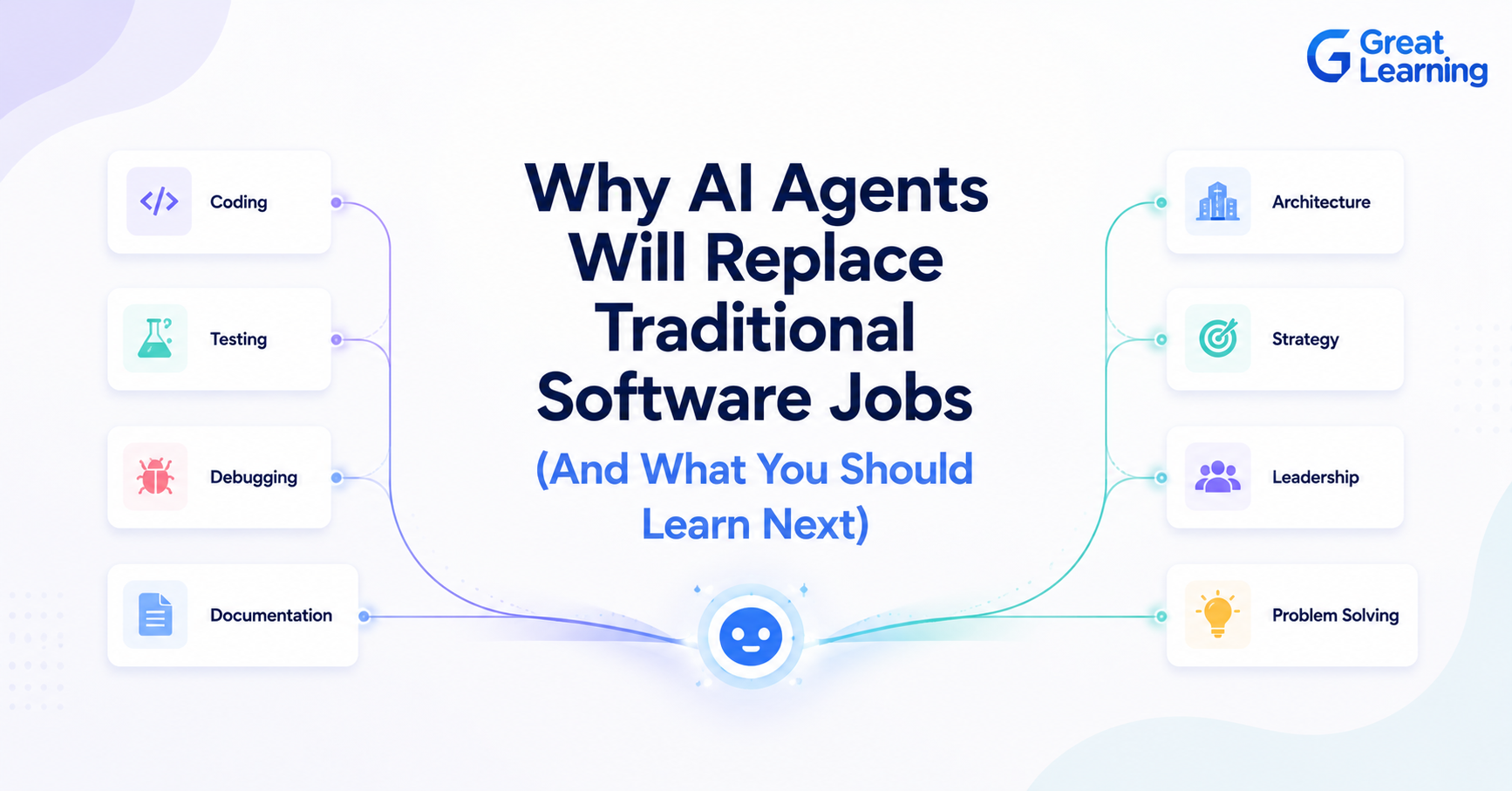
While AI agents excel at executing repetitive tasks, they still struggle with judgment, creativity, leadership, and strategic decision-making. These capabilities continue to make several software roles difficult to automate.
1. Software Architects
Software architects make critical decisions about scalability, security, system design, and long-term maintainability. They evaluate technical trade-offs, align architecture with business goals, and ensure systems can support future growth. These responsibilities require strategic thinking and experience that AI cannot fully replicate.
2. Product Engineers
Product engineers bridge the gap between customer needs and technical implementation. They identify user problems, prioritize features, interpret customer feedback, and collaborate with designers, developers, and business teams. Their work requires balancing technical feasibility with business value, making human judgment essential.
3. Cybersecurity Professionals
Cybersecurity experts defend systems against constantly evolving threats. Their role involves investigating security incidents, anticipating attacker behavior, assessing risks, and developing defense strategies. Since cyber threats continuously change, human expertise and critical thinking remain indispensable.
4. Engineering Managers
Engineering managers lead teams rather than just writing code. They mentor developers, resolve conflicts, coordinate with stakeholders, manage project priorities, and make strategic decisions that keep engineering efforts aligned with business objectives.
These leadership responsibilities depend heavily on communication, emotional intelligence, and people management.
The future of software engineering belongs to professionals who combine strong technical skills with critical thinking, collaboration, business understanding, and the ability to work effectively alongside AI agents.
Skills You Should Learn to Stay Relevant
The biggest mistake developers can make is focusing only on programming languages.
Languages change over time, but problem-solving and systems thinking remain valuable throughout a career.
To stay competitive in the AI era, developers should expand their expertise in several key areas.
Professionals looking to apply AI beyond software development can explore the Generative AI for Business program by The McCombs School. Designed for business and functional leaders, the program focuses on building AI workflows using no-code tools, identifying high-impact AI use cases, and deploying AI agents for real-world business applications.
UT Austin PG Program in AI Agents & Generative AI
Master GenAI, large language models, and multi-agent systems to automate business workflows. Learn to build and deploy intelligent AI agents with no coding background.
Second, strengthen your system design knowledge. AI can generate code, but designing scalable, secure, and maintainable software architectures still requires human judgment.
Third, learn cloud computing and DevOps practices. Modern software increasingly relies on cloud-native infrastructure, automated deployments, monitoring, and containerized applications.
Developers should also become familiar with AI frameworks, APIs, retrieval-augmented generation (RAG), Model Context Protocol (MCP), and multi-agent systems. These technologies are quickly becoming part of enterprise software development.
The free Getting Started with Agentic AI course by Great Learning Academy provides an excellent foundation before diving into advanced agent architectures.
Equally important are soft skills.
Communication, stakeholder management, collaboration, and business thinking are becoming major differentiators because AI cannot easily replace them.
The developers who succeed won't necessarily be those who write the most code. They'll be the ones who know how to combine engineering expertise with AI tools to deliver better outcomes.
For additional learning, you can also watch Great Learning's videos, such as the Generative AI Full Course.
AI Tools Every Developer Should Know
Learning AI development tools is quickly becoming an important skill for software engineers. Tools like GitHub Copilot, Cursor, and Claude Code can help developers write code faster, understand large codebases, and automate repetitive tasks.
As AI-powered coding assistants become an essential part of modern software engineering, developers can strengthen their hands-on skills with our Free Claude Code Course, which introduces the fundamentals of using Claude Code for AI-assisted software development.
For learners who want to build practical skills with Claude, these Free Claude Courses can provide a useful starting point for exploring Claude-powered development workflows.
Developers who want hands-on experience with AI prompting can also explore the free Prompt Engineering for ChatGPT and ChatGPT for Coders courses from Great Learning Academy.
The benefits are already clear. The 2025 Stack Overflow Developer Survey found that 52% of developers say AI tools have improved their productivity. As AI becomes a standard part of software development, developers who know how to use these tools effectively will have a clear advantage.
GitHub Copilot helps developers write code faster by suggesting functions, explaining existing code, and generating repetitive implementations.
Cursor extends AI-assisted programming by understanding entire projects, making it easier to edit large codebases.
Claude Code and OpenAI Codex are increasingly capable of planning software tasks, debugging applications, and producing production-ready code under human supervision.
For workflow automation, tools such as n8n allow developers to build AI-powered business processes without extensive manual coding.
Developers interested in building AI agents should also explore frameworks such as LangGraph, CrewAI, and AutoGen, which simplify the creation of autonomous, multi-agent applications.
If you'd like to build AI-powered workflows without extensive coding, our guide, Building AI Agents and Workflows for Every Role Without Coding, explains how modern AI automation platforms make this easier than ever.
Learning these tools today prepares developers for the software development environments of tomorrow.
Will AI Replace Software Engineers Completely?
Probably not.
History shows that every major technological advancement changes jobs rather than eliminating them entirely.
High-level programming languages didn't eliminate programmers.
Cloud computing didn't eliminate infrastructure engineers.
Low-code platforms didn't eliminate software developers.
Similarly, AI agents won't eliminate software engineering. They will eliminate many repetitive engineering tasks.
The role of software engineers is shifting from writing every line of code to designing intelligent systems, supervising AI-generated work, validating outputs, and solving complex business challenges.
Developers who ignore AI may find their skills becoming less competitive.
Those who embrace AI will likely become significantly more productive than previous generations of engineers.
Developers looking to advance their AI expertise can explore the AI for Software Development course by The McCombs School. Designed for software professionals, the program provides hands-on experience building full-stack AI applications using Generative and Agentic AI and offers a professional certificate upon completion.
GenAI for Software Development
Build, test, and deploy AI-powered web applications. Gain hands-on experience with full-stack development using Node.js, Express, MongoDB, and React while integrating Generative AI into real-world applications.
Final Thoughts
AI agents are reshaping software development, but they are not making software engineers obsolete. Instead, they are changing what engineers spend their time doing.
A 2026 GitLab enterprise report found that 78% of organizations have seen higher developer productivity from AI-generated code, while 85% say reviewing AI-generated code has become a bigger challenge than writing it.
This shift shows that developers are moving from writing code to reviewing, improving, and guiding AI-generated work.
The best way to stay ahead is to learn how to work alongside AI. Building skills in AI, cloud computing, system design, and automation will help you stay competitive in the future of software engineering.
Frequently Asked Questions(FAQ’s)
1. Will AI agents replace software developers?
AI agents will automate many routine programming tasks, but they are more likely to transform software engineering than replace it entirely. Developers who learn to work with AI will remain in high demand.
2. Which software jobs are most affected by AI?
Entry-level development, manual testing, repetitive maintenance, and documentation-heavy roles are expected to experience the greatest impact from AI automation.
3. What skills should software engineers learn in 2026?
Developers should focus on AI literacy, system design, cloud computing, DevOps, AI agent development, prompt engineering, cybersecurity, and communication skills.
4. Is programming still a good career?
Yes. Programming remains an excellent career choice, but success increasingly depends on understanding AI tools and using them to improve productivity rather than relying solely on manual coding.
5. Can AI build complete applications on its own?
AI agents can generate significant portions of an application, but human engineers are still needed to define requirements, review outputs, ensure security, make architectural decisions, and align software with business goals.