


- 1. Check Whether the Curriculum Reflects Current Business Needs
- 2. Look for Relevant MBA Specializations
- 3. Evaluate the Faculty's Industry and Academic Experience
- 4. Look for Hands-On Projects and Case-Based Learning
- 5. Assess the Online Learning Experience and Technology
- 6. Check for Industry Exposure and Networking
- 7. Examine Career Support and Employer Recognition
- 8. Verify UGC Entitlement Before Enrolling
- A Quick Checklist for Evaluating an Industry-Relevant Online MBA
- FAQs
Choosing an online MBA is not just about finding a recognized degree or a flexible study format. For working professionals, the bigger question is whether the program reflects the skills, tools, and business practices employers currently value. This is particularly relevant in India, where NITI Aayog's 2026 Education and Skilling for Employment report shows MBA employability at 78% for 2025 and 72.8% in the following reported period.
An industry-relevant online MBA degree should therefore connect management fundamentals with practical application, current business trends, and opportunities to build specialized expertise. Here are some factors to consider when evaluating one.
Advance your career with SRMIST's UGC-entitled Online MBA. Choose from 11 industry-focused specializations including Finance, Marketing, HR, AI & Data Science, Healthcare & Hospital Management and more.
1. Check Whether the Curriculum Reflects Current Business Needs
The curriculum is one of the first indicators of an MBA's industry relevance. A strong program should cover core management concepts such as finance, marketing, operations, strategy, and organisational behaviour while also addressing how businesses operate today. Review the MBA syllabus and curriculum to understand the subjects, specializations, and areas of study covered by different programs.
Look for subjects related to business analytics, digital transformation, artificial intelligence, data-driven decision-making, and technology-enabled business models, where relevant to your career goals.
The curriculum should also demonstrate a balance between management theory and its application to contemporary business situations. If most subjects focus only on conventional concepts without connecting them to changing workplace requirements, the program may offer limited exposure to current business practices.
2. Look for Relevant MBA Specializations
Specializations can make an online MBA more closely aligned with a particular career direction. Instead of studying only general management subjects, learners can develop deeper knowledge in a specific business function.
Depending on the program, specializations may include Finance, Marketing, Human Resources, Operations, International Business, Business Analytics, Digital Marketing, or technology-focused areas.
When evaluating a specialization, check whether it goes beyond introductory concepts. Look at the subjects covered, tools used, practical assignments, and the types of business problems learners are expected to solve.
For example, someone working in marketing may benefit from an online MBA in Marketing that covers digital channels, customer analytics, and data-driven marketing rather than only traditional marketing principles.
SRMIST Online MBA in Marketing Management
Designed for graduates and working professionals, this UGC-entitled Online MBA combines business fundamentals with marketing strategy, consumer insights, digital marketing, and practical projects to prepare you for careers in marketing and business growth.
3. Evaluate the Faculty's Industry and Academic Experience
Faculty expertise is another useful indicator of an MBA's relevance. Academic credentials are important, but learners can also look at whether faculty members bring current industry experience, research expertise, or exposure to real business challenges.
Practitioner perspectives can help connect classroom concepts with how organisations actually make decisions. Case studies, contemporary business examples, and discussions around industry developments can make management concepts more applicable to the workplace.
Rather than judging a program solely by faculty titles, review the faculty profiles and understand their academic and professional backgrounds.
4. Look for Hands-On Projects and Case-Based Learning
An industry-relevant MBA should give learners opportunities to apply what they study.
Look for case studies, simulations, capstone projects, business assignments, presentations, and real-world problem-solving exercises. These activities can help learners understand how frameworks and concepts are used in practical situations.
For working professionals, practical projects can also provide an opportunity to apply classroom learning to challenges they encounter in their own organisations.
The key question is simple: Will you only learn about business concepts, or will you have opportunities to use them?
5. Assess the Online Learning Experience and Technology
Since the program is delivered online, the learning experience itself matters. An online MBA should make effective use of digital learning tools rather than simply replicate textbook-based learning through recorded videos.
Look for features such as live online sessions, interactive discussions, digital collaboration, recorded resources, faculty interaction, and access to relevant business or analytics tools.
Programs that incorporate technology into learning can also give students experience with the type of digital collaboration that has become common across modern workplaces.
SRM University, Sikkim Online MBA
Advance your career with SRM University, Sikkim's UGC-entitled online MBA. Choose from 7 in-demand specializations in Finance, Marketing, HR, Analytics, Operations, Healthcare & Hospitality.
6. Check for Industry Exposure and Networking
Industry exposure can provide another connection between academic learning and professional practice.
Depending on the program, this may include guest sessions by industry professionals, practitioner-led discussions, mentorship, alumni interactions, networking opportunities, or industry projects.
These experiences can help learners understand how different organisations approach business challenges and how management concepts are applied across sectors.
For working professionals, networking can also be valuable because classmates and alumni may come from different industries, functions, and levels of experience.
7. Examine Career Support and Employer Recognition
Career support should be evaluated separately from claims about guaranteed career outcomes. Check what the institution actually provides, such as career mentoring, resume support, interview preparation, networking opportunities, or an alumni network.
It is also important to verify the recognition of the qualification. For an online MBA in India, prospective learners should check the university's official information and applicable regulatory requirements for online degree programs.
Ultimately, an MBA's industry relevance comes from the combination of its curriculum, specialization options, faculty, practical learning, industry exposure, and institutional recognition, rather than from any single feature.
8. Verify UGC Entitlement Before Enrolling
Before enrolling in any online MBA in India, verify whether the institution and program hold the required recognition or entitlement for your academic session.
The University Grants Commission advises students to check the year-wise recognition or entitlement status of higher education institutions and their approved programs before admission. UGC also states that students should verify the status for the specific admission session rather than relying on recognition from an earlier year. Source: UGC
Check the official UGC Distance Education Bureau records and the university's official website before paying fees or submitting an application.
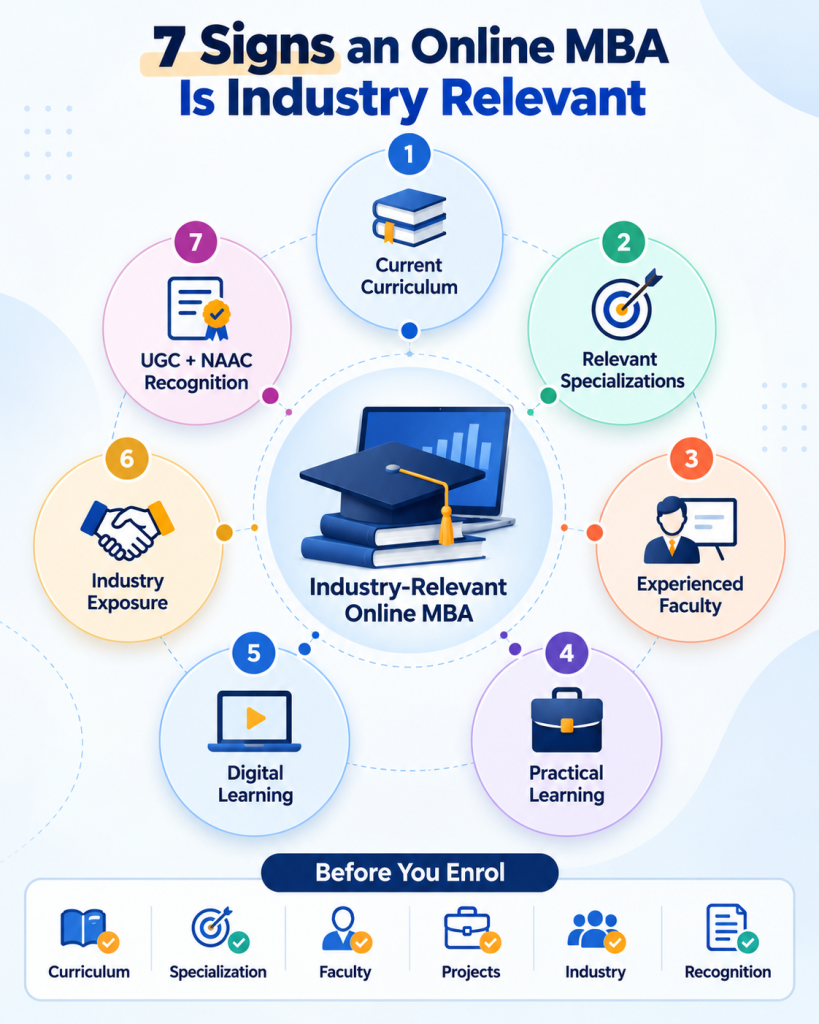
A Quick Checklist for Evaluating an Industry-Relevant Online MBA
Before choosing a program, ask:
- Curriculum: Does it cover current business and workplace skills?
- Specialization: Can I build expertise in an area relevant to my career?
- Faculty: Do instructors bring relevant academic or professional expertise?
- Projects: Will I work on practical business problems?
- Technology: Does the online format support interactive learning?
- Industry exposure: Can I learn from practitioners and interact with professionals?
- Career support: What specific career resources are available?
- Recognition: Is the qualification appropriately recognised?
FAQs
What makes an online MBA industry relevant?
An industry-relevant online MBA combines an updated curriculum, practical learning, relevant specializations, experienced faculty, and industry exposure. In India, learners should also check UGC entitlement for the online degree and the university’s NAAC accreditation. For example, SRM Institute of Science and Technology (SRMIST) offers a UGC-entitled online MBA degree and is NAAC A++ accredited, with specializations such as Business Analytics, Finance, Marketing, AI & Data Science, and Pharmaceutical Management.
Do MBA specializations make an online MBA more career-focused?
A specialization can allow learners to develop deeper knowledge in a particular business function, making their learning more targeted toward a chosen career direction.
How can I evaluate an online MBA before enrolling?
Review the curriculum, specialization options, faculty profiles, practical learning components, industry exposure, online learning experience, career support, and recognition of the qualification. You should also check the MBA eligibility criteria to understand the typical academic and work experience requirements before applying.
Is an online MBA in Finance a good specialization for working professionals?
An online MBA in Finance can be relevant for professionals working in banking, financial services, accounting, investment, or corporate finance. Look for a curriculum covering areas such as financial analysis, investment management, risk, and data-driven financial decision-making, along with opportunities for practical application.