
- Why Is an AI MBA Becoming Important for Business Leaders?
- Who Should Choose an MBA in AI and Business Management?
- What Should You Look for in an AI-Focused MBA?
- How Do You Evaluate an MBA's Career Outcomes?
- Should You Choose an Online, Full-Time, or Executive AI MBA?
- How Much Does an AI-Focused MBA Cost?
- MBA in AI vs Other MBA Specializations: Which Should You Choose?
- 7 Questions to Ask Before Choosing an AI MBA
- Final Checklist for Choosing an AI + Business MBA
- Frequently Asked Questions About Choosing an AI MBA
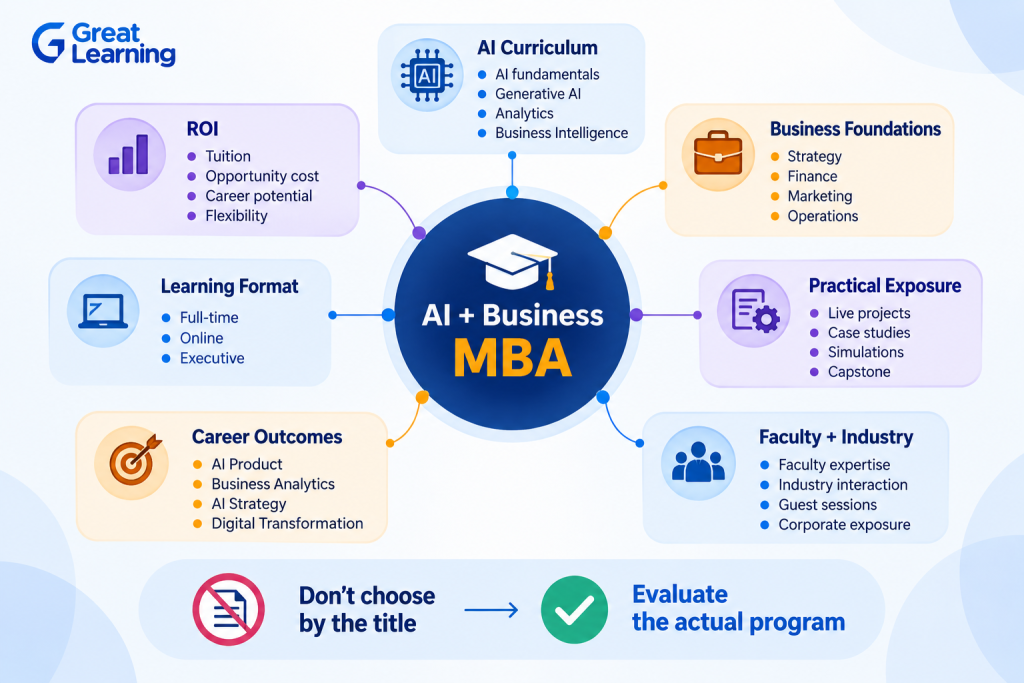
To choose an MBA that combines AI with business management, look beyond the course title and evaluate the AI depth of the curriculum, business fundamentals, hands-on projects, faculty expertise, industry exposure, career outcomes, learning format, and return on investment. This matters because AI is increasingly becoming a business leadership issue, not just a technology function.
In India, 87% of enterprises were actively using AI solutions as of December 2025, according to the NASSCOM AI Adoption Index cited by the Government of India. As organizations integrate AI into strategy, operations, marketing, finance, and product development, managers need to understand both the technology and how to turn it into measurable business value.
Why Is an AI MBA Becoming Important for Business Leaders?
An AI-integrated MBA combines traditional management education with the knowledge needed to understand, evaluate, and implement Artificial Intelligence in business. Rather than preparing students to become AI engine
ers, these programs typically focus on areas such as AI strategy, Business Analytics, Machine Learning fundamentals, Generative AI, automation, data-driven decision-making, and responsible AI, alongside subjects such as finance, marketing, operations, strategy, and leadership.
The distinction is important: business leaders do not necessarily need to build AI models themselves, but they should be able to identify where AI can create value, assess its risks and limitations, and lead teams through adoption. This is increasingly relevant in India, where Deloitte found that Indian enterprises are deploying AI at scale across functions including product development, strategy and operations, marketing and sales, and supply chain.
Who Should Choose an MBA in AI and Business Management?
An MBA in AI and business management suits learners who want to lead business applications of AI rather than work mainly on model engineering. The program should match the decisions you expect to make after graduation.
This specialization is relevant for:
- Graduates targeting product, analytics, consulting, or digital strategy roles
- Marketing, finance, operations, HR, and supply chain professionals who want to lead AI-supported workflows
- Managers responsible for automation, digital transformation, vendor selection, or AI governance
- Technical professionals moving into product management, consulting, or business leadership
- Entrepreneurs evaluating AI products, operating models, and investment decisions
If your main goal is to design algorithms, train models, or pursue research roles, a technical master’s degree in artificial intelligence, machine learning, or data science offers a closer match.
What Should You Look for in an AI-Focused MBA?
1. A Balanced AI and Business Curriculum
Start by examining the curriculum rather than relying on the program’s name. A strong AI-focused MBA should retain core management subjects while offering meaningful AI and analytics coursework. Reviewing an MBA syllabus can help you understand how subjects are structured across areas such as management, analytics, strategy, and specializations.
For example, an MBA that combines management fundamentals with subjects such as Machine Learning, NLP, Deep Learning, Business Intelligence, and Data Visualization can provide a more integrated approach to AI-driven management. SRMIST’s Online MBA in AI and Data Science follows this kind of structure, combining core management subjects with specialized AI and analytics coursework.
SRMIST Online MBA in Data Science & AI
Advance your career with SRMIST's UGC-entitled Online MBA in Data Science and Artificial Intelligence. Master machine learning, data visualization, and business analytics to drive data-centric decisions.
2. Industry-Relevant AI Skills
AI evolves quickly, so check whether the program teaches skills relevant to current business environments. Generative AI, Predictive Analytics, Business Intelligence, Data Visualization, and AI-powered decision-making can be particularly valuable.
A useful question to ask is: Does the program teach me how businesses use AI, or only what AI is?
The former is especially important for aspiring managers because AI implementation involves strategy, investment decisions, process redesign, change management, and risk assessment.
3. Hands-On Projects and Case Studies
Theory alone may not be enough. Look for an MBA that provides opportunities to work on real-world business problems, AI case studies, simulations, consulting assignments, or capstone projects.
Practical exposure can help students understand how an organization moves from identifying an AI opportunity to implementing and measuring it.
4. Faculty and Industry Connections
Faculty expertise can significantly influence the learning experience. Explore whether professors have experience in AI, analytics, digital transformation, or technology management.
Also consider industry partnerships, guest lectures, internships, live projects, and corporate interactions. These can expose students to how organizations are actually adopting AI.
How Do You Evaluate an MBA's Career Outcomes?
The right program should align with the career you want to build. An AI-focused MBA can support roles such as AI product manager, business analyst, digital transformation manager, AI strategy consultant, product manager, or business intelligence manager. For experienced professionals looking beyond an MBA toward advanced business leadership and general management, a Doctor of Business Administration in General Management can be another option.
Should You Choose an Online, Full-Time, or Executive AI MBA?
The right format depends on your experience and career objectives. A full-time MBA can suit candidates seeking a significant career transition and intensive campus experience. An online MBA can offer greater flexibility for working professionals and students with multiple commitments. An executive MBA may be more suitable for experienced managers who want to develop leadership and technology-strategy skills without leaving employment.
Compare the program's duration, networking opportunities, work-experience requirements, teaching format, and practical exposure before deciding.
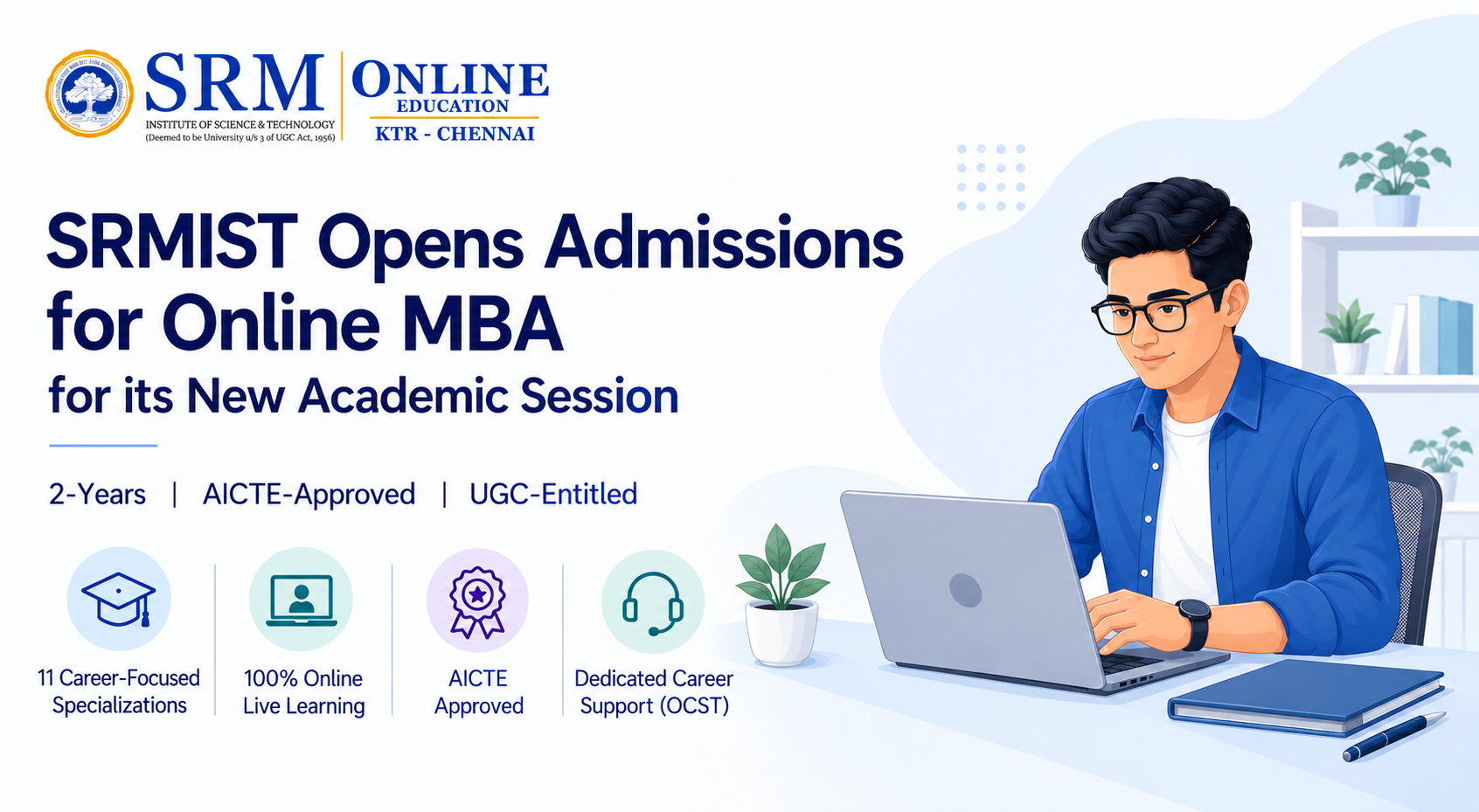
Advance your career with SRMIST's UGC-entitled Online MBA. Choose from 11 industry-focused specializations including Finance, Marketing, HR, AI & Data Science, Healthcare & Hospital Management and more.
How Much Does an AI-Focused MBA Cost?
Don't compare programs on tuition fees alone. Consider total program costs, scholarships, additional learning expenses, opportunity cost, and potential career outcomes.
A more expensive program may offer stronger industry connections or career support, while a lower-cost program may provide greater flexibility. The important question is whether the program's curriculum and outcomes justify the investment for your career goals.
MBA in AI vs Other MBA Specializations: Which Should You Choose?
MBA programs today offer several specializations, from finance, marketing, and human resources to operations, business analytics, and AI. This allows students to choose a path that aligns with their career goals and interests.
For example, someone aspiring to work in AI-driven product development, analytics, or digital transformation may benefit from an MBA in AI and business management. Meanwhile, a student interested in brand strategy may choose marketing, while someone targeting financial services may opt for an MBA in Finance.
Rather than asking which specialization is better, consider which skills and knowledge best support your career plans. An AI-focused MBA can be particularly relevant for professionals looking to understand both emerging technologies and their application in business.
7 Questions to Ask Before Choosing an AI MBA
Before applying, ask:
- How deeply is AI integrated into the curriculum?
- Does the program cover Generative AI and analytics?
- Are there real-world AI projects or case studies?
- What are the faculty's AI and business credentials?
- Which companies recruit graduates?
- What career and placement support is provided?
- Does the program fit my experience, budget, and career goals?
Final Checklist for Choosing an AI + Business MBA
The best MBA combining AI with business management should offer a balanced curriculum, practical AI exposure, experienced faculty, strong industry connections, relevant career pathways, and a format that fits your circumstances. Most importantly, don't choose a program simply because “AI” appears in its title. Evaluate what you will actually learn and whether those skills will help you lead AI-driven business decisions.
Frequently Asked Questions About Choosing an AI MBA
Do you need coding experience for an MBA in AI?
Most business-focused AI MBA programs do not expect engineering-level programming skills. You should still understand data, model outputs, AI limitations, and basic analytics. If you lack this background, look for foundation modules before advanced AI subjects.
Is an online MBA in AI recognized in India?
Recognition depends on the institution, program, delivery mode, and academic session. Check the current UGC-DEB records for the exact institution and program before enrolling.
What jobs align with an MBA in AI?
Relevant roles include AI product manager, business analyst, digital transformation manager, AI strategy consultant, business intelligence manager, and technology program manager. Your prior experience, technical skills, projects, and industry knowledge will influence your eligibility for each role.