
To find a pharma MBA with enough industry exposure, look for a program that combines pharmaceutical management concepts with practical projects, industry-relevant case studies, business simulations, and opportunities to learn from industry professionals. Evaluate the curriculum, faculty expertise, mentorship opportunities, and scope for real-world problem-solving before enrolling.
The need for practical management skills is evident in India's pharmaceutical sector. The industry recorded a turnover of ₹4.72 lakh crore in FY 2024–25, according to the Press Information Bureau, Government of India. As the sector spans drug manufacturing, marketing, distribution, regulatory compliance, and healthcare innovation, aspiring managers need to apply business knowledge to industry-specific challenges. Choosing an MBA in Pharmaceutical Management with relevant practical learning can help bridge the gap between academic concepts and workplace expectations.
What Does Industry Exposure Mean in a Pharma MBA?
Industry exposure means learning how pharmaceutical businesses operate and applying management concepts to realistic industry situations. Depending on the program, it can include case studies, business simulations, industry-led sessions, projects, internships, and company interactions.
For example, learners may examine how a pharmaceutical company positions a new product, manages its supply chain, responds to regulatory requirements, or evaluates market demand. These exercises connect classroom concepts with business decisions.
However, industry exposure does not always mean working directly with a pharmaceutical company. Before enrolling, check which practical learning activities are included and whether they involve actual industry participation or simulated business scenarios.
Also Read: Who Should Consider an MBA in Pharmaceutical Management?
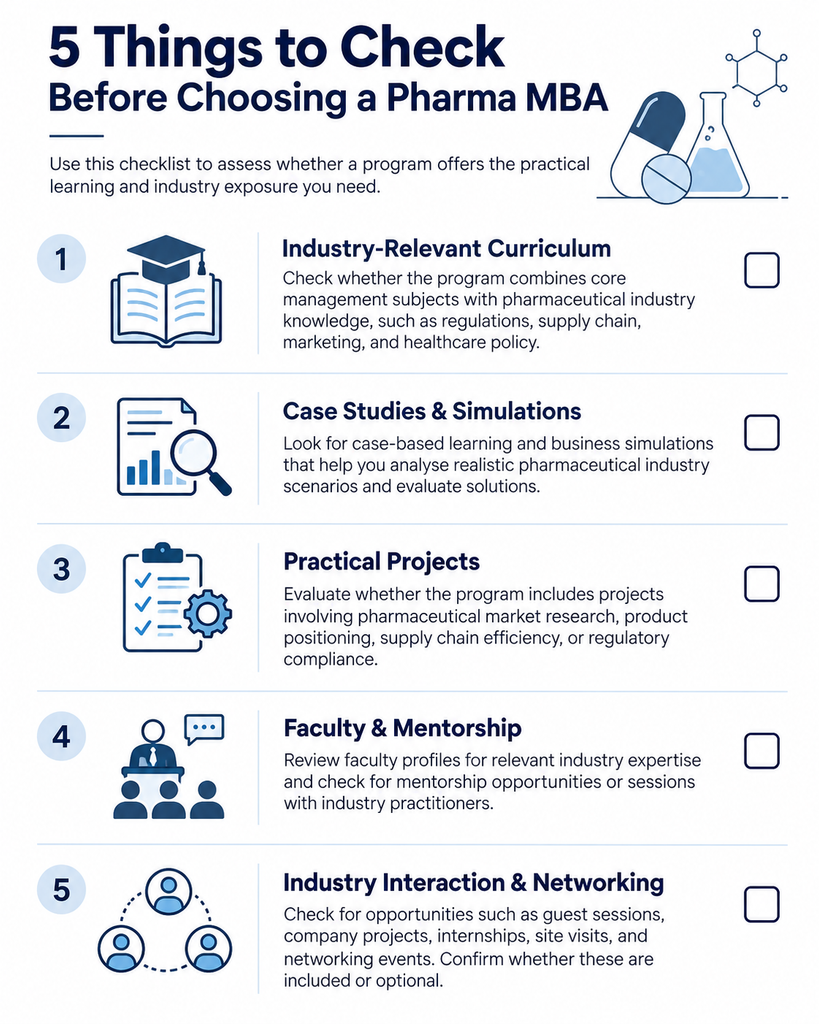
5 Things to Check Before Choosing a Pharma MBA
1. Look for an Industry-Relevant Curriculum
A strong MBA in Pharmaceutical Management should combine core business subjects with pharmaceutical industry knowledge. Look for topics such as pharma business management, pharmaceutical regulations, supply chain management, medical device marketing, digital health, and drug policy. These subjects can help you understand how commercial strategy, compliance, operations, and healthcare priorities influence pharmaceutical businesses.
Before enrolling, review a typical MBA syllabus to understand how core management subjects can complement specialized pharmaceutical business knowledge.
2. Check for Case Studies and Business Simulations
Case studies and simulations allow learners to examine business problems and evaluate possible solutions. For instance, a case study might explore how a pharmaceutical company responds to changing market demand or manages distribution challenges.
Check whether the program includes structured case-based learning and simulations, rather than relying exclusively on lectures and examinations. Ask how these activities are assessed and whether learners receive feedback.
3. Evaluate Projects and Practical Assignments
Projects provide an opportunity to apply management concepts to a defined problem. Look for assignments involving pharmaceutical market research, product positioning, supply chain efficiency, regulatory compliance, or business strategy.
An industry-focused end-term project can be particularly useful when it requires learners to analyze a problem, justify their recommendations, and present a practical solution. Review the project guidelines to understand how closely the work relates to pharmaceutical business challenges.
4. Review Faculty and Mentorship Opportunities
Faculty expertise influences how pharmaceutical management concepts are taught and discussed. Review faculty profiles, relevant industry experience, and the availability of mentorship.
Sessions with industry practitioners can offer additional perspectives on commercial operations, healthcare trends, and managerial decision-making. However, verify who conducts these sessions, how frequently they take place, and whether mentorship is included throughout the program.
5. Verify Industry Interaction and Networking
Guest sessions, industry discussions, company projects, internships, and site visits can offer different forms of industry interaction. Not every MBA includes all these opportunities, so check the program details before enrolling.
Before enrolling, ask who participates in industry sessions and how frequently these interactions occur. Are learners discussing case studies with faculty, attending guest lectures by pharmaceutical professionals, or working on projects involving companies? Also, confirm whether these activities are mandatory, optional, or subject to availability. These details will help you understand the actual level of industry involvement.
Can an Online MBA in Pharmaceutical Management Offer Practical Learning?
Yes. An Online MBA in Pharmaceutical Management can support applied learning through live sessions, case studies, business simulations, mentorship, and practical projects. The quality of the experience depends on how these elements are integrated into the curriculum.
SRMIST Online MBA in Pharmaceutical Management
Advance your career with SRMIST's UGC-entitled Online MBA in Pharmaceutical Management. Master pharmaceutical regulations, digital health, and supply chain management to prepare for leadership roles across pharma, healthcare, and life sciences.
For working professionals, an online format can also make it easier to balance education with existing responsibilities. Before choosing a program, review its live-session schedule, recorded learning resources, assessment methods, and project requirements.
Remember that practical coursework and direct industry exposure are different. If your priority is an internship, company placement, or on-site experience, confirm that the program explicitly offers that opportunity rather than assuming it is included.
If you are comparing online management programs, explore the online MBA offered by SRMIST to understand the broader program structure and available specializations before deciding which option aligns with your career goals.
Also Read: How Do You Choose an MBA Without Leaving Your Job?
Advance your career with SRMIST's UGC-entitled Online MBA. Choose from 11 industry-focused specializations including Finance, Marketing, HR, AI & Data Science, Healthcare & Hospital Management and more.
FAQs About Industry Exposure in a Pharma MBA
Can a Pharma MBA help you move into pharmaceutical management roles?
An MBA in Pharmaceutical Management can help you develop business and management skills relevant to roles in pharmaceutical marketing, sales management, product management, operations, and supply chain management. Career opportunities depend on your prior qualifications, experience, skills, and the requirements of individual employers.
Which industry projects should you look for in a Pharma MBA?
Look for projects involving pharmaceutical market research, product positioning, sales strategy, supply chain optimization, regulatory compliance, and market-entry planning. These projects can help you understand how management decisions affect pharmaceutical businesses.
Is an online MBA in Pharmaceutical Management as practical as an on-campus program?
An online MBA can offer practical learning through live sessions, case studies, business simulations, mentorship, and projects. However, the level of practical exposure depends on the curriculum. Compare the opportunities for industry interaction and hands-on learning rather than judging a program solely by its delivery format.