- How Can AI Solve Business Problems?
- How Does an MBA Help You Manage AI Projects From Start to Finish?
- Do You Need Coding Skills to Manage AI Projects After an MBA?
- How Can You Improve Project Management With AI?
- How Can You Improve AI Results for Your Business?
- Which Roles Can an MBA Graduate Pursue in AI Project Management?
- Conclusion
- FAQs
An MBA can prepare professionals to manage AI projects by helping them identify business problems, evaluate AI use cases, assess financial feasibility, coordinate technical teams, and measure business outcomes. These skills help organizations move beyond AI experimentation to solutions that improve productivity, customer experience, and operational efficiency. While an MBA provides a management foundation, leading complex AI projects also requires practical experience and an understanding of AI technologies.
AI adoption in India is already creating opportunities across business functions. According to Deloitte’s State of AI in the Enterprise 2026 report, 40% of surveyed Indian enterprises reported significant or full AI usage, compared with approximately 28% globally. This signals a growing need for professionals who can connect AI capabilities with business priorities and translate technology investments into measurable results.
How Can AI Solve Business Problems?
AI can solve business problems by analyzing large datasets, identifying patterns, automating repetitive tasks, generating insights, and supporting faster decision-making. Its value depends on how well the solution addresses a specific business need.
For example, a retail company can use AI to forecast demand, optimize inventory, and personalize product recommendations. A financial services company can use AI to flag potentially fraudulent transactions, while a customer service team can use AI assistants to handle routine queries and help employees find relevant information.
The key is to start with the problem rather than the technology. Before adopting an AI solution, businesses should identify the bottleneck, understand its underlying causes, and determine whether AI is the right approach. Some problems may be better addressed through process improvements or conventional automation.
How Does an MBA Help You Manage AI Projects From Start to Finish?
Managing AI projects requires an understanding of business strategy, data analysis, and AI applications. Programs such as an online MBA in AI, Business Analytics, and IT management bring these areas together.
SRMIST Online MBA in Data Science & AI
Advance your career with SRMIST's UGC-entitled Online MBA in Data Science and Artificial Intelligence. Master machine learning, data visualization, and business analytics to drive data-centric decisions.
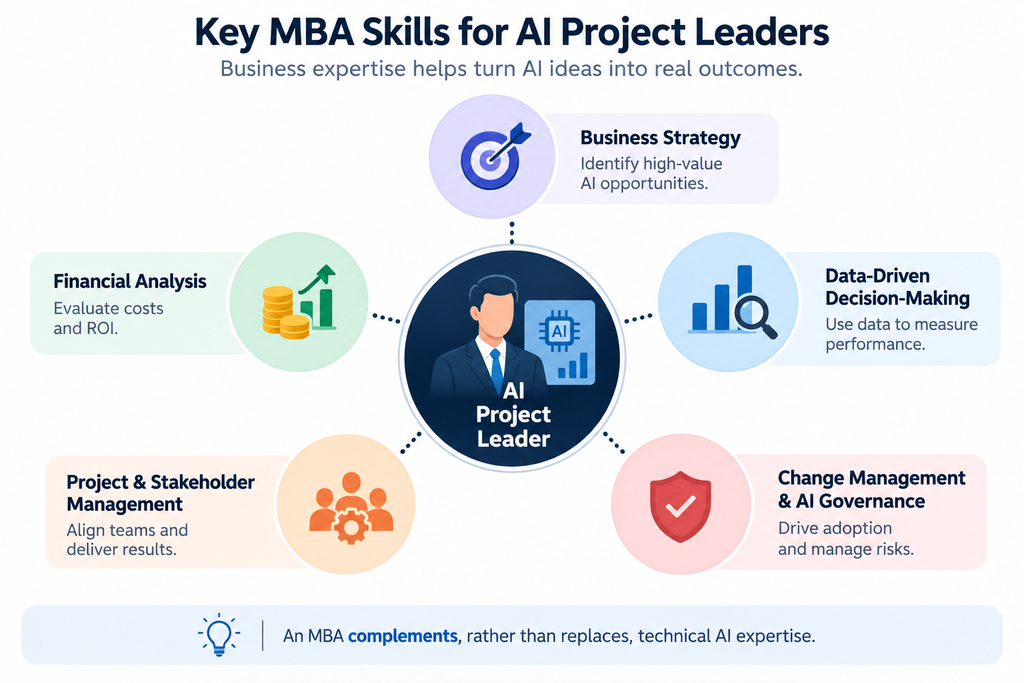
An MBA develops business, financial, and leadership capabilities that help professionals oversee AI projects across the following stages.
1. Identify Business Problems and Prioritize AI Use Cases
Successful AI projects begin with a clear business objective. MBA coursework in strategy, operations, and business analytics can help professionals identify inefficiencies, understand customer needs, and prioritize opportunities based on their potential impact.
For instance, an e-commerce business experiencing frequent delivery delays could explore AI-powered demand forecasting and route optimization. The project team would first identify the main causes of delays and assess whether better predictions could improve delivery performance.
2. Evaluate Feasibility, Costs, and Expected ROI
Not every AI use case justifies the investment. Financial analysis and managerial decision-making help professionals compare implementation costs with expected benefits, including productivity gains, reduced operating expenses, and potential revenue growth.
An MBA-trained manager can develop a business case that considers technology costs, data availability, implementation time, employee training, and ongoing maintenance. This helps decision-makers prioritize projects that align with organizational goals and available resources.
3. Coordinate Technical Teams and Business Stakeholders
AI projects often involve business leaders, data scientists, engineers, IT teams, and end users. Project management and communication skills help managers align these stakeholders around shared objectives, responsibilities, timelines, and deliverables.
Managers must also address implementation challenges, such as integrating AI tools with existing systems, preparing employees for new workflows, and establishing appropriate data security and governance practices.
4. Measure Outcomes and Business Impact
Deploying an AI model does not automatically translate into business value. Managers must define success metrics before implementation and evaluate results against a baseline.
Depending on the use case, these metrics may include customer response time, forecast accuracy, employee productivity, conversion rates, operating costs, or customer satisfaction. Monitoring these indicators helps teams determine whether the solution is delivering its intended benefits and where improvements are needed.
Do You Need Coding Skills to Manage AI Projects After an MBA?
Not every AI project management role requires advanced coding skills. Business-focused professionals often concentrate on defining requirements, evaluating costs, coordinating teams, and measuring project performance rather than developing AI models themselves.
An MBA helps develop these management capabilities. However, understanding basic AI concepts, data analysis, and tools such as Excel, SQL, or Power BI strengthens your ability to work with technical teams. Technical implementation roles demand deeper expertise, while independent AI project leadership generally requires relevant experience.
How Can You Improve Project Management With AI?
AI can improve project management by helping teams forecast risks, prioritize tasks, automate routine reporting, and allocate resources more effectively. Project managers can combine AI capabilities with Agile methodologies and Microsoft tools to streamline planning, coordinate teams, and manage project delivery from start to finish. Explore project management with Agile, AI, and Microsoft tools for a practical perspective on integrating these approaches
For example, a project manager overseeing a product launch can use AI to summarize team updates, identify dependencies, and highlight tasks at risk of missing deadlines. This allows the manager to focus on decision-making and resolving bottlenecks rather than manually consolidating information.
An MBA can complement these capabilities through skills in project planning, operations management, resource allocation, and stakeholder communication. Managers must still validate AI-generated recommendations, protect confidential data, and retain accountability for important decisions.
How Can You Improve AI Results for Your Business?
To improve AI results for your business, focus on five practical steps:
- Define measurable objectives: Identify the business problem and establish baseline metrics, such as processing time, conversion rates, or operating costs.
- Improve data quality: Ensure the data used by AI systems is accurate, relevant, secure, and representative of the intended use case.
- Choose the right solution: Evaluate AI tools based on their suitability for the task, integration requirements, cost, and scalability.
- Run a pilot project: Test the solution on a limited scale, gather user feedback, and compare its performance against predefined targets.
- Monitor and optimize: Track results continuously, address errors, train employees, and refine workflows as business requirements evolve.
Business leaders play an important role in this process by connecting technical performance with organizational priorities. An AI tool that produces accurate outputs may still fail to deliver value if employees do not adopt it or if it does not improve the underlying business process.
Which Roles Can an MBA Graduate Pursue in AI Project Management?
Professionals with an MBA and relevant AI literacy may explore roles such as AI project manager, AI product manager, business transformation manager, AI strategy consultant, and digital transformation lead.
These roles involve different responsibilities, from coordinating AI implementations and managing budgets to identifying business use cases and evaluating performance. For professionals considering management education to build these capabilities, choosing a program with relevant AI coursework, practical projects, and business fundamentals is an important step. This guide explains how to choose an MBA that combines AI with business management.
Conclusion
For students interested in AI-related business careers, an MBA provides a foundation in the financial, analytical, and management skills involved in AI projects. The next step is to apply these skills through case studies, internships, and practical projects.
The Online MBA Degree from SRMIST offers specializations across business and management disciplines, including AI and Data Science, Business Analytics, and IT Management. Students should compare the curriculum, practical learning opportunities, and relevance of each specialization to their career goals.
Advance your career with SRMIST's UGC-entitled Online MBA. Choose from 11 industry-focused specializations including Finance, Marketing, HR, AI & Data Science, Healthcare & Hospital Management and more.
FAQs
Is an MBA enough to become an AI project manager?
An MBA builds business, leadership, and project management skills. AI knowledge and relevant work experience are also important.
Which MBA specialization is best for AI project management?
AI and Data Science, Business Analytics, and IT Management are relevant choices. Select based on your career goals and curriculum.
Can non-technical students manage AI projects after an MBA?
Yes. Non-technical graduates can pursue business-facing AI roles by developing AI literacy, analytical skills, and project experience.
What skills should MBA students learn for AI projects?
Focus on business analysis, budgeting, project planning, stakeholder management, and tools such as Excel, SQL, and Power BI.