
- What Is Qwen3.8-Max?
- Qwen3.8-Max Key Features and Specifications
- What Makes Qwen3.8-Max Different From Earlier Qwen Models?
- Qwen3.8-Max for Coding and AI Agents
- What Qwen3.8-Max Means for Students
- What Qwen3.8-Max Means for Professionals
- Is Qwen3.8-Max Open-Weight or Open Source?
- What Are the Limitations of Qwen3.8-Max?
- Should You Learn Qwen3.8-Max?
- Why Qwen3.8-Max Matters for the Future of AI
- Conclusion
- Frequently Asked Questions
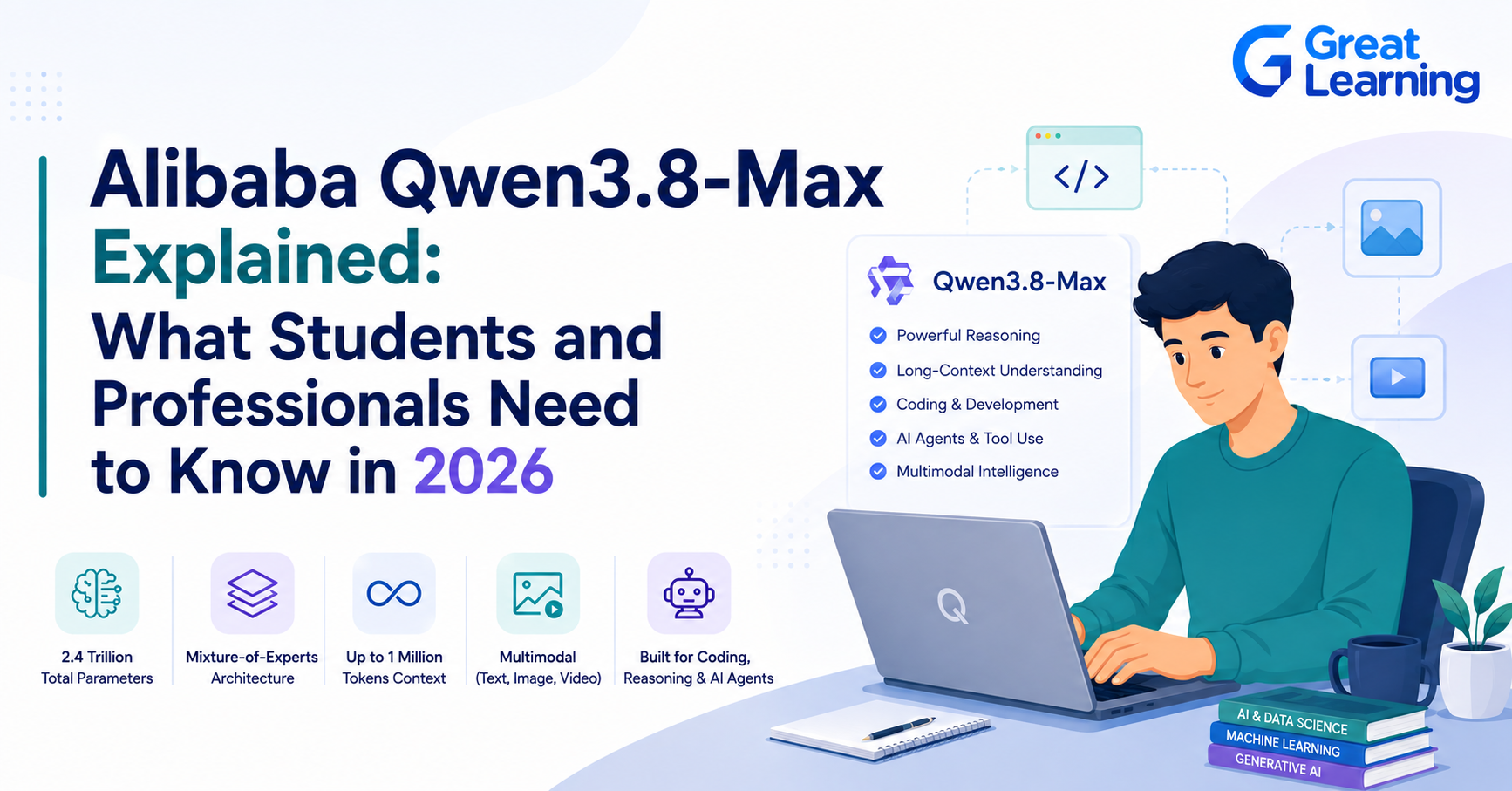
Alibaba’s Qwen3.8-Max is the latest flagship model in the Qwen family, bringing a stronger focus on coding, multimodal reasoning, long-context processing, and AI agents.
Released in August 2026, the model uses a Mixture-of-Experts architecture with 2.4 trillion total parameters and about 95 billion active parameters per request.
Beyond its size, Qwen3.8-Max is notable for its focus on tasks that require multiple steps, including software development, research, computer interaction, and other agentic workflows.
For students and professionals, this makes the model relevant not just as another AI chatbot, but as an example of how AI is moving toward systems that can perform tasks rather than simply generate answers.
What Is Qwen3.8-Max?
Qwen3.8-Max is Alibaba’s latest large language model and the newest flagship addition to its Qwen model family. The model is designed for demanding tasks involving reasoning, coding, multimodal understanding, tool use, and extended workflows.
One of its most notable technical characteristics is its Mixture-of-Experts (MoE) architecture. Although the model contains approximately 2.4 trillion parameters, only around 95 billion parameters are activated for a given request.
This sparse architecture can help reduce the computational requirements of inference compared with activating the entire model for every input.
Qwen3.8-Max also supports a 1-million-token context window, allowing it to work with very large amounts of information in a single interaction. This can be particularly useful for analyzing long documents, large codebases, and extended multimodal inputs.
Alibaba Cloud's current documentation also lists 1 million tokens for its Qwen3.7-Max API generation, showing the broader Qwen family’s continued focus on long-context applications.
Qwen3.8-Max Key Features and Specifications
The following specifications provide a quick overview of what makes Qwen3.8-Max different from conventional AI chatbots.
| Specification | Qwen3.8-Max |
| Developer | Alibaba / Qwen |
| Model type | Large language model |
| Architecture | Mixture of Experts |
| Total parameters | 2.4 trillion |
| Active parameters | Approximately 95 billion |
| Context window | Up to 1 million tokens |
| Input modalities | Text, images, and video |
| Major focus areas | Coding, reasoning, agents, multimodal tasks |
| Release | August 2026 |
| Availability | API access with planned open-weight release |
Alibaba has positioned Qwen3.8-Max as an open-weight model, although businesses should distinguish open weights from open-source licensing and verify the final terms before commercial deployment.
Reuters reported that Alibaba was considering revenue-sharing requirements for certain large commercial users.
What Makes Qwen3.8-Max Different From Earlier Qwen Models?
The most important change is not simply the increase in model size. Qwen3.8-Max is designed around longer and more complex AI workflows.
Traditional chatbot interactions generally follow a simple pattern: a user asks a question and the model generates an answer.
Agentic systems introduce additional steps. An AI system can interpret a goal, use tools, inspect results, make changes, and continue working toward an outcome.
For example, a coding workflow could involve:
- Understanding a software requirement.
- Inspecting an existing codebase.
- Writing or modifying code.
- Running tests.
- Identifying errors.
- Making corrections.
- Repeating the process until the task is complete.
This makes Qwen3.8-Max particularly relevant to the development of AI agents and AI-powered workflows.
Qwen3.8-Max for Coding and AI Agents
Coding is one of the most important applications for Qwen3.8-Max.
The model is designed for software engineering tasks that go beyond generating isolated code snippets. It can be used within workflows involving code analysis, debugging, testing, repository-level tasks, and computer interaction.
However, benchmark results show why developers should avoid treating any single AI model as universally superior.
Reported evaluations show Qwen3.8-Max performing strongly on several agentic and coding-related benchmarks, including Terminal-Bench 2.1 and PaperBench.
At the same time, it does not lead every benchmark, with reported results showing it behind some competing frontier models on benchmarks such as SWE-bench Pro.
That distinction matters.
A model can perform extremely well on one type of software engineering task while producing weaker results on another. Developers should therefore evaluate Qwen3.8-Max against the specific tasks, programming languages, tools, and workflows they intend to use.
What Qwen3.8-Max Means for Students
Students are likely to encounter models such as Qwen3.8-Max throughout their education and early careers. The most useful approach is not to learn one specific model but to understand how to work effectively with advanced AI systems.
1. AI-Assisted Coding
Students learning Python, Java, JavaScript, C++, or other programming languages can use AI models to:
- Explain programming concepts
- Debug code
- Generate practice problems
- Review implementations
- Suggest improvements
- Build small applications
- Create test cases
However, students should treat AI-generated code as something to understand and verify, not simply copy.
The ability to explain why a piece of code works remains important even when AI can generate it.
2. Learning AI Agents
Qwen3.8-Max also highlights the growing importance of agentic AI.
Students interested in AI development can begin learning:
- APIs
- Tool calling
- Function calling
- Retrieval-augmented generation
- Agent workflows
- Memory systems
- Evaluation
- Model orchestration
- AI application deployment
These skills are transferable across different AI models, making them more valuable than learning the interface of a single chatbot.
3. Research and Large Documents
With its large context capabilities and multimodal focus, Qwen3.8-Max can also support research-oriented workflows.
Students can potentially use such systems to analyze lengthy documents, organize research material, compare information, summarize technical content, or work with large codebases.
The important limitation is that AI-generated analysis still needs verification, particularly when working with academic sources, technical claims, or citations.
What Qwen3.8-Max Means for Professionals
For professionals, the bigger opportunity is workflow automation.
Instead of using AI only to generate emails or summarize documents, organizations can integrate models into workflows that involve multiple tools and stages.
1. Software Developers
Developers can use AI agents for:
- Code generation
- Debugging
- Testing
- Documentation
- Code review
- Repository analysis
- Development automation
2. Data Professionals
Data scientists and analysts can use AI systems to assist with:
- Data exploration
- SQL generation
- Python coding
- Documentation
- Report creation
- Research
- Repetitive analytical workflows
The output still needs human validation, especially when decisions depend on data accuracy.
3. Product and Business Professionals
AI agents can also support:
- Market research
- Competitive analysis
- Document analysis
- Meeting preparation
- Report generation
- Workflow coordination
The value comes from integrating AI into an existing business process rather than simply adding another chatbot to the technology stack.
Professionals looking to build practical expertise in autonomous AI systems can explore an AI Agents course by Johns Hopkins University covering AI agents, Agentic RAG, multi-agent systems, evaluation, security, and production deployment.
Certificate Program in Agentic AI
Learn the architecture of intelligent agentic systems. Build agents that perceive, plan, learn, and act using Python-based projects and cutting-edge agentic architectures.
How Does Qwen3.8-Max Compare With ChatGPT and Claude?
| Capability | Qwen3.8-Max | ChatGPT | Claude |
| Model developer | Alibaba | OpenAI | Anthropic |
| Coding | Strong focus | Strong | Strong |
| Long-context tasks | Up to 1M tokens | Varies by model | Strong |
| Multimodal capabilities | Text, image, video | Text, image, audio, video* | Text and image |
| AI agents | Major focus | Strong | Strong |
| Tool use | Supported | Strong | Strong |
| Open-weight availability | Yes | No | No |
| Best suited for | Coding, agents, long-context and multimodal workflows | General-purpose AI, reasoning, coding, and multimodal tasks | Reasoning, coding, research, and long-context work |
*Capabilities vary by ChatGPT model and product.
The key difference is not that Qwen3.8-Max simply replaces ChatGPT or Claude.
Each model family is designed around different priorities, and performance can vary significantly depending on the task, model version, tools, and deployment environment.
Qwen3.8-Max is particularly notable for its open-weight approach, large context window, coding capabilities, and focus on agentic workflows.
Is Qwen3.8-Max Open-Weight or Open Source?
This is an important distinction for developers and businesses.
Alibaba has positioned Qwen3.8-Max as an open-weight model, meaning developers are expected to gain access to the model weights rather than being limited to a hosted chatbot or API.
However, open-weight does not automatically mean unrestricted open-source use.
Licensing terms determine what developers and businesses can legally do with a model, particularly for commercial applications. Reuters reported that Alibaba was considering a revenue-sharing arrangement for certain large commercial users of Qwen3.8-Max.
Therefore, developers planning commercial deployment should review the model's final license and usage conditions instead of assuming that open-weight availability means unrestricted commercial use.
What Are the Limitations of Qwen3.8-Max?
Despite its capabilities, Qwen3.8-Max is not a replacement for human expertise.
1. Benchmark Performance Varies
The model performs strongly on several evaluations but does not lead every benchmark. This means its suitability depends on the particular task.
2. AI-Generated Output Still Requires Verification
A more capable model can still generate incorrect information, faulty code, or unsupported conclusions.
3. Deployment Can Be Complex
Running a large open-weight model locally or within an enterprise environment requires significant infrastructure, technical expertise, and cost considerations.
4. Licensing Matters
Organizations should carefully review licensing and commercial-use requirements before integrating the model into production systems.
5. AI Agents Need Oversight
Giving an AI system access to tools, files, software, or external systems introduces additional security and reliability considerations. Agentic AI should therefore be evaluated and monitored rather than given unrestricted autonomy.
Should You Learn Qwen3.8-Max?
Yes, but don't focus on Qwen3.8-Max alone.
For students, the priority should be building transferable skills in:
- Python and programming
- SQL
- Machine learning fundamentals
- Generative AI
- Prompt engineering
- APIs
- RAG
- AI agents
- Model evaluation
Professionals should additionally learn how to integrate AI into existing workflows and evaluate whether it improves productivity, quality, cost, or execution speed.
The model may change, but these underlying skills are likely to remain useful.
If you want to build these skills systematically, an Agentic AI course by IIT Bombay can help you develop practical knowledge of agentic workflows, AI agents, and the technologies used to build AI-powered applications.
IIT Bombay Certificate in Agentic AI
Master Agentic AI with IIT Bombay. Build dynamic, autonomous agentic systems and master multi-agent orchestration using LangGraph and CrewAI.
Why Qwen3.8-Max Matters for the Future of AI
Qwen3.8-Max reflects a broader shift in AI development.
The industry is moving from systems that primarily generate content toward systems that can plan, use tools, interact with software, and execute multi-step tasks.
Its large context window, multimodal capabilities, sparse MoE architecture, and focus on coding and agentic workflows illustrate this transition.
Reuters also reported that Alibaba's launch formed part of the broader competition around open-weight AI models, as companies increasingly seek to combine advanced capabilities with greater developer access.
For students, the implication is clear: learning how to build with AI may become more important than simply learning how to use AI chatbots.
For professionals, the opportunity is even broader. The valuable question is no longer just:
“Which AI model should I use?”
It is:
“Which parts of my workflow can AI reliably execute, and how should I design the system around it?”
Conclusion
Qwen3.8-Max is significant because it represents more than another increase in AI model size.
Its 2.4 trillion total parameters, approximately 95 billion active parameters, million-token context window, multimodal capabilities, and focus on coding and agentic workflows place it among the most notable AI model releases of 2026.
For students, it offers another reason to develop skills in programming, generative AI, APIs, and AI agents. For professionals, it highlights the growing opportunity to integrate AI into real-world workflows rather than using it only for individual prompts.
The most useful takeaway is therefore not to memorize the specifications of Qwen3.8-Max. It is to understand the larger direction of AI: models are increasingly becoming systems that can reason, use tools, and execute work across multiple steps.
Frequently Asked Questions
1. What is Qwen3.8-Max?
Qwen3.8-Max is Alibaba’s latest flagship AI model, designed for coding, reasoning, multimodal processing, long-context tasks, and agentic AI workflows.
2. How many parameters does Qwen3.8-Max have?
Qwen3.8-Max has approximately 2.4 trillion total parameters, with around 95 billion parameters activated for a given request through its Mixture-of-Experts architecture.
3. What is Qwen3.8-Max used for?
Qwen3.8-Max can be used for coding, research, multimodal analysis, AI agents, long-context processing, software development, and other complex multi-step workflows.
4. Is Qwen3.8-Max open source?
Qwen3.8-Max is positioned as an open-weight model. However, developers should check its specific license and commercial-use terms rather than assuming that open-weight availability means unrestricted open-source use.
5. Is Qwen3.8-Max useful for students?
Yes. Students can use Qwen3.8-Max for coding practice, research, debugging, technical learning, project development, and experimenting with AI agents. Its outputs should still be reviewed and verified.
6. Should professionals learn Qwen3.8-Max?
Professionals can benefit from learning Qwen3.8-Max and similar AI models, but transferable skills such as Python, APIs, AI agents, RAG, tool calling, model evaluation, and workflow automation are more important than learning one specific model.