
- What is Tokenmaxxing?
- How Tokenmaxxing Took Over Corporate AI Culture
- Case Study 1: Microsoft Calls Out Its Own Tokenmaxxing Problem
- Case Study 2: Uber Caps AI Spending After Blowing Through Its Annual Budget
- The Numbers Behind the Tokenmaxxing Problem
- Why This Matters for Enterprises Adopting AI
- How Employees and Teams Can Avoid Tokenmaxxing
- Frequently Asked Questions
As Generative AI becomes a standard part of workplace productivity, a new trend is emerging: employees using AI tools far more than a task actually requires.
Known as Tokenmaxxing, the practice is often driven by adoption targets, performance metrics, or a desire to demonstrate the use of Artificial Intelligence within an organization.
What started as internet slang has quickly become a topic of discussion in corporate boardrooms.
In 2026, reports involving companies such as Microsoft and Uber brought renewed attention to the issue, highlighting how aggressive AI adoption can sometimes lead to rising costs without a proportional increase in business value.
As enterprises continue investing heavily in AI, the challenge is no longer encouraging employees to use these tools—it is ensuring they use them effectively.
This shift from AI adoption to AI value creation is becoming a major focus for organizations worldwide. As businesses evaluate whether their AI investments are translating into measurable outcomes, understanding the broader impact of Generative AI for Business: Boosting Productivity & Efficiency becomes increasingly important.
In this blog, we will explore what Tokenmaxxing means, why it matters, and what recent developments reveal about the future of enterprise AI adoption.
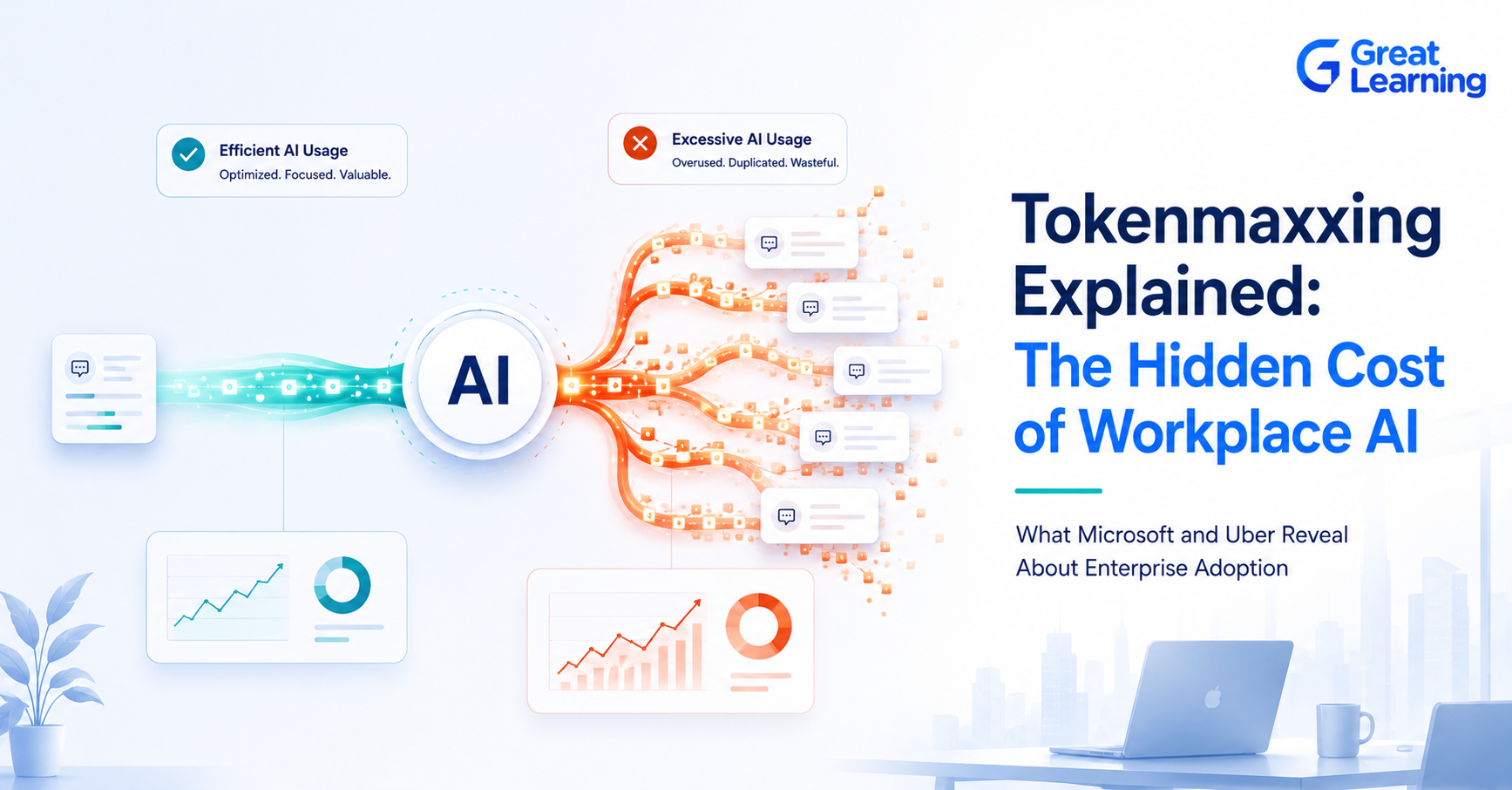
What is Tokenmaxxing?
A token is just the basic unit AI models use to read and write text, about three-quarters of a word. Every prompt you send and every reply you get back burns tokens, and tokens cost real money.
Tokenmaxxing is what happens when people burn through tokens without getting much in return. Picture leaving every light on in an office building. You're using the resource, sure, but not for any good reason. A two-line email gets run through a top-tier AI model.
A meeting summary that nobody will ever read is generated in three different ways "just in case." Multiply that across a few thousand employees, and the costs add up fast.
One of the simplest ways to reduce unnecessary AI usage is to improve prompt quality. Professionals looking to build this skill can start with the free prompt engineering course by Great Learning Academy.
How Tokenmaxxing Took Over Corporate AI Culture
For most of the past year, companies pushed employees to use AI as much as possible. Some even built internal leaderboards that ranked workers by how many tokens they burned through, almost like a sales contest.
The idea made sense on paper: more AI usage should mean more output and faster adoption. But it didn't really play out that way. Amazon reportedly shut down one of its own internal AI leaderboards after finding that employees were running pointless autonomous bots just to climb the rankings. That's a pretty clear sign the metric had stopped meaning anything.
A bigger study backs this up. Bain & Company surveyed 951 large companies worldwide and found that 37% expected AI cost savings of 10% to 20%, but 40% of the companies that actually measured their results reported savings of 10% or less.
Only 4% saw savings above 30%. And here's the kicker: 90% of the companies that missed their targets are still planning to spend even more on AI next year.
Usage and value just aren't the same thing. Once the token bills started appearing as a real line item, many companies realized they'd been chasing the wrong number all along.
Case Study 1: Microsoft Calls Out Its Own Tokenmaxxing Problem
Microsoft CEO Satya Nadella didn't dodge the question. During a live taping of The New York Times' "Hard Fork" podcast, he was asked how much Tokenmaxxing happens inside Microsoft. His answer: "a lot." He even admitted it's personal, saying he's a tokenmaxxer himself and that it's addictive.
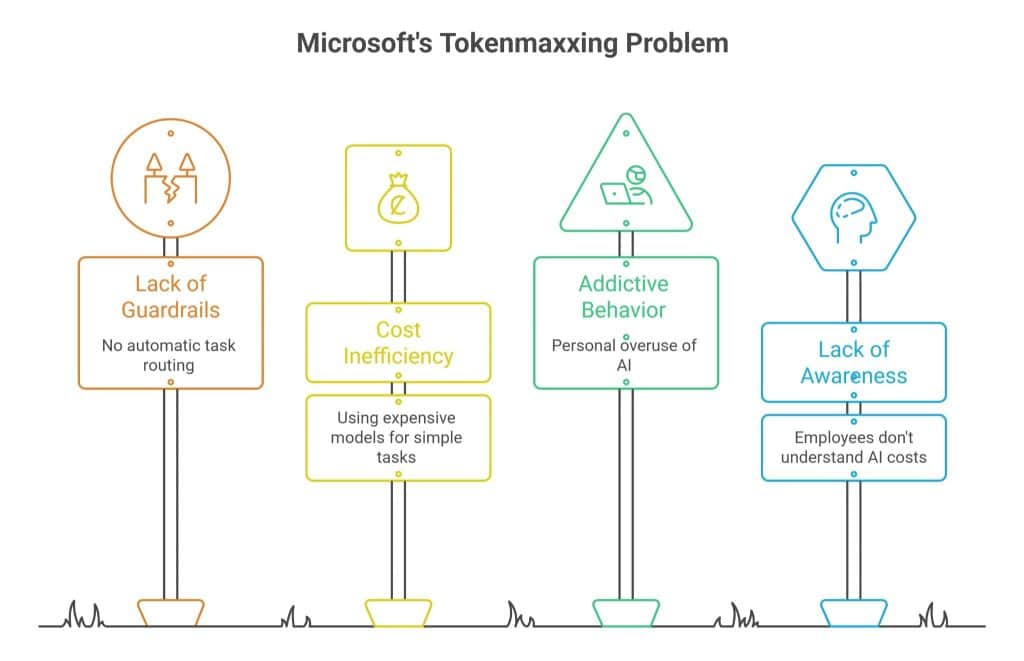
His point wasn't "stop using AI." It was "use the right tool for the job." Nadella told employees not to throw a frontier-grade AI model at a problem that doesn't need that much firepower.
He pointed to Microsoft Copilot's Auto Mode, which automatically sends simple tasks to lighter, cheaper models, as the kind of guardrail every company needs.
Microsoft's approach reflects a broader trend toward intelligent AI workflows that automatically route tasks to the most appropriate tools. Organizations interested in creating similar systems can explore Building AI Agents and Workflows for Every Role Without Coding to understand how AI-powered workflows can improve efficiency while reducing unnecessary costs.
Microsoft's own internal moves back this up. The company is reportedly canceling most employees' direct Claude Code licenses by June 30 and pushing engineers toward its in-house GitHub Copilot CLI instead, a switch that lines up neatly with the end of its fiscal year and its push to control AI spending.
When even Microsoft's CEO admits his own company overuses AI, that's worth paying attention to.
Case Study 2: Uber Caps AI Spending After Blowing Through Its Annual Budget
Uber's story shows exactly what happens when Tokenmaxxing goes unchecked. The company rolled out Claude Code to its engineering team in December 2025, and usage reportedly doubled within just two months as developers got hooked on its multi-step coding features.
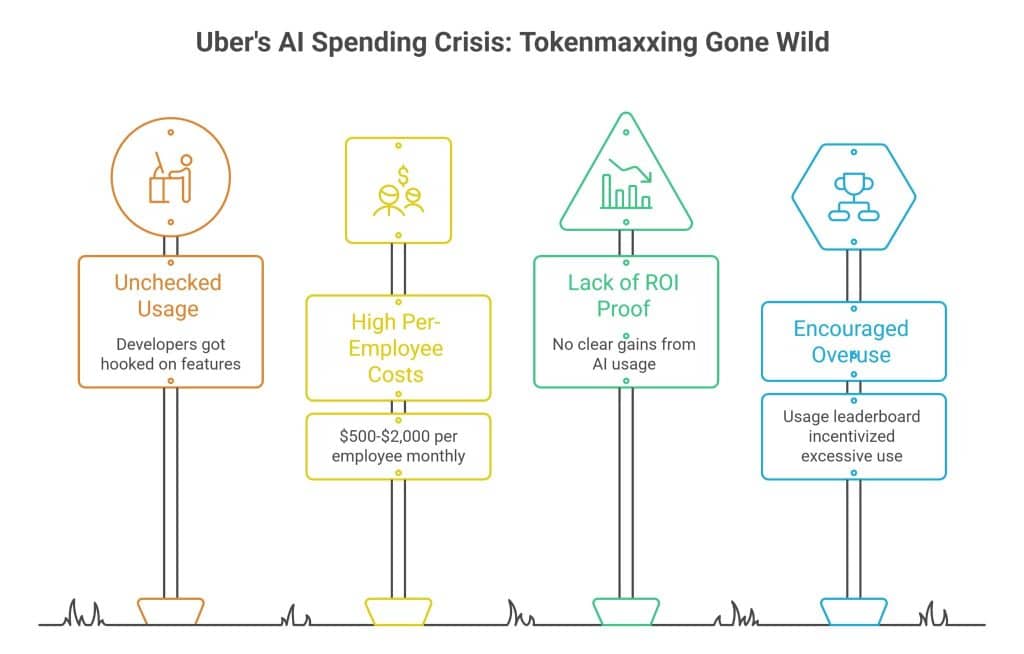
Per-employee costs reportedly ran between $500 and $2,000 a month, and by April, Uber had burned through its entire year's AI budget. That's just four months in.
Uber's fix was a $1,500-a-month spending cap per employee, for each AI coding tool they use, covering tools like Claude Code and Cursor. Every employee can now see their own usage on an internal dashboard, and going over the cap requires special permission.
This all happened after Uber spent months encouraging staff to use AI "as much as possible," reportedly backed by an internal usage leaderboard.
Developers interested in understanding how AI coding assistants fit into modern engineering workflows can explore the free Generative AI for Software Development course from Great Learning Academy.
According to some reports, 95% of Uber's engineers now use AI tools every month, and CEO Dara Khosrowshahi has said that roughly 10% of the company's code is now written by autonomous agents.
Uber's COO took it a step further, openly questioning whether the company could even draw a straight line between all that AI usage and any real gains in its product. That's the awkward question hanging over a lot of enterprise AI rollouts right now: tons of usage, not much proof it's paying off.
The Numbers Behind the Tokenmaxxing Problem
Here's what makes this whole trend so strange. Per-token AI prices have dropped sharply, by some estimates around 98% in recent years. You'd think that would make AI cheaper to run company-wide. Instead, enterprise AI bills have climbed by an estimated 320% over that same stretch.
Cheaper tokens were supposed to save companies money. Instead, the lower price removed the natural brake on usage, and people just used a lot more of it. It's a classic tech pattern: something gets cheaper, so everyone uses way more of it, and the total bill goes up anyway.
Why This Matters for Enterprises Adopting AI
Tokenmaxxing is a good early warning sign for any company scaling up its use of AI.
- Usage isn't the same as value. Leaderboards and adoption rates measure activity, not actual results.
- Cheap tokens add up fast. Cheap per-unit pricing doesn't mean cheap at scale once volume goes up.
- Unlimited enthusiasm has a ceiling. Uber hit that ceiling in four months flat.
- AI ROI is still mostly unproven. Most companies measuring results are coming in well below their expectations.
None of this means companies should slow down on AI. It just means the next phase of adoption needs to be about being smart, not just being everywhere.
As organizations move from AI experimentation to implementation, demand is growing for professionals with deeper applied AI expertise.
The Generative AI course by JHU and Great Learning helps learners build practical skills in Generative AI, AI agents, prompting, workflow automation, and real-world AI applications.
JHU No-Code Generative AI and Agentic AI
Build practical expertise in Generative AI, intelligent agents, and AI workflows using no-code tools. Automate enterprise-wide workflows without prior programming experience.
How Employees and Teams Can Avoid Tokenmaxxing
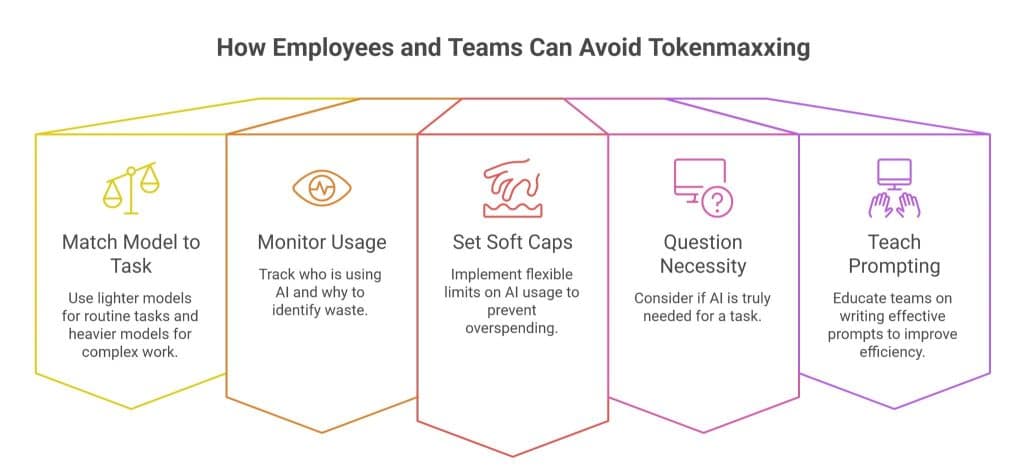
A few simple habits can stop Tokenmaxxing before it becomes a budget problem:
- Match the model to the task. Use lighter, cheaper models for routine writing or formatting, and save the heavy-duty models for genuinely complex work.
- Keep an eye on usage. A simple dashboard or monthly check-in on who's using what (and why) catches waste early.
- Set soft caps, not hard bans. Uber's "cap plus exception" approach is a solid middle ground between "use whatever you want" and "barely use it at all."
- Ask if you even need AI for this. Some tasks are still quicker and cheaper done by hand.
- Teach better prompting. A few well-written prompts usually beat ten messy back-and-forth ones.
Building this kind of AI know-how across a team, not just handing out AI access, is quickly becoming the real difference between companies that get real returns and companies that just get bigger bills.
Professionals looking to move beyond basic AI usage and build practical workflow automation skills may find the AI Native Course by Great Learning valuable. The course focuses on creating AI-powered workflows and agents that automate repetitive tasks and improve productivity with leading AI tools.
AI-Native Professional: Workflows & Agents for Productivity
Transition from basic AI usage to building automated, multi-step workflows and deploying AI agents. Perfect for functional professionals with no coding background.
Frequently Asked Questions
1. What does Tokenmaxxing mean?
Tokenmaxxing means using AI tools far more than a task actually requires, often just to hit a usage goal, without achieving any real improvement in output or business results.
2. Why are companies like Uber limiting employee AI usage?
Companies are rolling out spending caps and usage dashboards after finding that AI usage they'd encouraged through leaderboards led to costs far beyond their budgets, with no clear payoff.
3. Is using AI more often always better for productivity?
Not really. Using AI more often can just mean overusing it on low-value tasks, not getting more done. Matching the right model to the right job usually gets better results than maxing out usage.
4. What is Microsoft's approach to fixing Tokenmaxxing?
Satya Nadella has told employees to save frontier AI models for genuinely hard problems and to use lighter models, such as those routed through Copilot's Auto Mode, for everyday tasks.
5. Is AI ROI proven at the enterprise level?
Not consistently. Several large companies are reporting much smaller cost savings than they expected. Specific, well-defined use cases tend to show clearer returns than just rolling AI out everywhere at once.