
- What Is Generative AI in Sales?
- What Are AI Agents in Sales?
- Why Lead Qualification Is a Challenge
- How AI Agents Improve Lead Qualification
- How AI Agents Improve Sales Follow-Ups
- AI Agents vs Traditional Sales Automation
- Benefits of AI Agents for Sales Teams
- Limitations of AI Agents in Sales
- Best Practices for Using AI Agents in Sales
- The Future of AI-Powered Sales
- Conclusion
- Frequently Asked Questions
Sales teams have always faced the same challenge: too many leads, too little time. A typical sales representative spends a staggering two-thirds of their day on non-selling activities like qualifying prospects, sending follow-up emails, updating CRM records, and scheduling meetings.
According to Salesforce, this leaves reps spending only about 30% of their time actively selling. McKinsey estimates that while administrative tasks are essential, automating them can reclaim 15% to 20% of selling time, giving reps the critical bandwidth needed to build relationships, close deals, and drive pipeline velocity.
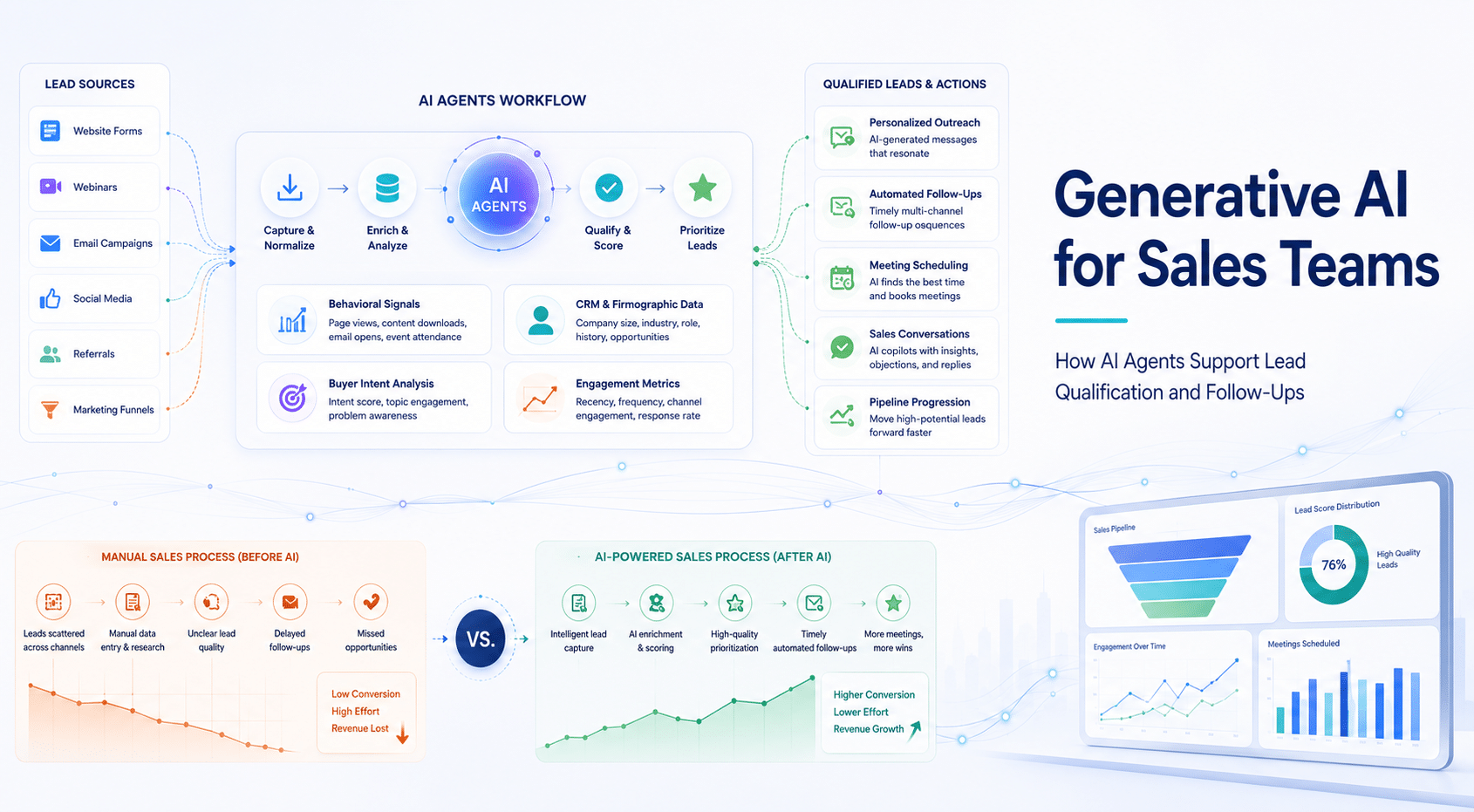
This is where Generative AI and AI agents are starting to change sales workflows. Instead of acting as simple productivity tools, modern AI agents can analyze incoming leads, qualify prospects, personalize outreach, schedule follow-ups, and assist sales teams throughout the customer journey.
As organizations increasingly adopt AI-powered sales tools, the focus is shifting from automation alone to smarter lead management and more effective customer engagement.
In this blog, we will explore how AI agents support lead qualification and follow-ups, the benefits they offer sales teams, and how businesses can use them effectively.
What Is Generative AI in Sales?
Generative AI in sales refers to AI systems that create sales emails, call summaries, follow-up messages, proposals, lead notes, and customer responses from sales and CRM data. Sales teams use it to save time on writing, personalization, research, and documentation.
What Are AI Agents in Sales?
AI agents are software systems that can perform tasks, make decisions based on predefined rules or data, and interact with users with minimal human intervention.
Unlike traditional automation tools that follow fixed workflows, AI agents can understand context, process natural language, analyze customer interactions, and determine appropriate next steps.
Those interested in building AI-powered workflows can explore the Microsoft Copilot Agentic AI course by Great Learning Academy.
In a sales environment, AI agents can:
- Evaluate incoming leads
- Score prospects based on predefined criteria
- Respond to common customer inquiries
- Generate personalized outreach messages
- Schedule meetings automatically
- Recommend next actions for sales representatives
- Track customer engagement across channels
This allows sales teams to focus on high-value conversations rather than repetitive administrative work.
Why Lead Qualification Is a Challenge
Lead qualification is one of the most important stages in the sales process.
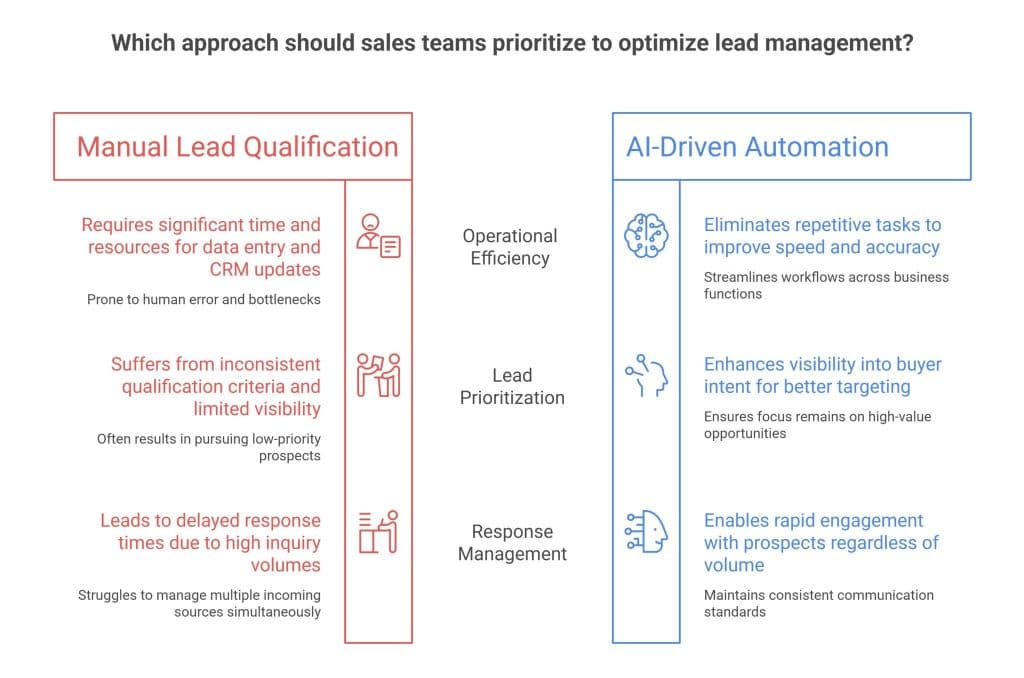
Sales teams often receive inquiries from multiple sources, including websites, marketing campaigns, referrals, webinars, and social media platforms. Not every lead is ready to buy, and pursuing unqualified prospects can waste valuable time and resources.
Professionals looking to improve lead acquisition and conversion strategies can explore the lead generation course by Great Learning Academy.
Common lead qualification challenges include:
- Large volumes of incoming leads
- Incomplete customer information
- Delayed response times
- Inconsistent qualification criteria
- Limited visibility into buyer intent
- Manual data entry and CRM updates
Many of these challenges are not unique to sales teams. Explore the blog How Automation and AI Are Transforming Business Operations to learn how automation helps eliminate repetitive tasks and improve efficiency across various business functions.
When these issues accumulate, sales teams may miss opportunities or spend excessive effort on low-priority prospects.
How AI Agents Improve Lead Qualification
1. Automated Lead Scoring
AI agents can evaluate leads using historical sales data, customer behavior, demographics, engagement patterns, and intent signals.
Instead of manually reviewing every inquiry, sales teams receive prioritized lead lists based on the likelihood of conversion.
For example, an AI agent can identify prospects who:
- Visited pricing pages multiple times
- Downloaded product resources
- Attended webinars
- Opened multiple email campaigns
- Requested product demonstrations
This helps sales representatives focus their efforts where they are most likely to generate results.
AI-driven lead prioritization is part of a broader shift toward personalized customer engagement. Explore the blog How AI and machine learning are revolutionizing customer experience to learn how AI is helping businesses deliver more personalized and effective customer interactions.
2. Real-Time Qualification Conversations
Modern AI agents can engage prospects through chat interfaces, websites, and messaging platforms.
Rather than asking a sales representative to conduct an initial screening call, the AI agent can gather information such as:
- Company size
- Industry
- Budget range
- Business challenges
- Purchase timeline
The collected information can then be automatically passed to the sales team, reducing qualification time and improving response speed.
3. CRM Data Enrichment
Incomplete customer records often create friction during the sales process.
AI agents can enrich lead profiles by collecting publicly available business information, analyzing customer interactions, and organizing data into CRM systems.
Professionals looking to strengthen their understanding of customer data and sales pipelines can explore Great Learning's free Customer Relationship Management course.
This provides sales teams with a more complete view of each prospect before initiating outreach.
4. Buyer Intent Detection
Not all leads show the same level of interest.
AI agents can analyze behavioral signals across websites, emails, content downloads, and conversations to identify high-intent prospects.
This allows organizations to prioritize leads that demonstrate stronger purchase intent and allocate resources more effectively.
How AI Agents Improve Sales Follow-Ups
Many deals are not lost because of product quality or pricing. They are lost because follow-ups happen too late or not at all.
Research consistently shows that timely follow-up significantly improves conversion rates, yet many sales teams struggle to maintain consistent engagement across hundreds of prospects.
AI agents help solve this problem.
1. Personalized Follow-Up Messages
AI agents can generate personalized emails and messages based on previous interactions.
Businesses looking to expand AI beyond sales outreach can also explore How to Solve Business Problems with ChatGPT, which covers practical business applications of conversational AI.
Instead of sending generic templates, sales teams can create follow-ups that reference:
- Previous conversations
- Customer interests
- Product discussions
- Downloaded resources
- Meeting outcomes
This helps maintain relevance and improve engagement.
For those interested in improving customer communication strategies, Great Learning's free Email Marketing course offers useful foundational concepts.
2. Automated Follow-Up Sequences
AI agents can automatically trigger follow-up campaigns based on customer behavior.
Examples include:
- Sending reminders after demo requests
- Sharing additional resources after webinars
- Re-engaging inactive prospects
- Following up after proposal submissions
This ensures prospects remain engaged throughout the sales cycle.
3 . Meeting Scheduling Assistance
Scheduling meetings often involves multiple emails and calendar coordination.
AI agents can identify available time slots, coordinate calendars, send invitations, and automatically manage rescheduling requests.
This reduces administrative workload and speeds up the sales process.
4 . Next-Best-Action Recommendations
AI agents can analyze customer interactions and recommend the most effective next step.
For example, an agent may suggest:
- Scheduling a product demonstration
- Sharing a case study
- Offering a free trial
- Escalating the lead to a senior representative
These recommendations help sales teams make more informed decisions.
AI Agents vs Traditional Sales Automation
| Area | Traditional Sales Automation | AI Sales Agents |
| Workflow | Follows fixed rules | Uses context and data to choose next steps |
| Lead scoring | Uses preset scoring rules | Updates scores using behavior, intent, and CRM signals |
| Follow-ups | Sends scheduled templates | Personalizes messages based on interaction history |
| CRM updates | Requires manual input or fixed triggers | Summarizes interactions and updates fields |
| Sales handoff | Based on form fills or static criteria | Based on fit, intent, urgency, and engagement |
Benefits of AI Agents for Sales Teams
AI agents help sales teams streamline workflows, improve efficiency, and focus more on revenue-generating activities. Some of the key benefits include:
- Faster response times: Engage prospects quickly through automated interactions and follow-ups.
- Improved lead prioritization: Identify high-intent leads based on customer behavior and engagement signals.
- Higher sales productivity: Automate repetitive tasks such as scheduling, CRM updates, and follow-up reminders.
- More personalized outreach: Generate tailored messages and recommendations based on prospect data.
- Better sales forecasting: Use AI-driven insights to track pipeline health and predict potential outcomes more accurately.
Learners can also explore Great Learning's free AI in Customer Relationship Management course to understand how AI enhances customer interactions and engagement.
Limitations of AI Agents in Sales
While AI agents can significantly improve sales operations, they work best when combined with human expertise. Some limitations include:
- Complex relationship building: Trust, negotiation, and consultative selling still require human interaction.
- Dependence on data quality: Incomplete or inaccurate CRM data can reduce the effectiveness of AI recommendations.
- Risk of over-automation: Excessive automation may make customer interactions feel less personal.
- Compliance and privacy concerns: Organizations must ensure AI usage aligns with data privacy regulations and internal policies.
- Need for ongoing oversight: AI outputs should be regularly monitored and refined to maintain accuracy and relevance.
Best Practices for Using AI Agents in Sales
To maximize value from AI agents, organizations should:
- Define clear lead qualification criteria.
- Keep CRM data clean and updated.
- Use AI for routine tasks while preserving human involvement in strategic conversations.
- Monitor AI recommendations regularly.
- Continuously refine workflows based on sales outcomes.
- Measure performance using business metrics rather than automation metrics alone.
The most successful sales teams use AI as a support system rather than a replacement for human expertise.
Professionals who want to move beyond basic AI usage can explore the AI Native Course by Great Learning.
How this program helps: Learners gain hands-on experience building autonomous AI agents and practical AI-driven workflows that automate repetitive work, improve efficiency, and enhance day-to-day productivity.
AI-Native Professional: Workflows & Agents for Productivity
Transition from basic AI usage to building automated, multi-step workflows and deploying AI agents. Perfect for functional professionals with no coding background.
The Future of AI-Powered Sales
The role of AI in sales is on the brink of exponential growth, poised to take over the heavy lifting of top-of-funnel pipeline generation.
Future systems may be able to:
- Manage multi-channel prospect interactions
- Conduct deeper customer research automatically
- Generate highly personalized outreach at scale
- Coordinate complex sales workflows
- Provide predictive insights throughout the customer journey
As these capabilities mature, sales professionals will increasingly shift from administrative work toward relationship management, strategy, and consultative selling.
Conclusion
Generative AI is transforming how sales teams qualify leads and manage follow-ups. Professionals seeking a broader understanding of modern AI technologies can explore the Generative AI training course by Great Learning Academy.
Learn about Generative AI and how to apply it for creating art, generating content, and exploring endless possibilities. Perfect for anyone eager to dive into the future of technology.
AI agents can analyze prospects, automate repetitive tasks, personalize outreach, and help sales representatives focus on the opportunities that matter most.
By improving lead qualification, accelerating response times, and supporting consistent follow-up, these systems can enhance both productivity and customer experience.
However, the most effective sales organizations recognize that AI works best when combined with human expertise. Rather than replacing sales professionals, AI agents act as intelligent assistants that help teams work smarter, engage prospects more effectively, and drive better business outcomes.
Frequently Asked Questions
1. How is Generative AI used in sales?
Generative AI helps sales teams create personalized emails, qualify leads, summarize customer interactions, automate follow-ups, and generate sales content more efficiently.
2. What are AI agents in sales?
AI agents are intelligent systems that can perform sales-related tasks such as lead scoring, customer engagement, scheduling meetings, and recommending next actions with minimal human intervention.
3. Can AI agents replace sales representatives?
No. AI agents can automate repetitive tasks and provide insights, but relationship building, negotiation, and strategic decision-making still require human expertise.
4. How do AI agents improve lead qualification?
They analyze customer data, engagement signals, demographics, and buying intent to identify and prioritize the leads most likely to convert.
5. What are the benefits of using AI for sales follow-ups?
AI helps sales teams maintain consistent communication, personalize outreach, automate reminders, improve response times, and reduce administrative workload.
6. Can AI agents generate sales emails and follow-up messages?
Yes. AI agents can create personalized sales emails, follow-up messages, and outreach sequences based on customer data, previous interactions, and engagement history. This helps sales teams maintain consistent communication while reducing manual effort.
7. What types of sales teams benefit most from AI agents?
AI agents can benefit a wide range of sales teams, including B2B sales, SaaS sales, inside sales, customer success, and business development teams. They are particularly useful for organizations that handle large volumes of leads and need to scale qualification and follow-up processes efficiently.