
- Featured AI Projects in the Texas McCombs AI and Machine Learning Program
- Project 1: Build a Wind Energy Equipment Failure Prediction Model Using Machine Learning
- Project 2: Create a Financial Report Insight Assistant with Retrieval-Augmented Generation (RAG)
- Project 3: Automate Last-Mile Delivery Exception Handling with Agentic AI
- Project 4: Build an AI-Powered Energy Intelligence Assistant
- Key AI Skills You'll Build Across These Projects
- Who Should Consider This AI and Machine Learning Program?
- Conclusion
- Frequently Asked Questions
Learning AI goes beyond algorithms and frameworks. It also means applying them to solve real business challenges.
Employers increasingly value professionals who can build AI solutions that improve decision-making, automate workflows, and generate measurable business outcomes.
The Post Graduate Program in Artificial Intelligence and Machine Learning: Business Applications from Texas McCombs reflects this hands-on approach through four sample projects.
These projects cover predictive maintenance, financial document intelligence, Agentic AI, and energy analytics, giving learners hands-on exposure to machine learning, Retrieval-Augmented Generation (RAG), multi-agent systems, and AI deployment.
Together, they show how AI technologies can be applied to solve practical challenges across industries.
This article explores each featured project, the technologies involved, and the skills learners develop throughout the program.
Featured AI Projects in the Texas McCombs AI and Machine Learning Program
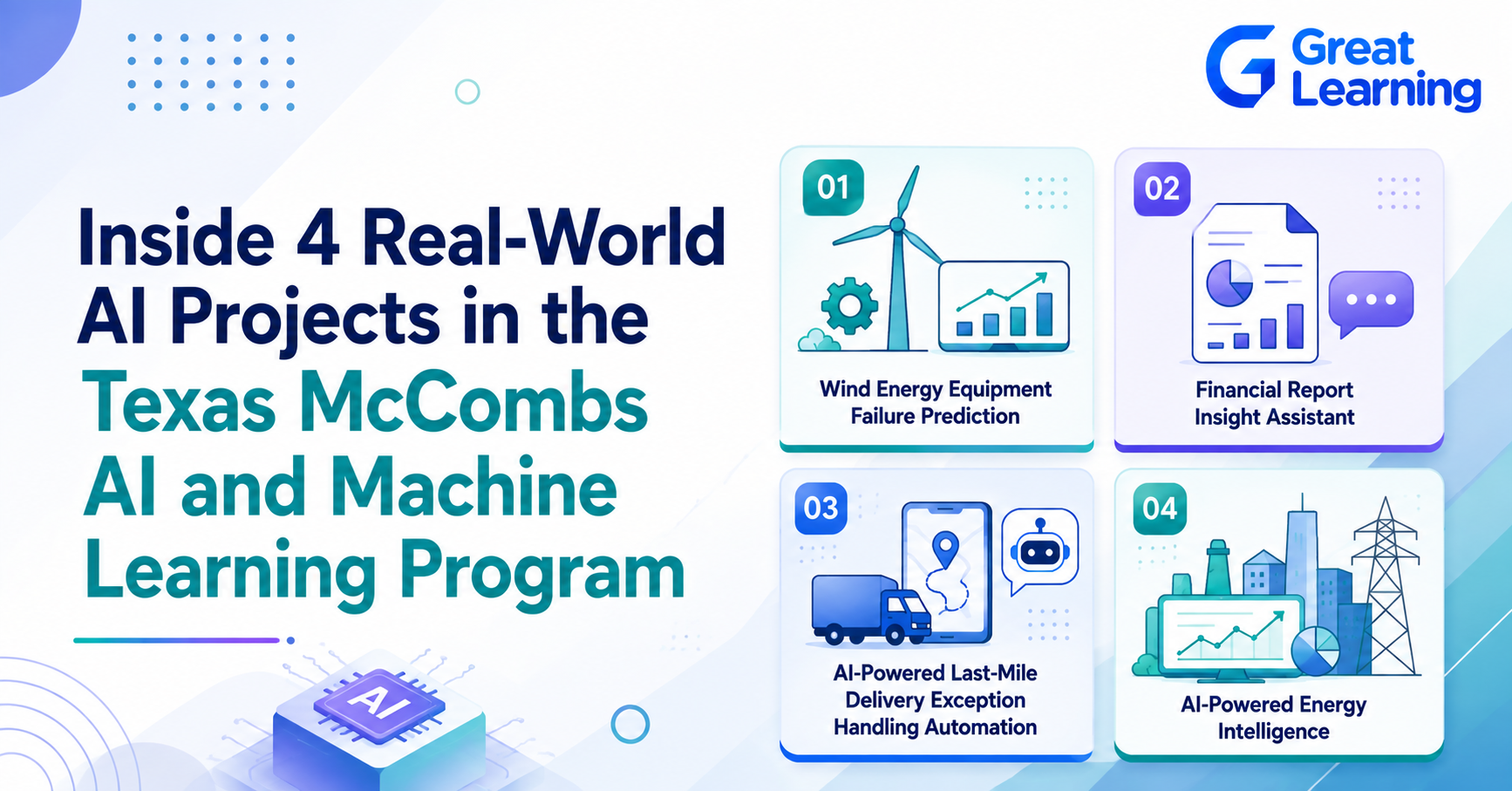
The program features four sample projects, each designed around a different business use case and AI capability. Together, they provide exposure to predictive modeling, Generative AI, autonomous agents, and deployed AI systems.
| Project | AI Focus | Business Application |
| Wind Energy Equipment Failure Prediction | Machine Learning & Neural Networks | Predictive maintenance |
| Financial Report Insight Assistant | Retrieval-Augmented Generation (RAG) | Financial document analysis |
| AI-Powered Last-Mile Delivery Exception Handling Automation | Agentic AI & Multi-Agent Systems | Logistics automation |
| AI-Powered Energy Intelligence | RAG & AI Deployment | Energy research and decision support |
Rather than focusing on a single domain, these projects introduce learners to AI applications across energy, finance, logistics, and enterprise operations.
Project 1: Build a Wind Energy Equipment Failure Prediction Model Using Machine Learning
Unexpected equipment failures can lead to costly downtime and maintenance delays in wind energy operations.
This project focuses on using machine learning to identify early signs of equipment failure, enabling maintenance teams to take preventive action before issues become critical.
What You'll Build
Learners analyze equipment-health data and develop machine learning and neural network models capable of predicting potential failures.
The project covers the complete machine learning workflow—from exploratory data analysis and data preprocessing to model training, evaluation, and regularization techniques that help reduce overfitting.
Key Technologies
Learners work with widely used machine learning tools, including tools, including:
- Scikit-learn
- TensorFlow
- Keras
These frameworks support model development, experimentation, and performance evaluation in predictive maintenance use cases.
Skills You'll Develop
By completing this project, learners gain practical experience in:
- Data preprocessing and feature exploration
- Machine learning model development
- Neural network development
- Model comparison and evaluation
- Regularization techniques
- Translating predictive insights into business decisions
The project aligns with the program's Predictive Modeling with Machine Learning and Neural Networks module, helping learners understand how AI can improve operational efficiency in industrial environments.
Project 2: Create a Financial Report Insight Assistant with Retrieval-Augmented Generation (RAG)
Financial analysts often spend significant time searching through lengthy annual reports for specific information about a company's performance, risks, and strategy.
This project demonstrates how Retrieval-Augmented Generation (RAG) can streamline that process by retrieving relevant information before generating responses.
What You'll Build
Learners build an AI-powered financial assistant capable of searching large financial documents, retrieving the most relevant content, and generating context-aware answers.
Unlike a standard chatbot, the assistant grounds its responses using retrieved document passages, improving accuracy and reducing unsupported outputs.
Key Technologies
The project introduces several core Generative AI technologies, including:
- Langchain
- Hugging Face
- OpenAI API
- Vector databases
- Retrieval-Augmented Generation (RAG)
- RAG Evaluation
Together, these tools support semantic search, document retrieval, and grounded response generation for enterprise knowledge systems.
Skills You'll Develop
Through this project, learners gain experience with:
- Prompt engineering
- Document processing
- Semantic retrieval
- Vector database concepts
- Large language model workflows
- Retrieval-Augmented Generation
- Generative AI evaluation
These skills align with the program's Generative AI for Natural Language Processing module and reflect common enterprise use cases where organizations need AI systems to analyze large volumes of business documents efficiently.
Project 3: Automate Last-Mile Delivery Exception Handling with Agentic AI
Delivery operations often encounter exceptions such as incorrect addresses, failed deliveries, damaged packages, or restricted access.
Resolving these issues typically requires reviewing company policies, determining the next course of action, communicating with customers, and escalating complex cases.
This project demonstrates how Agentic AI can automate these workflows while keeping humans involved in critical decisions.
What You'll Build
Learners develop a multi-agent system that can:
- Detect delivery exceptions from operational logs
- Apply policy-based reasoning to recommend actions
- Generate customer communications
- Escalate complex cases for human review
- Maintain an auditable record of every decision
The project introduces LangGraph to build stateful AI workflows and demonstrates how human-in-the-loop controls improve transparency and reliability in enterprise AI systems.
Key Technologies
The project includes:
- LangGraph
- LangChain
- LangSmith
- OpenAI API
- Multi-agent systems
- Human-in-the-loop evaluation
Learners use these technologies to explore how AI agents collaborate, use external tools, and support business workflows, use external tools, and support business workflows while allowing human oversight when required.
Skills You'll Develop
Through this project, learners gain experience with:
- Multi-agent system design
- Agentic workflow orchestration
- Policy-based reasoning
- Human-in-the-loop evaluation
- AI-powered workflow automation
- Customer communication generation
These skills align with the program's Agentic AI for Automation module and reflect common enterprise use cases where organizations need AI agents to automate complex workflows while maintaining human oversight and auditability.
Project 4: Build an AI-Powered Energy Intelligence Assistant
Energy analysts often review extensive technical reports to understand market trends, technologies, regulations, and investment opportunities.
Manually extracting insights from multiple reports is time-consuming, making AI-assisted research increasingly valuable.
What You'll Build
In this project, learners build and deploy a RAG-based energy intelligence assistant that retrieves information from technical energy reports and generates source-grounded insights.
The assistant is designed to support faster research and informed decision-making for energy investment teams.
Key Technologies
Learners work with:
- Large language models
- Retrieval-Augmented Generation (RAG)
- Vector databases
- OpenAI API
- AI deployment concepts
The project also introduces key deployment considerations, including such as integrating AI applications into real-world environments and evaluating their performance.
Skills You'll Develop
Through this project, learners gain experience with:
- Large language model workflows
- Document processing
- Semantic retrieval
- Vector database concepts
- Retrieval-Augmented Generation
- Grounded and cited response generation
- AI-driven decision support
These skills align with the program's Generative AI for Natural Language Processing and Deploying AI Solutions modules and reflect common enterprise use cases where organizations use AI to analyze technical documents and generate actionable insights for research and decision-making.
Key AI Skills You'll Build Across These Projects
While each project focuses on a different business problem, together they provide exposure to the complete AI application lifecycle.
Learners progress from predictive machine learning to Generative AI, Agentic AI, and deployment, building skills that are relevant across multiple industries.
By completing these projects, learners gain experience in:
- Python-based AI development
- Machine learning and neural networks
- Retrieval-Augmented Generation (RAG)
- Prompt engineering
- Vector databases
- Multi-agent system orchestration
- Human-in-the-loop AI evaluation
- AI deployment fundamentals
- Business problem-solving using AI
The program also combines these projects with recorded lessons, faculty masterclasses, mentorship, project feedback, and a shareable e-portfolio, helping learners demonstrate practical AI capabilities beyond theoretical knowledge.
Post Graduate Program in AI & Machine Learning: Business Applications
Master in-demand AI and machine learning skills with this executive-level AI course—designed to transform professionals into strategic tech leaders.
Who Should Consider This AI and Machine Learning Program?
The Artificial Intelligence course by Texas McCombs is designed for professionals looking to build, deploy, and lead AI-powered solutions across business functions. According to the program brochure, it is suitable for:
- Business leaders and functional heads with deep domain expertise seeking to deploy scalable AI systems or lead teams building them.
- Professionals in tech-adjacent roles who want to build a strong foundation in AI to successfully transition into a high-growth AI and Machine Learning career.
- Tech practitioners and technical leaders who want to strengthen their ability to build and deploy AI-powered solutions.
No programming experience is required, as the program includes foundational Python programming. Applicants must meet the specified academic eligibility criteria.
Conclusion
The four featured projects in the Texas McCombs AI and Machine Learning program demonstrate how modern AI is applied to solve practical business problems across predictive analytics, document intelligence, logistics automation, and energy research.
Together, they provide hands-on exposure to machine learning, RAG, Agentic AI, and deployment while helping learners build a portfolio that showcases real-world AI implementation skills.
For the latest details on project offerings, duration, and curriculum, verify the information with the current program documentation before applying.
Frequently Asked Questions
1. How many hands-on projects are included?
The program includes 4 hands-on projects and 30+ real-world case studies covering a range of AI and Machine Learning applications.
2. Which industries do these projects cover?
The hands-on projects cover use cases across energy, finance, and operations, including predictive maintenance, financial document analysis, logistics automation, and energy intelligence.
3. Does the program include Agentic AI?
Yes. The program includes a dedicated Agentic AI for Automation module and a hands-on project focused on AI-powered last-mile delivery exception handling using multi-agent systems and human-in-the-loop evaluation.
4. Do learners work on Generative AI projects?
Yes. The program includes hands-on projects involving Generative AI and Retrieval-Augmented Generation (RAG), including the Financial Report Insight Assistant and AI-Powered Energy Intelligence projects.
5. Is prior programming experience required?
No. Prior programming experience is not required. The program includes foundational Python programming to help learners build the skills needed for AI and Machine Learning applications.