

- Why Data Science Matters for Reliable AI Systems
- How Data Quality Affects AI Reliability
- How Applied Data Science Helps Build and Evaluate AI Models
- Why Statistical Reasoning Is Essential for Reliable AI Decisions
- How Applied Data Science Supports Modern AI Systems
- How Professionals Can Evaluate AI Systems for Reliability
- How the MIT Professional Education Applied AI and Data Science Program Builds These Skills
- Final Thoughts
- Frequently Asked Questions
Building reliable AI systems requires more than selecting a powerful model. Reliable AI systems are AI applications that produce consistent, accurate, and dependable results while handling uncertainty, changing data, and potential failure cases appropriately.
Applied data science is the practical use of data analysis, statistical analysis, machine learning, and related methods to solve real-world problems and support data-driven decisions.
In AI development, it helps professionals prepare data, identify patterns, build models, evaluate performance, and improve system outcomes.
The importance of this foundation is becoming clearer as organizations scale AI. McKinsey's 2026 research found that more than two-thirds of high-performing companies identify data as the primary obstacle to scaling AI.
A practical AI reliability lifecycle can be viewed as:
Data → Analysis → Model Development → Evaluation → Monitoring → Improvement
For example, a company developing an AI model to predict customer churn may have a technically strong model but still produce unreliable predictions if customer records are incomplete, outdated, or poorly represented.
Applied data science helps identify these issues and evaluate whether the model performs reliably across relevant customer groups.
Why Data Science Matters for Reliable AI Systems
The role of data science in building AI systems begins with understanding the data used for training, testing, and evaluation. Poor-quality, incomplete, outdated, or biased data can introduce errors that affect model performance, even when the underlying algorithm is technically sound.
Applied data science helps professionals examine datasets, identify patterns, address inconsistencies, and determine whether the available data is suitable for the problem. Statistical reasoning also helps distinguish meaningful patterns from noise and understand uncertainty in results.
This becomes especially important as organizations move AI projects toward production. Informatica's 2026 research found that 57% of data leaders identified data reliability as a key barrier to moving AI projects from pilots to production.
For example, if an AI system is trained to forecast product demand using inconsistent historical sales data, its predictions may appear accurate during testing but perform poorly when deployed. Data science helps uncover such problems before they affect business decisions.
Therefore, data science is not simply a step before model development. It provides the methods needed to understand data, evaluate evidence, and build more reliable AI systems.
How Data Quality Affects AI Reliability
Data quality directly influences how an AI system performs. Factors such as accuracy, completeness, consistency, timeliness, and fairness determine whether AI models produce dependable results.
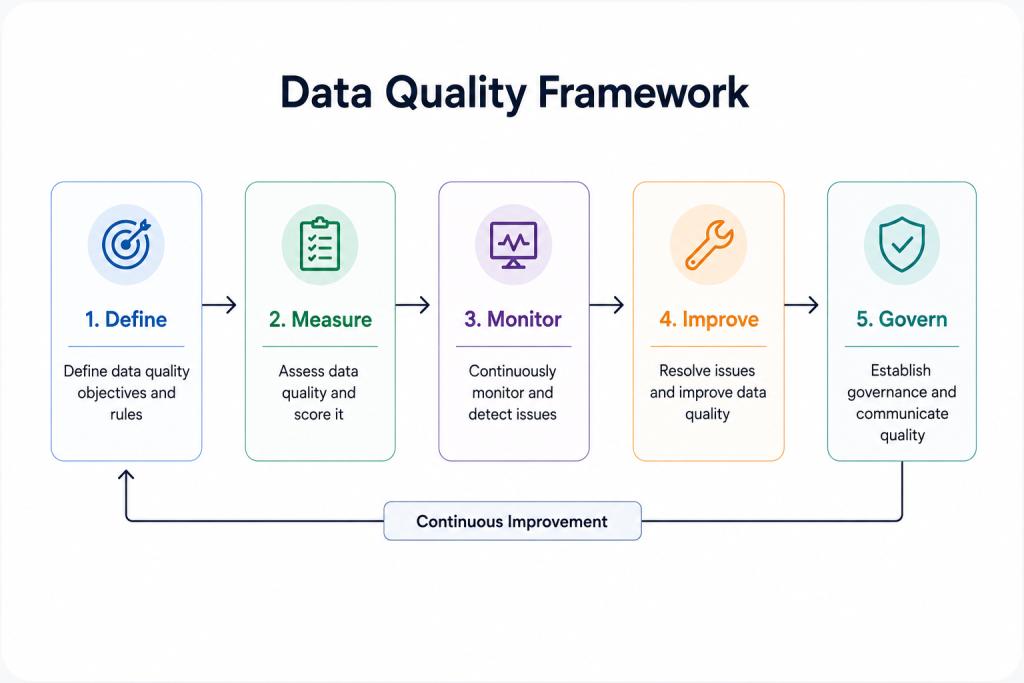
Missing values, outliers, inconsistent records, outdated information, and biased datasets can introduce errors that affect predictions and downstream decisions.
Applied data science helps address these issues through data exploration, cleaning, validation, and transformation.
Professionals can identify unusual observations, examine missing information, and assess whether the dataset represents the problem and users the AI system is intended to serve.
The challenge becomes greater when AI systems depend on real-time or continuously changing data.
Confluent's 2026 Data Streaming Report found that 66% of global IT leaders identified uncertainty around data lineage, timeliness, and data quality as a challenge when scaling AI.
Data preparation should therefore be treated as an ongoing part of AI development rather than a one-time preliminary task.
Reliable inputs provide a stronger foundation for reliable outputs, helping teams build AI systems that are more consistent and suitable for real-world use.
How Applied Data Science Helps Build and Evaluate AI Models
Applied data science helps professionals move from prepared data to models that can be tested and improved.
Exploratory data analysis can reveal important patterns, while feature selection and preparation help determine which information should contribute to a model.
Machine learning methods can then be applied based on the problem and available data. Developing a model is only one stage of building a reliable AI system.
Evaluation helps determine whether the model performs consistently when applied to new and unseen data. Professionals also need to evaluate how well it performs on data it has not seen before.
Techniques such as cross-validation, error analysis, and appropriate performance metrics can help identify overfitting and other weaknesses.
For classification problems, precision, recall, and F1-score may be useful, while regression tasks can use metrics such as MAE or RMSE.
Resources to read: F1 Score in Machine Learning: Formula, Precision and Recall
For example, a model predicting customer churn may show high overall accuracy but perform poorly for a smaller customer segment. Analyzing errors and evaluating performance across relevant groups can reveal this limitation.
This process helps answer a critical question: does the model perform reliably beyond the data used to develop it?
Why Statistical Reasoning Is Essential for Reliable AI Decisions
Statistical reasoning helps professionals determine whether patterns in data represent meaningful signals and understand the uncertainty behind AI-generated results. This helps teams assess how much confidence they should place in AI predictions before using them for decisions.
This matters because a model can produce a prediction without that prediction being equally reliable in every situation.
Techniques such as hypothesis testing, confidence intervals, correlation analysis, and statistical validation can provide additional context when analyzing data and evaluating model behavior.
For example, a business may observe that customers who receive a particular offer have higher conversion rates. Statistical analysis helps determine whether the difference is linked to the offer itself or whether other factors, such as customer segments or seasonal changes, influenced the result.
Statistical analysis can help determine whether the observed difference represents a meaningful relationship or could simply be the result of random variation.
Statistical reasoning can also help professionals compare models and assess whether changes in performance are meaningful. This supports better decisions about model selection, testing, and deployment.
Ultimately, how statistical analysis supports AI goes beyond calculating numbers. It helps professionals understand what the evidence shows, how much uncertainty exists, and how confidently an AI result should be used for decision-making.
How Applied Data Science Supports Modern AI Systems
Applied data science continues to play a key role as AI expands beyond traditional machine learning into deep learning, recommendation systems, forecasting, Generative AI, Retrieval-Augmented Generation (RAG), and Agentic AI.
Across these applications, data science supports data preparation, pattern discovery, evaluation, and continuous improvement.
For example, a recommendation system can analyze customer behavior to personalize product suggestions, while forecasting models can use historical sales data to estimate future demand.
A RAG application depends on relevant and reliable information sources to generate grounded responses, while an Agentic AI system may use business data to determine which tools or actions are appropriate.
These applications still depend on data for training, retrieval, evaluation, and continuous improvement.
Data science helps professionals prepare relevant datasets, identify patterns, measure performance, and evaluate whether outputs meet the requirements of a particular application.
This becomes increasingly important as AI moves toward real-time applications. Confluent's 2026 research found that 72% of global IT leaders say insufficient real-time data infrastructure is stalling their efforts to scale AI.
As systems become more autonomous, data science helps maintain the connection between data, system behavior, evaluation, and real-world outcomes.
How Professionals Can Evaluate AI Systems for Reliability
Evaluating AI reliability requires more than checking whether a model produces accurate outputs. Professionals also need to understand how the system behaves with unseen data, unexpected inputs, edge cases, and changing conditions.
AI evaluation can include accuracy, robustness, bias assessment, fairness checks, explainability, and failure analysis.
Accuracy measures how well the system performs, robustness tests how it handles unexpected conditions, fairness checks identify unequal outcomes, explainability helps understand AI decisions, and failure analysis reveals where systems need improvement.
Trust is also an important part of reliability. Continuous evaluation can help identify changes in performance, emerging failure patterns, or shifts in underlying data.
Teams can then investigate these issues and determine whether the model or system needs adjustment.
The goal is to establish a continuous cycle of testing, monitoring, analysis, and improvement, helping professionals determine not only whether an AI system works, but whether it remains reliable as conditions change.
How the MIT Professional Education Applied AI and Data Science Program Builds These Skills
The AI and Data Science course by MIT Professional Education combines data science foundations with modern AI concepts, helping professionals develop skills across the AI development lifecycle.
MIT Professional Education's Data Science Course
Gain the expertise top companies seek and open doors to Data Science jobs.
The curriculum covers statistical analysis, data quality, machine learning, deep learning, recommendation systems, Generative AI, and Agentic AI. It also introduces evaluation approaches and metrics for assessing AI system performance.
Through real-world case studies, projects, and a capstone, professionals can apply these concepts to practical problems rather than learning them only as theoretical concepts.
The program also covers evaluation methods for modern AI applications, including measures such as tool accuracy, ROUGE, BERTScore, and LLM-as-a-Judge. This provides exposure to different approaches for assessing AI outputs based on specific applications and use cases.
This program is designed for professionals looking to build strong expertise in Data Science, Machine Learning, modern AI applications, Agentic AI, and AI evaluation methods, enabling them to apply AI effectively to real-world business and technical challenges.
Overall, the program connects data science, model development, AI evaluation, and modern AI applications, providing professionals with a broader foundation for building and assessing reliable AI systems.
Final Thoughts
Reliable AI does not begin with the model. It begins with understanding the data, applying sound statistical reasoning, evaluating model performance, and continuously monitoring the system.
Applied data science brings these practices together, helping professionals identify data problems, build appropriate models, measure uncertainty, and evaluate AI systems against real-world requirements.
The AI and Data Science course by MIT Professional Education can help professionals develop these capabilities through its coverage of data science, machine learning, deep learning, Generative AI, Agentic AI, and AI evaluation.
Ultimately, using data science to build reliable AI means creating a continuous process of:
Data analysis → Model development → Evaluation → Monitoring → Improvement
Frequently Asked Questions
1. What is applied data science in AI?
Applied data science involves using data analysis, statistics, machine learning, and related techniques to solve practical problems. In AI, it helps professionals prepare data, build models, evaluate results, and improve system performance.
2. How does data science improve AI reliability?
Data science improves AI reliability by addressing data quality, model performance, statistical uncertainty, and evaluation. These practices help identify problems before and after an AI system is deployed.
3. Why is data quality important for AI systems?
AI models learn from data, so missing, inconsistent, outdated, or biased data can affect their outputs. Preparing and validating data provides a stronger foundation for reliable AI systems.
4. How does statistical analysis support AI?
Statistical analysis helps professionals understand patterns, uncertainty, variation, and relationships in data. Techniques such as hypothesis testing and confidence intervals can provide additional context when evaluating AI results.
5. How can AI models be evaluated for reliability?
Models can be evaluated using appropriate performance metrics, cross-validation, error analysis, robustness testing, bias assessment, and unseen data. Continuous monitoring can also identify performance changes after deployment.
6. What skills are needed to build reliable AI systems?
Professionals can benefit from skills in data preparation, statistical analysis, machine learning, model evaluation, data quality, AI evaluation, and monitoring. Knowledge of Generative AI and Agentic AI can also help when working with modern AI systems.
7. Which AI and Data Science course can help professionals build these skills?
The AI and Data Science course by MIT Professional Education covers data science and statistical foundations, machine learning, deep learning, Generative AI, Agentic AI, and AI evaluation. It also includes practical projects and a capstone focused on applying these concepts to real-world problems.
8. What makes an AI system reliable?
A reliable AI system produces consistent and trustworthy outputs across different conditions. Reliability depends on factors such as data quality, model evaluation, monitoring, fairness, explainability, and continuous improvement.
9. How does data science support Generative AI systems?
Data science supports Generative AI by preparing quality data, evaluating generated outputs, measuring performance, and improving system reliability. These practices help ensure AI responses are relevant, accurate, and useful.