
- What Are Smaller Models in Multi-Agent Systems?
- Why Smaller Models Are Becoming Popular for Multi-Agent Systems
- How Smaller Models Improve Multi-Agent System Performance
- When Large Models Still Outperform Smaller Models
- Cost vs Performance: Choosing the Right Model for Multi-Agent Systems
- How to Measure the Cost and Speed of a Multi-Agent System
- Best Practices for Building Efficient Multi-Agent Systems
- Challenges of Using Smaller Models in Multi-Agent Architectures
- How Professionals Can Learn to Build Production-Ready Multi-Agent Systems
- Final Thoughts
- Frequently Asked Questions
As organizations deploy more AI agents across business workflows, improving performance without increasing infrastructure costs has become a key challenge.
According to McKinsey's State of AI 2025 report, 62% of organizations are already experimenting with AI agents, making efficient multi-agent system design a growing priority.
As adoption increases, organizations are exploring whether smaller models in multi-agent systems can deliver faster responses and lower costs without sacrificing performance.
This article explains how smaller models fit into multi-agent architectures, where they work best, and the trade-offs to consider when building scalable, production-ready AI systems.
What Are Smaller Models in Multi-Agent Systems?
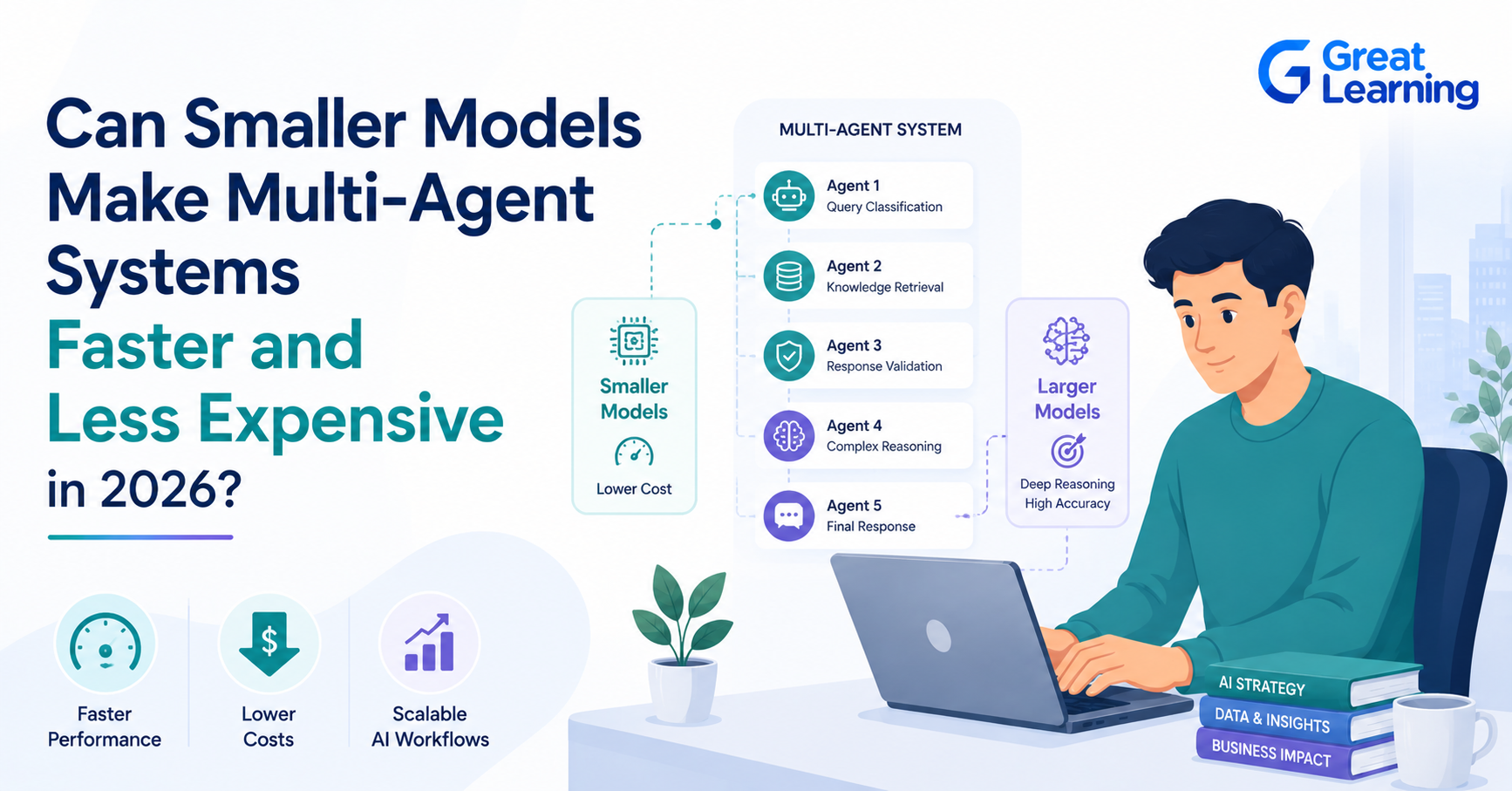
Smaller models in multi-agent systems are lightweight language models assigned to specialized tasks, enabling faster execution and lower costs without relying on a single large model for every decision.
A multi-agent system consists of multiple AI agents working together to complete a workflow. Each agent performs a specific role, such as retrieving information, summarizing documents, validating outputs, or interacting with external tools.
Rather than assigning every task to a high-capacity model, organizations increasingly use smaller models for predictable or repetitive tasks while reserving larger models for complex reasoning and decision-making.
For example, a customer support workflow might include:
| AI Agent | Recommended Model Type |
| Query Classification | Small model |
| Knowledge Retrieval | Small model |
| Response Validation | Small model |
| Complex Reasoning | Large model |
| Final Response Generation | Large model |
This hybrid approach allows organizations to optimize performance without sacrificing response quality.
Why Smaller Models Are Becoming Popular for Multi-Agent Systems
Smaller models are gaining popularity because they offer faster inference, lower operational costs, and greater scalability for specialized AI tasks.
Running every request through a frontier language model can quickly become expensive, particularly in enterprise environments where thousands of AI interactions occur each day.
Smaller models provide an efficient alternative for tasks that do not require deep reasoning or extensive contextual understanding.
They are particularly effective for:
- Intent classification
- Data extraction
- Content routing
- Information retrieval
- Tool selection
- Output formatting
- Workflow orchestration
For instance, an AI-powered document processing system does not need a large model simply to identify invoice numbers or extract dates from forms. A smaller model can complete these tasks quickly, allowing the larger model to focus on more complex reasoning later in the workflow.
This task-specific approach improves overall system efficiency while helping organizations manage infrastructure costs more effectively.
How Smaller Models Improve Multi-Agent System Performance
Assigning specialized tasks to smaller models reduces latency, improves resource utilization, and allows multi-agent systems to scale more efficiently.
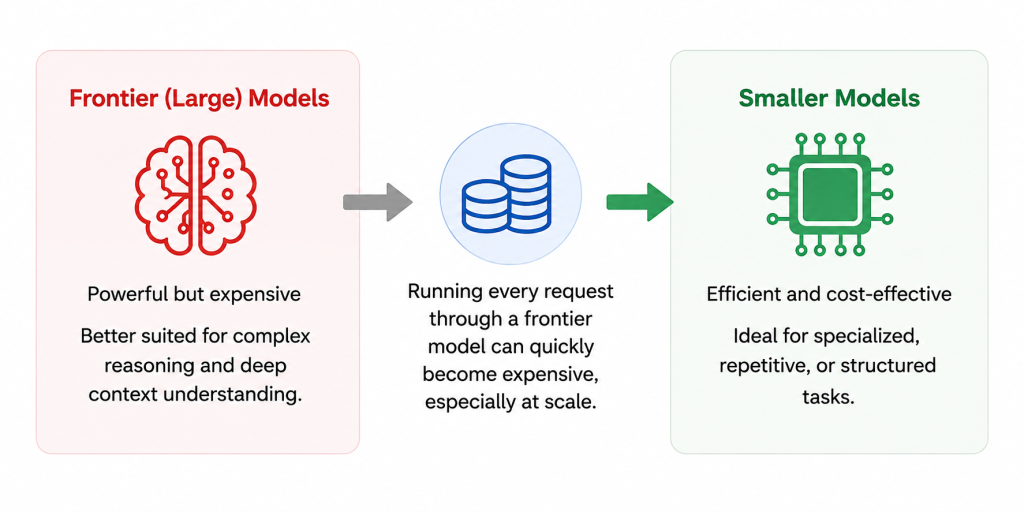
One of the biggest advantages of multi-agent architectures is that different agents can use different models based on the complexity of their responsibilities.
This enables organizations to balance speed, accuracy, and cost rather than applying the same model to every task.
Smaller models improve performance in several ways:
| Benefit | Business Impact |
| Lower latency | Faster response times |
| Reduced inference costs | Lower operational expenses |
| Higher throughput | Support more concurrent users |
| Better resource allocation | Reserve larger models for reasoning |
| Improved scalability | Handle enterprise workloads efficiently |
Consider an AI research assistant that analyzes hundreds of documents. Smaller models can retrieve, classify, and summarize relevant content before passing only the most important information to a larger model for synthesis. This layered approach reduces unnecessary computation while maintaining high-quality outputs.
By matching model size to task complexity, organizations can build AI systems that are both responsive and cost-effective.
When Large Models Still Outperform Smaller Models
Despite their advantages, smaller models are not suitable for every AI task. Large language models remain essential for complex reasoning, long-context understanding, and nuanced decision-making.
Tasks involving strategic planning, advanced coding, multi-step reasoning, or domain-specific analysis often require the broader knowledge and reasoning capabilities of larger models.
Large models are generally better suited for:
- Complex business analysis
- Long-context document understanding
- Strategic planning
- Multi-step reasoning
- Advanced code generation
- Creative content generation
- Scientific and legal analysis
For example, while a smaller model can classify customer support requests, resolving a complex technical issue that requires interpreting multiple knowledge sources and generating a detailed solution may still benefit from a larger model.
The most effective multi-agent systems combine both model types, assigning each task to the model best suited for its complexity rather than relying exclusively on either small or large models.
Cost vs Performance: Choosing the Right Model for Multi-Agent Systems
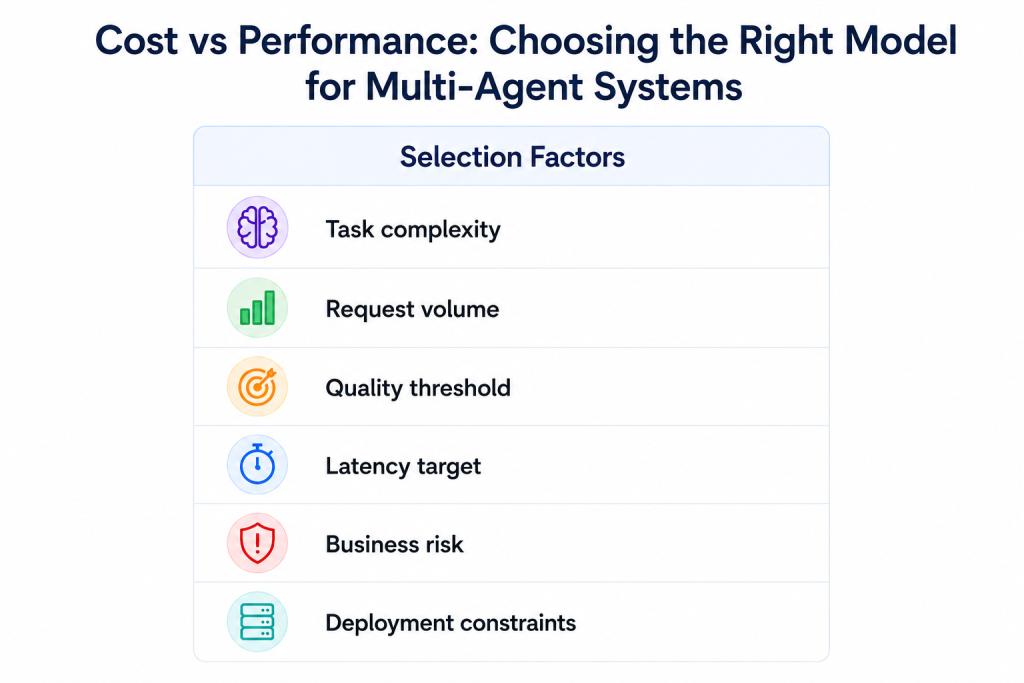
Choosing the right model for a multi-agent system is about balancing accuracy, speed, and cost rather than always selecting the largest available model.
Every AI task has different computational requirements. While large language models excel at reasoning-intensive tasks, they also require more computing resources and increase inference costs.
Smaller models, on the other hand, can handle repetitive and well-defined tasks efficiently, making them a cost-effective choice for many enterprise workflows.
Cost optimization has become a major focus for enterprise AI. According to McKinsey, 80% of high-performing organizations identify efficiency as a primary objective of their AI initiatives, making model selection an important architectural decision rather than simply choosing the largest available model.
A practical decision framework looks like this:
| Selection Factor | Question to Ask | Model Decision |
| Task complexity | Does the task require classification, extraction, reasoning, or planning? | Use smaller models for narrow tasks and stronger models for complex reasoning |
| Request volume | How often will the agent run? | Prioritize efficient models for high-volume tasks |
| Quality threshold | What accuracy or success rate must the agent meet? | Choose the lowest-cost model meeting the threshold |
| Latency target | What P50 and P95 response times are acceptable? | Measure the full workflow, not one model call |
| Business risk | What happens when the agent produces a wrong answer or action? | Add stronger models or human review for high-risk decisions |
| Deployment constraints | Does the workflow require local processing, privacy controls, or limited hardware? | Evaluate local SLMs, private endpoints, or managed APIs |
The final decision should come from task-specific testing. Run the same evaluation set through a smaller model, a stronger model, and a routed hybrid system. Compare quality, total cost, latency, retries, tool accuracy, and escalation rate before selecting the production design.
Instead of asking whether a smaller or larger model is better, organizations should evaluate which model is best suited for each stage of the workflow.
How to Measure the Cost and Speed of a Multi-Agent System
Teams should calculate cost and latency across the full workflow.
Use these formulas:
Total workflow cost = model input cost + model output cost + tool cost + infrastructure cost + retry cost + human-review cost
End-to-end latency = routing time + critical-path model time + tool time + validation time + retry time
Cost per successful task = total workflow cost ÷ number of correctly completed tasks
A cheaper model call does not create a cheaper workflow when the system needs several retries or frequent escalation. A faster model does not create a faster workflow when tool execution and agent handoffs dominate the critical path.
Create a fixed evaluation set representing common, difficult, ambiguous, and high-risk requests. Test every architecture against the same set. Record P50 latency, P95 latency, task success, cost per successful task, tool-call correctness, retry rate, and safety failures.
Best Practices for Building Efficient Multi-Agent Systems
Efficient multi-agent systems assign the right model to the right task while maintaining seamless collaboration between specialized AI agents.
Simply replacing every large model with a smaller one rarely produces the best results. Instead, organizations should design workflows where each agent performs a clearly defined responsibility using the most appropriate model.
Some best practices include:
- Assign specialized roles to each AI agent.
- Use smaller models for repetitive and high-volume tasks.
- Reserve larger models for reasoning and decision-making.
- Build modular workflows that allow models to be updated independently.
- Monitor latency, cost, and response quality regularly.
- Evaluate workflows using real business scenarios before deployment.
For example, an enterprise research assistant can use one agent to retrieve documents, another to summarize content, a third to verify sources, and a larger reasoning model to generate the final report. This modular approach improves efficiency while reducing unnecessary AI computation.
Challenges of Using Smaller Models in Multi-Agent Architectures
Although smaller models improve efficiency, they also introduce limitations that organizations must consider when designing production-ready AI systems.
Compact models often have fewer parameters and a smaller reasoning capacity than frontier models. As a result, they may struggle with tasks that require deep contextual understanding, complex planning, or domain-specific expertise.
Some common challenges include:
- Limited reasoning ability
- Reduced contextual understanding
- Lower performance on highly specialized tasks
- Greater dependence on high-quality prompts
- Additional orchestration complexity
These limitations can often be addressed by combining smaller models with larger reasoning models in a hybrid architecture. This allows organizations to optimize both performance and cost without compromising the overall quality of AI outputs.
How Professionals Can Learn to Build Production-Ready Multi-Agent Systems
Building efficient multi-agent systems requires more than understanding language models. Professionals also need hands-on experience with orchestration frameworks, evaluation techniques, retrieval systems, and deployment strategies.
While experimenting with open-source frameworks is an excellent starting point, many developers find it challenging to design scalable multi-agent architectures that perform reliably in production environments.
A strong learning path should include:
- Multi-agent architecture design
- Agent orchestration frameworks
- Retrieval-Augmented Generation (RAG)
- Tool integration and APIs
- Memory management
- Agent evaluation and observability
- Performance optimization
- Production deployment
Learning through real-world projects is particularly valuable because it helps professionals understand how these components work together in enterprise AI systems.
For professionals seeking structured guidance, the AI Agents course by Johns Hopkins University offers hands-on learning focused on building production-ready AI agents.
Certificate Program in Agentic AI
Learn the architecture of intelligent agentic systems. Build agents that perceive, plan, learn, and act using Python-based projects and cutting-edge agentic architectures.
The curriculum covers topics such as Agentic RAG, LangGraph, multi-agent systems, reinforcement learning, observability, evaluation, and real-world AI workflows, helping learners develop practical skills that align with current industry needs.
Final Thoughts
Smaller models can make multi-agent systems faster and more cost-effective when used for the right tasks.
Rather than replacing large language models, they work best alongside them to balance speed, accuracy, and operational costs in production AI workflows.
To learn how to build production-ready multi-agent systems, professionals should focus on hands-on training in multi-agent architectures, Agentic RAG, LangGraph, and real-world AI projects.
The AI Agents Certificate Program by Johns Hopkins University offers a structured path for developing production-ready AI engineering skills.
Frequently Asked Questions
1. Can smaller models replace large language models in multi-agent systems?
Not entirely. Smaller models are well suited for specialized tasks such as classification, retrieval, routing, and data extraction. However, large language models remain better suited for complex reasoning, long-context understanding, and strategic decision-making. Many production-ready systems combine both to balance performance, speed, and cost.
2. Why are smaller models more cost-effective for multi-agent systems?
Smaller models typically require fewer computational resources, resulting in lower inference costs and faster response times. Assigning them to repetitive or well-defined tasks helps organizations reduce operational expenses while reserving larger models for tasks that require advanced reasoning.
3. How do organizations choose between smaller and larger models?
The choice depends on the complexity of the task. Smaller models are ideal for routine, high-volume workflows, while larger models are better for tasks involving multi-step reasoning, detailed analysis, or complex content generation. Matching model size to task complexity often delivers the best balance of cost and performance.
4. What skills are needed to build efficient multi-agent systems?
Professionals should understand AI agent orchestration, large language models, Retrieval-Augmented Generation (RAG), APIs, memory management, evaluation, observability, and deployment. Hands-on experience with frameworks such as LangGraph and production workflows is also valuable for building enterprise-ready multi-agent systems.