

- Why Using AI Tools Alone Is Not Enough
- What AI Skills Do Business Professionals Need?
- How AI-Powered Workflows Create Business Value
- How AI Can Improve Business Outcomes
- Why AI Strategy Matters for Business Professionals
- Why Responsible AI Is Essential for Business Impact
- How to Build AI Skills for Business Applications
- How an AI Course Can Build Business-Ready AI Skills
- Final Thoughts
- Frequently Asked Questions
AI tools have changed how professionals work, from generating reports and analyzing information to automating routine tasks. But knowing how to use ChatGPT, Claude, or another AI tool does not automatically translate into business value.
AI for business professionals is about more than tool proficiency. It requires understanding how to identify valuable use cases, connect AI with business data and workflows, evaluate outputs, manage risks, and measure results.
As organizations move from AI experimentation toward broader adoption, professionals need to develop the skills to turn AI capabilities into practical business solutions.
Why Using AI Tools Alone Is Not Enough
Generative AI tools can improve individual productivity. A marketing professional can create campaign ideas, a financial analyst can summarize reports, and a manager can use AI to prepare presentations or analyze documents.
However, these are only individual use cases. Creating broader business impact requires professionals to consider:
- What business problem should AI solve?
- What data does the solution need?
- How should AI outputs be validated?
- Where should human oversight remain?
- How can AI fit into existing workflows?
- How will the business measure ROI?
This distinction is becoming increasingly important. McKinsey's 2025 State of AI survey found that 88% of respondents report regular AI use in at least one business function, up from 78% a year earlier.
Yet most organizations remain at the experimentation or pilot stage, showing that adoption does not automatically translate into scaled business impact.
The opportunity, therefore, is not simply to use more AI tools. It is about learning how to embed AI into processes that improve productivity, decision-making, customer experiences, or business operations.
What AI Skills Do Business Professionals Need?
Modern professionals need a combination of AI, technical, strategic, and governance skills. Developing the right AI skills for business professionals is not about learning every new AI tool or becoming an AI engineer.
It is about understanding how AI capabilities can be applied to real business problems and knowing how to evaluate, implement, and manage those solutions effectively.
| AI Skill | Business Application |
| Generative AI | Create content, summarize information, and support analysis |
| Prompt Engineering | Improve the quality and consistency of AI outputs |
| RAG | Connect AI applications with company knowledge and business data |
| Agentic AI | Automate multi-step tasks and workflows |
| AI Automation | Connect AI with existing business processes and applications |
| AI Evaluation | Assess accuracy, reliability, and performance |
| Responsible AI | Manage privacy, bias, security, and governance risks |
| AI Strategy | Identify valuable use cases and align AI with business goals |
Professionals do not need to master every new AI platform. The more valuable skill is knowing which AI capability fits a particular business problem and how to apply it responsibly.
For example, a customer-service team could use RAG to connect an AI assistant to product documentation and company policies. An AI agent could then retrieve relevant information, draft a response, and escalate complex cases to a human representative.
How AI-Powered Workflows Create Business Value
The biggest shift is moving from individual AI tasks to end-to-end AI-powered workflows. This is where agentic AI for business can create significant value.
Rather than simply generating an answer, an AI agent can retrieve information, analyze data, use connected tools, make recommendations, and complete multiple steps within a defined workflow while keeping humans involved where judgment or approval is required.
A simple workflow can follow this progression:
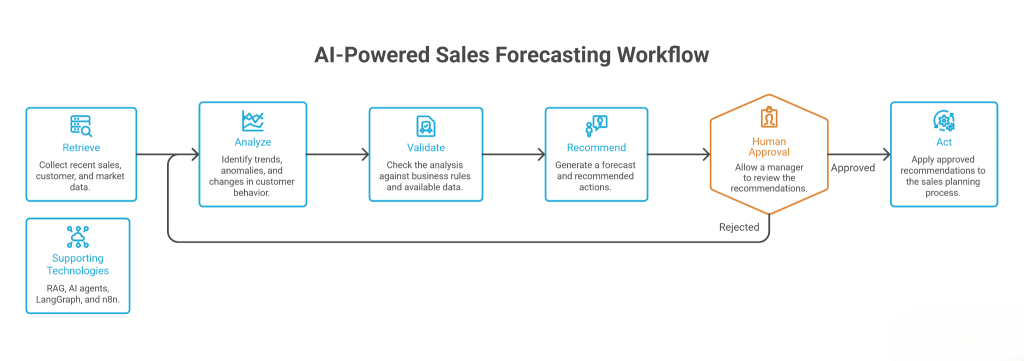
Retrieve → Analyze → Validate → Recommend → Human Approval → Act
Consider a sales forecasting process:
- Retrieve: Collect recent sales, customer, and market data.
- Analyze: Identify trends, anomalies, and changes in customer behavior.
- Validate: Check the analysis against business rules and available data.
- Recommend: Generate a forecast and recommended actions.
- Human approval: Allow a manager to review the recommendations.
- Act: Apply approved recommendations to the sales planning process.
This approach demonstrates the difference between using an AI chatbot and designing an AI-enabled business process.
Technologies such as RAG, AI agents, LangGraph, and n8n can support these workflows depending on the business use case and technical requirements.
McKinsey's latest research also highlights workflow redesign as an important characteristic of organizations capturing greater value from AI.
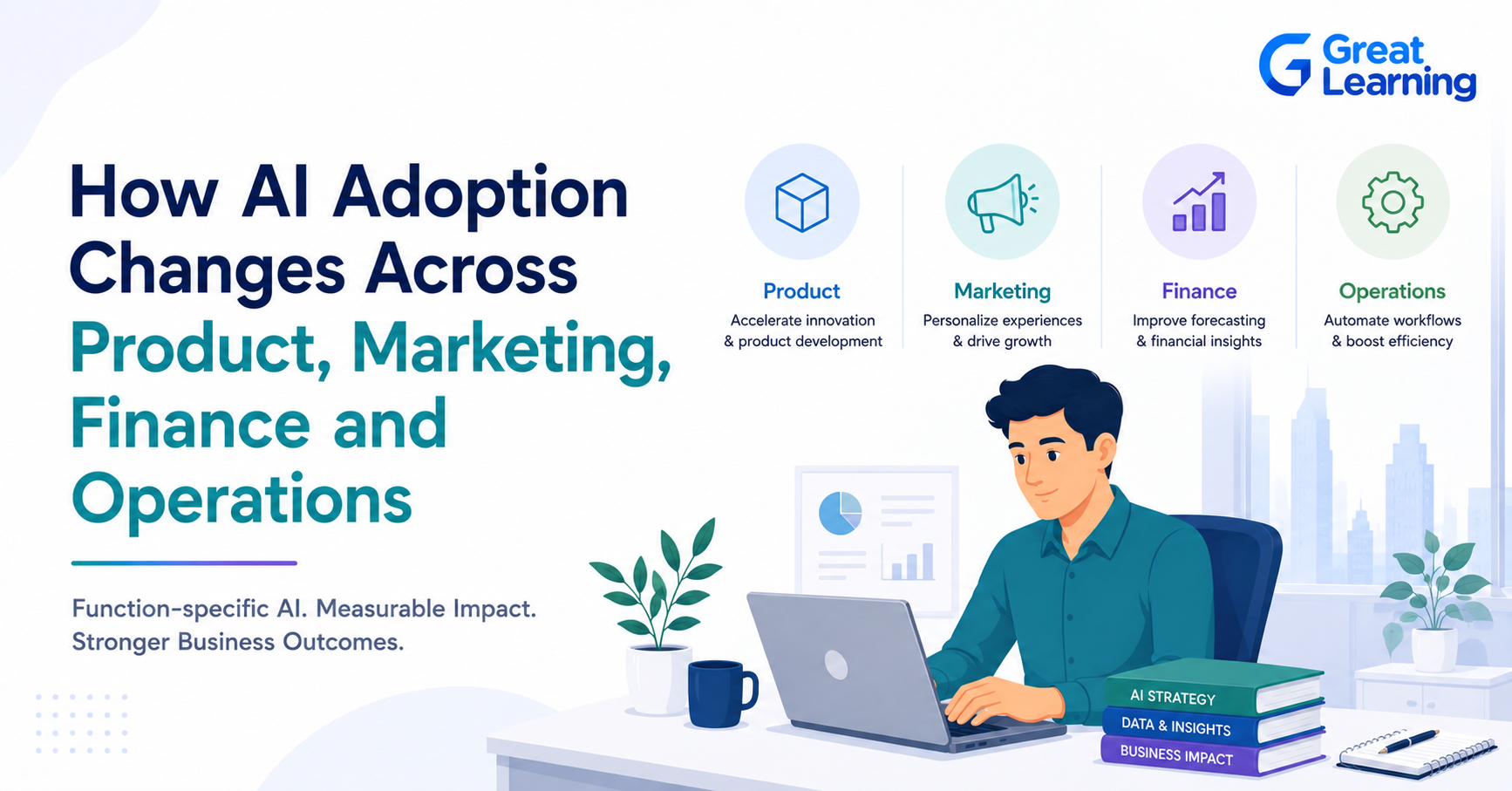
How AI Can Improve Business Outcomes
AI should ultimately be evaluated by the business outcomes it produces rather than by the number of tools an organization adopts.
| Business Function | Potential AI Impact |
| Operations | Automate repetitive processes and improve efficiency |
| Marketing | Analyze customer behavior and personalize campaigns |
| Finance | Automate reporting and support forecasting |
| Sales | Improve lead prioritization and sales forecasting |
| Customer Service | Accelerate responses and improve issue resolution |
| Product | Analyze feedback and identify improvement opportunities |
For example, an AI-powered customer-support workflow could classify incoming requests, retrieve relevant information, generate a grounded response, and escalate complex cases to a human agent.
Its success can then be measured using response time, resolution rate, employee productivity, customer satisfaction, and operating cost.
This outcome-focused approach matters because an AI implementation can be technically impressive without creating meaningful value. Before adopting a solution, professionals should define the expected outcome and establish KPIs for measuring it.
Why AI Strategy Matters for Business Professionals
Selecting an AI tool is only one part of an effective AI strategy. Professionals must first understand the business problem, the available data, the operational constraints, and the expected return.
A practical AI strategy for business connects AI investments to measurable organizational priorities rather than treating AI adoption as a technology exercise.
It helps businesses decide which use cases to prioritize, what capabilities and data are required, where human oversight is necessary, and how success will be measured.
A practical AI strategy for business should answer four questions:
- What business problem are we solving?
- Where can AI create measurable value?
- What data, technology, and workflow are required?
- How will success, risk, and ROI be measured?
For example, a company trying to reduce customer-support costs should not automatically deploy a chatbot. It should first examine support volumes, common issues, existing processes, available knowledge sources, and service-level requirements.
The right AI solution could involve ticket classification, RAG, response generation, workflow automation, or an AI agent. The choice should be driven by the business problem rather than by the popularity of a particular technology.
Why Responsible AI Is Essential for Business Impact
AI systems can produce inaccurate outputs, expose sensitive information, introduce bias, or make recommendations that require human judgment.
Business professionals should therefore understand:
- Data privacy: Protect sensitive business and customer information.
- Accuracy: Validate AI outputs before using them for important decisions.
- Bias and fairness: Identify potentially harmful patterns in AI systems.
- Human oversight: Keep people involved in high-impact decisions.
- Governance: Establish clear policies for AI development and use.
Responsible AI is not separate from business value. Trust, reliability, and appropriate governance are necessary for scaling AI across an organization.
How to Build AI Skills for Business Applications
Professionals can develop their AI capabilities through four progressive stages:
| Stage | Focus | Outcome |
| 1. AI Foundations | LLMs, Generative AI, prompt engineering | Use AI tools effectively |
| 2. AI Applications | RAG, automation, AI workflows | Build practical AI solutions |
| 3. Agentic AI | AI agents, multi-agent systems, orchestration | Automate complex workflows |
| 4. Strategy & Governance | Evaluation, responsible AI, ROI, strategy | Scale AI responsibly |
This progression moves professionals from using AI tools → building AI workflows → managing AI systems → driving AI strategy.
The goal is not to become an expert in every AI technology. Instead, professionals should develop the judgment to identify valuable use cases, select appropriate AI capabilities, design effective workflows, and evaluate their business impact.
How an AI Course Can Build Business-Ready AI Skills
The Artificial Intelligence course by Texas McCombs combines AI foundations with Generative AI, RAG, Agentic AI, AI workflows, responsible AI, and hands-on business applications.
Post Graduate Program in AI & Machine Learning: Business Applications
Master in-demand AI and machine learning skills with this executive-level AI course—designed to transform professionals into strategic tech leaders.
The program includes 30+ tools and technologies, real-world case studies, and hands-on projects designed around practical AI and business challenges.
Its curriculum includes technologies such as LangChain, LangGraph, Claude, OpenAI APIs, n8n, Hugging Face, and RAG, as well as single- and multi-agent systems and AI evaluation.
The program is also designed for business leaders and functional heads who want to build the technical understanding required to implement AI within their functions and drive business impact.
Final Thoughts
AI tools are the starting point, not the complete AI skill set. Business professionals who understand how to connect AI with data, workflows, strategy, and governance can move from simply using AI to creating measurable business value.
As AI adoption expands, the ability to identify the right use case, design effective AI workflows, evaluate outcomes, and guide responsible implementation will become increasingly valuable.
Developing these capabilities can help professionals contribute more effectively to AI-driven transformation across functions and industries.
Frequently Asked Questions
1. Why aren't AI tools alone enough for business professionals?
AI tools can improve individual productivity, but meaningful business impact requires professionals to understand AI workflows, data, evaluation, governance, and business strategy.
2. What AI skills should business professionals learn?
AI skills for business professionals include Generative AI, RAG, AI agents, automation, AI evaluation, responsible AI, and AI strategy.
3. What's the difference between Generative AI and Agentic AI?
Generative AI creates content such as text, code, summaries, and recommendations. Agentic AI can plan and execute multi-step tasks, use tools, retrieve information, and coordinate actions with limited human intervention.
4. How can AI create measurable business impact?
AI can improve productivity, reduce costs, accelerate decisions, automate processes, improve customer experiences, and support revenue growth. Organizations should define KPIs before implementation to measure these outcomes.
5. Do business professionals need coding skills to use AI effectively?
Not necessarily. However, understanding basic programming, data, AI workflows, and application development helps professionals evaluate AI solutions and collaborate effectively with technical teams.
6. How can businesses measure AI ROI?
Businesses can compare the measurable benefits of an AI initiative with its implementation and operating costs. Relevant metrics may include time saved, cost reduction, productivity, revenue impact, customer satisfaction, accuracy, and process completion rates.
7. Is an AI course worth it for business professionals?
An AI course can provide structured learning for professionals who want to move beyond basic AI tool use. A strong program should combine AI fundamentals with Generative AI, Agentic AI, practical workflows, responsible AI, and business applications.
8. What's a good first AI skill for a non-technical manager to learn?
Prompt engineering and AI evaluation are strong starting points because they help managers use AI effectively and assess the quality and reliability of its outputs before learning more technical skills.