
- What Makes a Business Problem Worth Solving With AI?
- How Do Enterprises Identify High-Value AI Use Cases?
- How Do Enterprises Evaluate AI Feasibility?
- How Do Enterprises Measure AI ROI and Business Impact?
- What AI Problems Should Enterprises Avoid?
- How Can Enterprises Prioritize AI Use Cases for Implementation?
- What Is the Best Way to Move From an AI Idea to a Production Use Case?
- What Skills Do Business Leaders Need to Prioritize AI Use Cases?
- How the Texas McCombs Artificial Intelligence Course Builds AI Business Skills
- Final Thoughts
- Frequently Asked Questions
Not every business problem needs AI. Enterprise AI use case selection is most effective when organizations focus on clear business problems and measurable outcomes.
Enterprises should evaluate factors such as business value, data readiness, technical feasibility, implementation cost, ROI, and risk before investing in an AI solution.
An AI use case may be worth pursuing when it can increase revenue, reduce costs, improve productivity, enhance customer experience, reduce risk, or support better decisions.
The challenge is becoming more important as AI adoption expands. A Deloitte 2026 report found that 40% of Indian respondents report significant or full AI usage, showing that organizations are moving beyond experimentation toward broader implementation.
The question is therefore not simply “Can we use AI for this problem?” but “Is this problem valuable and feasible enough to justify using AI?”
What Makes a Business Problem Worth Solving With AI?
A business problem becomes a strong AI candidate when there is a clear outcome that AI can meaningfully improve. The problem should also occur frequently enough, have sufficient data or information, and offer measurable value if solved.
This is where Enterprise AI Use Case Selection helps organizations identify opportunities where AI can deliver meaningful and measurable business value.
For example, a company receiving thousands of customer queries every day may benefit from an AI support system because the workload is repetitive, the information is available, and improvements can be measured through response time, resolution rates, and customer satisfaction.
Other strong AI candidates may include:
- Forecasting demand or sales
- Detecting fraud or unusual transactions
- Personalizing recommendations
- Analyzing large volumes of documents
- Predicting equipment failures
- Automating repetitive knowledge-work tasks
However, AI is not always the best solution. If a simple workflow automation or rule-based system can solve the problem more reliably and cheaply, adding an AI model may create unnecessary complexity.
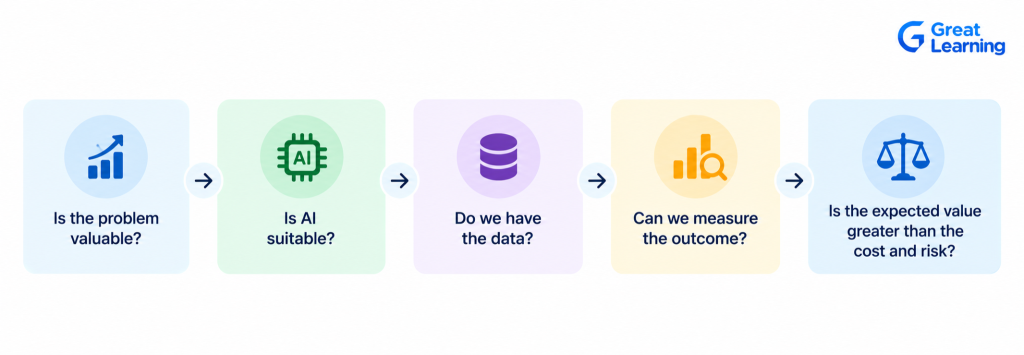
A useful starting point is to ask:
Is the problem valuable? → Is AI suitable? → Do we have the data? → Can we measure the outcome? → Is the expected value greater than the cost and risk?
How Do Enterprises Identify High-Value AI Use Cases?
Enterprises can begin by looking at areas where employees or customers face repetitive, data-intensive, time-consuming, or difficult decision-making processes.
For example:
| Business Problem | Potential AI Use Case |
| High customer-support volume | AI support assistant |
| Demand uncertainty | Forecasting |
| Large document workload | Document intelligence |
| Fraud detection challenges | Predictive models |
| Complex information retrieval | RAG-based assistant |
| Product discovery challenges | Recommendation systems |
The strongest opportunities are usually connected to an existing business objective.
An organization trying to reduce customer-service costs might prioritize an AI support assistant, while a retailer focused on inventory efficiency might prioritize demand forecasting.
SAP's Value of AI Report 2026 found that 85% of Indian organizations see Agentic AI transforming business operations, while projected AI ROI in India is expected to increase from 22% to 39% within two years.
This reinforces an important point: AI use-case selection should focus on where AI can create measurable business value, rather than simply where the technology can be applied.
How Do Enterprises Evaluate AI Feasibility?
A high-value problem is not automatically a good AI use case. Enterprises also need to determine whether AI can solve it effectively with the available data, technology, skills, and infrastructure.
Key feasibility questions include:
- Is enough relevant and reliable data available?
- Can the existing systems provide access to that data?
- Can AI deliver better results than the current process?
- Can the solution integrate with existing workflows?
- Are the required AI skills and infrastructure available?
- Can the organization manage security, privacy, and compliance risks?
Data readiness is particularly important. An AI idea may appear valuable on paper but become difficult to implement when data is fragmented, outdated, poorly labeled, or inaccessible.
Enterprises should therefore assess feasibility before investing heavily in development. A simple feasibility score covering data readiness, technical complexity, integration requirements, risk, and implementation effort can help teams eliminate weak ideas early.
How Do Enterprises Measure AI ROI and Business Impact?
AI projects should be evaluated against business outcomes rather than model performance alone. Enterprises need to define what success means before building the solution.
Depending on the use case, useful AI ROI metrics may include:
| Business goal | Possible AI metrics |
| Reduce operating costs | Cost per transaction, hours saved |
| Improve productivity | Tasks completed, time saved |
| Increase revenue | Conversion rate, sales generated |
| Improve customer experience | Resolution time, satisfaction |
| Reduce risk | Fraud prevented, errors reduced |
| Improve decisions | Forecast accuracy, decision time |
The baseline should be measured before implementation so that the organization can compare results after deployment.
This distinction is important because an AI system can achieve high technical accuracy without creating meaningful business value. The stronger approach is to connect model performance to a measurable business KPI.
For example, a demand forecasting model should not be judged only by forecasting accuracy. The enterprise should also measure whether it reduces excess inventory, stockouts, or working capital.
What AI Problems Should Enterprises Avoid?
Not every repetitive or data-heavy process needs AI. Enterprises should avoid AI when the problem can be solved more simply, cheaply, and reliably through rules, automation, analytics, or process improvements.
AI may not be appropriate when:
- The problem has no clear business outcome.
- There is insufficient or unreliable data.
- The process is too infrequent to justify the investment.
- A simple rule-based solution can achieve the same result.
- The expected value is lower than implementation and maintenance costs.
- The risks of incorrect decisions are too high without adequate controls.
- Success cannot be measured objectively.
Enterprises should also be cautious about adopting AI simply because competitors are using it.
The goal is not to maximize the number of AI projects. It is to identify a smaller set of problems where AI can create measurable, sustainable business value.
How Can Enterprises Prioritize AI Use Cases for Implementation?
Once potential AI use cases have been identified and evaluated, enterprises need a consistent way to prioritize them. A useful framework considers both business value and implementation feasibility.
A simple scoring model can evaluate each use case across:
- Business impact
- Expected ROI
- Data readiness
- Technical feasibility
- Implementation effort
- Risk and compliance
- Time to value
- Scalability
This creates a clearer distinction between ideas that are interesting and ideas that are worth funding.
For example, an AI customer-support assistant may score highly because it has a clear business outcome, large transaction volume, available data, and relatively measurable benefits. A highly experimental AI system with uncertain value and limited data may receive a much lower priority.
Indian industry research also shows the shift toward practical AI implementation. The Confederation of Indian Industry's 2026 annual report notes that its National AI Awards recognized 54 impactful AI implementations from more than 120 nominations, highlighting the growing emphasis on applied business use cases.
What Is the Best Way to Move From an AI Idea to a Production Use Case?
Enterprises should avoid moving directly from an AI idea to a large-scale deployment. A phased approach reduces risk and makes it easier to determine whether the problem is actually worth solving.
A practical AI use case lifecycle is:
Business Problem → Use Case → Feasibility → Business Case → Pilot → Evaluation → Scale
Start by defining the problem and expected business outcome. Next, assess data, technology, risks, and integration requirements.
The pilot should then test whether AI can produce measurable improvement under realistic conditions. Teams should compare the results against the original baseline and predefined success metrics.
If the pilot demonstrates sufficient value, the solution can move toward production. If it does not, the organization can stop or redesign the use case before committing significant resources.
This approach helps enterprises treat AI as a business investment rather than simply a technology experiment.
What Skills Do Business Leaders Need to Prioritize AI Use Cases?
Deciding which AI problems are worth solving requires more than technical AI knowledge. Business leaders and working professionals need to develop AI skills for working professionals that help them connect AI capabilities with business strategy, operational challenges, financial outcomes, and organizational readiness
Important skills include:
- Identifying AI opportunities from business problems
- Understanding AI and machine learning capabilities
- Evaluating data and technical feasibility
- Building AI business cases
- Measuring ROI and business impact
- Assessing AI risks and responsible AI requirements
- Prioritizing projects based on value and feasibility
- Communicating AI opportunities across business and technical teams
These capabilities are increasingly important for professionals who need to apply AI to business problems, and developing practical AI skills for business professionals can help them evaluate, implement, and manage AI solutions effectively.
Instead of asking, “Where can we use AI?”, organizations can ask, “Which business problem has enough value, data, feasibility, and measurable impact to justify AI?”
That shift is what turns AI adoption from experimentation into a structured business decision.
How the Texas McCombs Artificial Intelligence Course Builds AI Business Skills
Identifying valuable AI opportunities requires both technical understanding and business judgment. Professionals need to understand how AI works, where it can create value, and how to evaluate its risks, feasibility, and business impact.
The Artificial Intelligence course by Texas McCombs and Great Lakes Executive Learning covers AI and machine learning fundamentals along with Generative AI, Agentic AI, RAG, MLOps, LLMOps, and AI agent development.
PG Program in AI & Machine Learning
Master AI with hands-on projects, expert mentorship, and a prestigious certificate from UT Austin and Great Lakes Executive Learning.
The program also uses hands-on projects and real-world AI projects and case studies to connect AI capabilities with business problems.
The curriculum also develops strategic judgment around AI outputs, business decisions, trade-offs, risks, and ROI.
This can help professionals move from simply understanding AI technologies to evaluating where they can create meaningful business value.
Final Thoughts
Enterprises do not need to solve every business problem with AI. The better approach is to identify problems where AI can deliver measurable value and where the organization has the data, technology, skills, and controls needed to implement it.
A strong AI use case typically has a clear business outcome, sufficient data, feasible implementation requirements, measurable ROI, and manageable risk.
The decision process can therefore be summarized as:
Business Problem → AI Opportunity → Value → Feasibility → ROI → Risk → Prioritization → Pilot → Scale
Developing the ability to make these decisions is becoming increasingly important as organizations expand their AI investments.
The Artificial Intelligence course by Texas McCombs can help professionals build the technical and strategic understanding needed to evaluate AI opportunities and connect them with business outcomes.
Frequently Asked Questions
1. What makes a business problem worth solving with AI?
A business problem is worth solving with AI when it has a clear business outcome, sufficient data, measurable value, and a feasible implementation path. The expected benefits should justify the cost, complexity, and risks involved.
2. How do enterprises identify high-value AI use cases?
Enterprises can identify high-value AI use cases by examining repetitive, data-intensive, high-volume, or decision-heavy processes where AI could improve revenue, productivity, customer experience, cost efficiency, or risk management.
3. How do companies evaluate AI feasibility?
Companies evaluate AI feasibility by assessing data availability and quality, technical requirements, system integration, AI skills, infrastructure, security, compliance, implementation effort, and expected business value.
4. How should enterprises measure AI ROI?
AI ROI should be connected to business KPIs such as revenue growth, cost reduction, productivity gains, customer satisfaction, reduced errors, improved forecasting, or risk reduction. Model accuracy alone does not establish business ROI.
5. What AI problems should enterprises avoid?
Enterprises should avoid AI projects with unclear business value, insufficient data, excessive implementation costs, high unmanaged risks, or problems that can be solved more simply through rules, automation, or traditional analytics.
6. How should enterprises prioritize AI use cases?
Enterprises can score potential use cases based on business impact, ROI, data readiness, technical feasibility, implementation effort, risk, time to value, and scalability. High-value and highly feasible opportunities should generally receive priority.
7. Why is AI business knowledge important for professionals?
AI business knowledge helps professionals connect technical capabilities with organizational goals. It enables them to evaluate AI opportunities, understand trade-offs, measure business impact, and make better decisions about AI adoption.
8. Which course can help professionals develop AI and business skills?
The Artificial Intelligence course by Texas McCombs combines AI and machine learning concepts with Generative AI, Agentic AI, practical projects, case studies, and business-focused application.