
- Why Data Pipelines Matter for AI Performance
- How Data Quality Affects AI Models
- Better Data vs. Bigger AI Models: Which Matters More?
- How to Build Better Data Pipelines for AI
- How Real-Time Data Pipelines Improve Modern AI Systems
- How to Monitor and Improve AI Data Pipelines
- How Better Data Pipelines Support Reliable AI Systems
- How the MIT Professional Education Applied AI and Data Science Program Builds These Skills
- Final Thoughts
- Frequently Asked Questions
Building a high-performing AI system is not only about choosing a larger or more capable model. The quality, freshness, consistency, and accessibility of the data entering that model can have a major impact on its results.
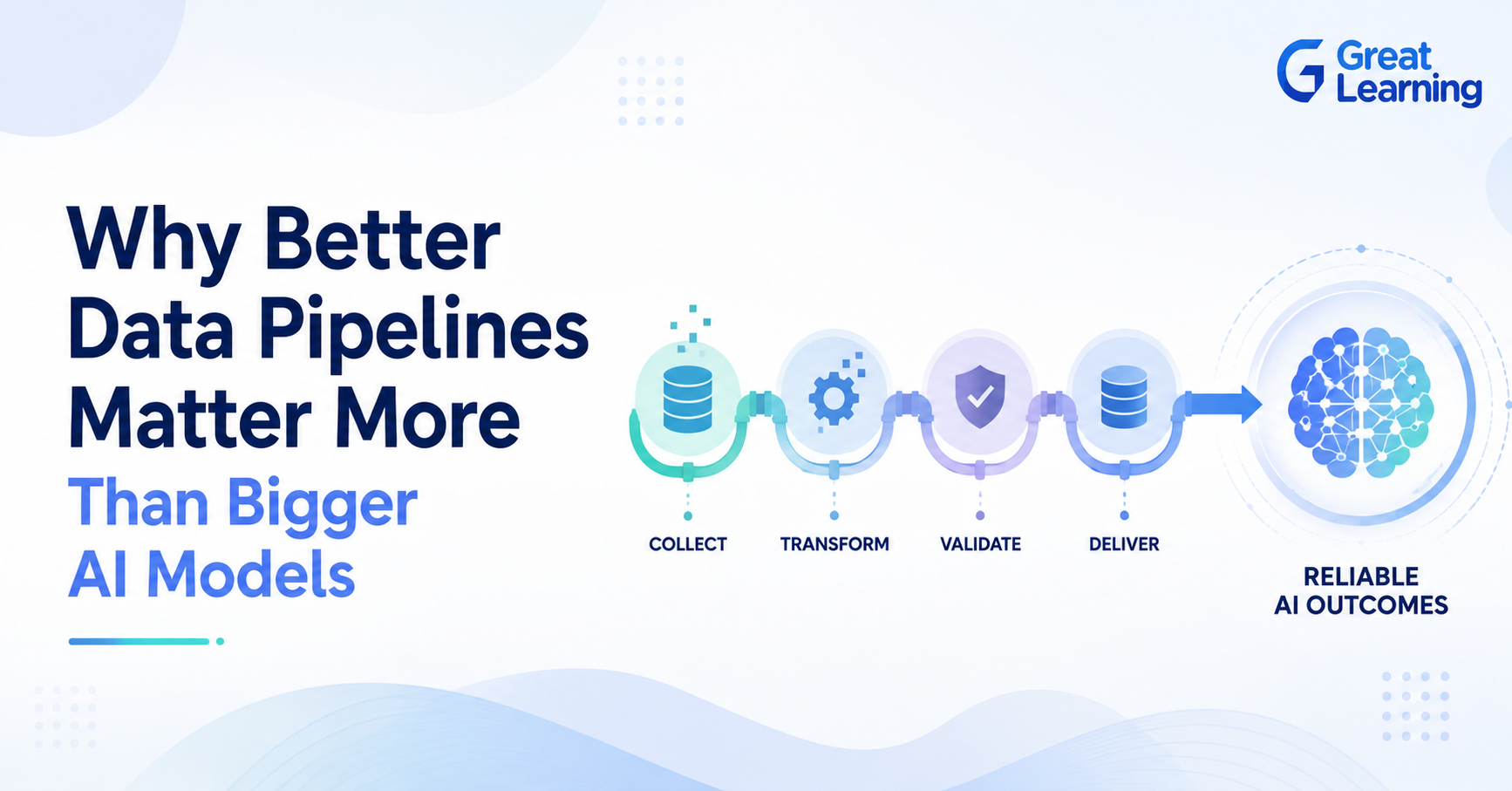
A data pipeline for AI is the set of processes and technologies used to collect, transform, validate, move, and prepare data for AI applications.
A strong pipeline helps ensure that models receive the right information in the right format and at the right time.
This matters because AI systems can amplify problems in their underlying data. McKinsey's 2026 research found that more than two-thirds of high-performing companies identify data as their primary obstacle to enabling AI.
Consider a customer-service AI system trained on outdated product information. Even a highly capable model may generate incorrect answers if the information supplied to it is incomplete or obsolete.
Improving the underlying data pipeline could therefore have a greater practical impact than simply switching to a larger model.
The core relationship is:
Better Data → Better Inputs → Better Model Performance → More Reliable AI
Why Data Pipelines Matter for AI Performance
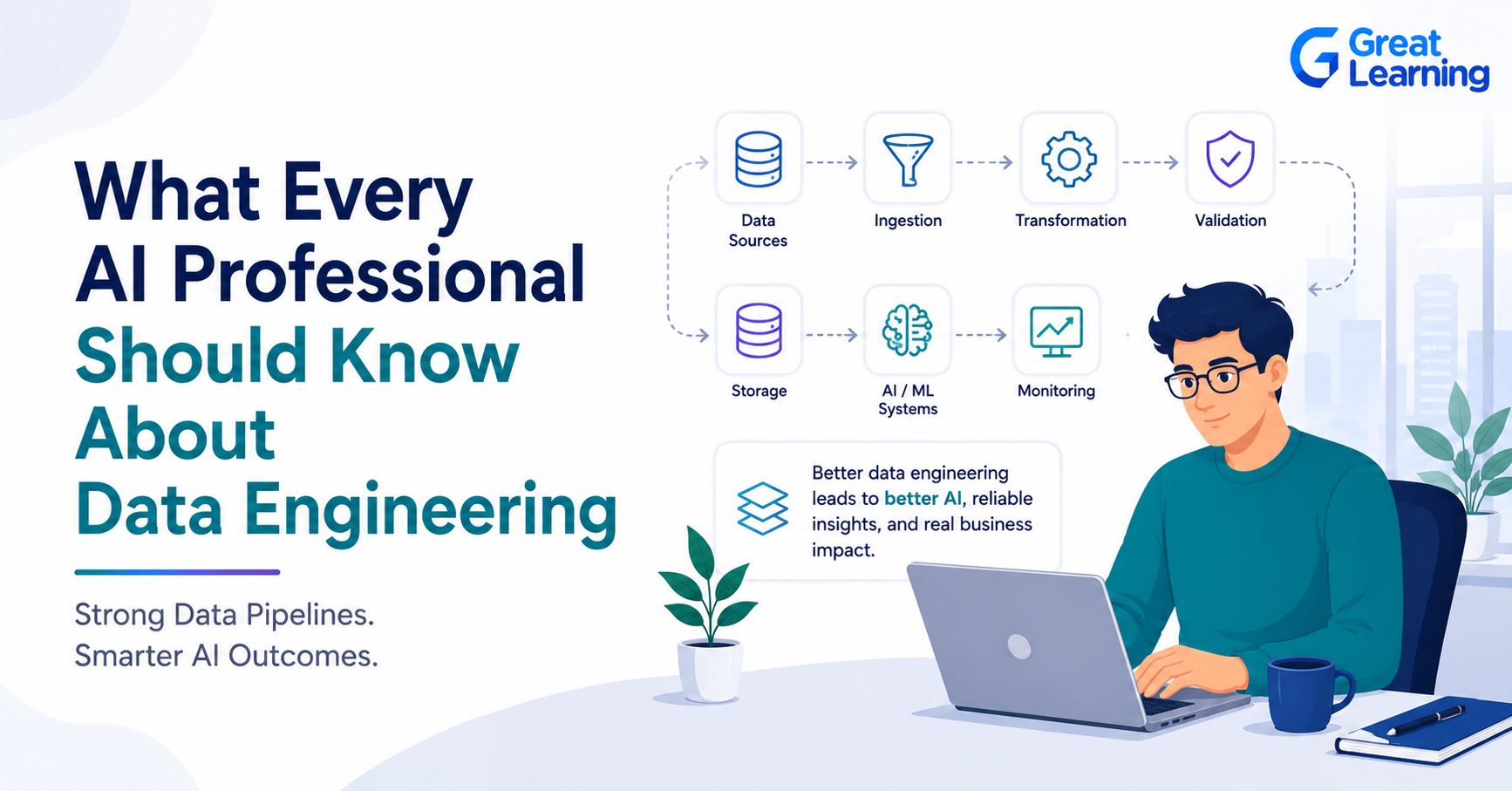
A data pipeline determines how information moves from its original sources into the systems that use it. For AI applications, this can involve data collection, ingestion, cleaning, transformation, validation, storage, and delivery.
These processes are also important for an AI Developer working with data-driven applications.
For example, a demand-forecasting system may collect sales transactions from multiple locations. The pipeline needs to standardize product identifiers, handle missing values, remove duplicate records, and deliver updated information to the forecasting model.
If these steps are unreliable, the model may produce poor forecasts regardless of how advanced the algorithm is.
This is why data quality and AI performance are closely connected. A pipeline can also determine whether data is fresh enough for the use case, whether its source can be traced, and whether changes in the underlying data are detected before they affect model outputs.
The challenge becomes more significant as organizations move AI beyond experiments. McKinsey's 2026 research found that only 7% of companies have fully scaled AI across their organizations, with data readiness identified as a major constraint.
A better data pipeline therefore does more than move information. It creates a dependable foundation that allows AI systems to access relevant, validated, traceable, and usable data.
A reliable pipeline is a key part of Data Engineering for AI, helping ensure AI systems receive accurate and usable data.
How Data Quality Affects AI Models
Data quality directly influences the information an AI model learns from or retrieves during execution. Missing values, duplicate records, inconsistent formats, outdated information, incorrect labels, and biased datasets can all affect model performance.
Addressing these issues through Understanding Data Cleaning helps create more consistent data for AI systems.
For example, imagine a recommendation system that uses customer purchase history. If transactions from one sales channel are missing from the pipeline, the system may develop an incomplete view of customer behavior.
A larger model cannot automatically recover information that was never provided to it.
Data validation can help identify these problems before they reach downstream AI applications. Teams can establish checks for completeness, accuracy, consistency, freshness, and unusual changes in incoming data.
This becomes particularly important for Generative AI and retrieval-augmented generation (RAG) systems, which retrieve external information before generating a response, where the quality of retrieved information can directly influence the answer.
McKinsey notes that AI systems increasingly depend on structured and unstructured data and that small data-quality issues can spread across transformations and applications as information is reused.
Therefore, improving AI model performance does not always require a larger model. In many cases, improving the quality and reliability of the data entering the system can address a more fundamental limitation.
Applied Data Science for AI helps professionals prepare data, evaluate models, and build more reliable AI applications.
Better Data vs. Bigger AI Models: Which Matters More?
When an AI system delivers poor results, the first instinct may be to use a larger model. However, increasing model size does not automatically solve problems caused by poor, incomplete, outdated, or inaccessible data.
A better data pipeline can improve the information available to the model without requiring a more expensive model.
This can involve improving data quality, removing duplicates, updating stale information, standardizing formats, or making relevant data available at the right time.
For example, consider a demand-forecasting system that consistently predicts lower sales than expected. Moving to a larger model may increase computational complexity without addressing the underlying issue if the pipeline excludes recent sales from several locations.
Fixing the pipeline could improve the predictions more directly.
This is becoming a significant issue as organizations scale AI. Confluent's 2026 Data Streaming Report found that 72% of global IT leaders say insufficient real-time data infrastructure is stalling their efforts to scale AI, while 66% cite uncertainty around data lineage, timeliness, and quality.
That does not mean larger models are unnecessary. More capable models can improve reasoning, language understanding, and other capabilities. The key question is whether the limitation is actually model capability or data quality.
A useful decision framework is:
If the model cannot understand the task → consider a better model.
If the model lacks the right information → improve the data pipeline.
How to Build Better Data Pipelines for AI
Building reliable data pipelines for AI requires more than moving data between systems. The pipeline should make sure that information is available, accurate, consistent, validated, and traceable before it reaches an AI application.
A practical pipeline can include several stages:
- Data ingestion: Collect information from databases, applications, APIs, files, sensors, or other sources.
- Data transformation: Standardize formats, combine sources, remove duplicates, and prepare data for downstream use.
- Data validation: Check for missing values, unexpected changes, incorrect formats, and other quality issues.
- Data storage and delivery: Make validated data available to models, analytics systems, RAG applications, or other AI workflows. Reliable data can also support AI-powered Reporting and other analytics workflows.
- Monitoring: Track data freshness, completeness, pipeline failures, and changes in data patterns.
These controls become particularly important as pipelines grow more complex. Fivetran's 2026 global benchmark found that 97% of enterprises reported disruptions to AI or analytics because of pipeline issues, while 53% of engineering time was spent on pipeline maintenance.
For example, a RAG system may retrieve information from product documentation, customer records, and internal policies. If the pipeline does not update those sources consistently, the AI application may retrieve outdated information and generate an incorrect response.
The objective is therefore not simply to create a pipeline that works. It is to build one that continues delivering trustworthy data as sources, schemas, workloads, and AI applications change.
How Real-Time Data Pipelines Improve Modern AI Systems
Data freshness can be just as important as data accuracy for AI applications that operate in changing environments.
A pipeline that delivers yesterday's information may be sufficient for historical analysis but unsuitable for fraud detection, recommendations, inventory management, or AI agents making decisions from current business conditions.
Real-time data pipelines continuously move information from operational systems into AI applications.
They can help systems respond to new transactions, customer activity, inventory changes, sensor readings, or other events as they occur.
For example, a recommendation engine can use recent customer interactions to update suggestions, while a fraud detection system can analyze new transactions as they arrive.
Similarly, an AI agent connected to enterprise systems may need current information about inventory, orders, or customer accounts before taking an action.
The scale of this requirement is significant. Confluent's 2026 research surveyed 4,625 IT leaders worldwide and found that insufficient real-time data infrastructure was the leading challenge cited for scaling AI, at 72%.
This is why real-time data infrastructure is increasingly becoming part of the AI stack. For modern AI systems, the goal is not simply to use more data, but to make sure the right data reaches the right system at the right time.
How to Monitor and Improve AI Data Pipelines
Building a reliable AI data pipeline does not end once data reaches the model. Teams need to continuously monitor whether the pipeline is delivering complete, accurate, fresh, and consistent data.
Important monitoring signals include:
- Data freshness: Is new data arriving on schedule?
- Completeness: Are expected records or fields missing?
- Schema changes: Have upstream systems changed the structure of the data?
- Validation errors: Are records failing quality checks?
- Data drift: Has the distribution of incoming data changed?
- Pipeline failures: Are ingestion or transformation steps failing?
This distinction matters because a pipeline can technically complete successfully while still delivering incorrect or incomplete data.

Datadog notes that data pipelines are critical infrastructure for AI and that end-to-end monitoring is essential for maintaining the health of downstream AI and ML applications.
For example, a customer data pipeline may continue running normally even after an upstream system changes a field from a number to text. Without validation and monitoring, the issue may reach the AI model and affect predictions without generating an obvious pipeline failure.
Teams can therefore use data observability, automated quality checks, alerts, and lineage tracking to identify problems earlier.
This highlights the value of monitoring data as it moves through pipelines, tracing quality issues back to their sources, and connecting data changes with downstream model outcomes.
The goal is to create a continuous feedback loop:
Monitor → Detect → Investigate → Fix → Validate → Monitor
This helps ensure that improvements to AI performance are supported by a data pipeline that remains reliable as the underlying data and business environment change.
How Better Data Pipelines Support Reliable AI Systems
A reliable AI system depends on more than model accuracy. The data pipeline must consistently provide the information the system needs, while teams must be able to identify when that information changes or becomes unreliable.
This creates a direct connection between data quality, model performance, and AI reliability. A recommendation model may become less effective when customer behavior changes. A forecasting model may degrade when market conditions shift.
A RAG application may provide outdated answers when its underlying knowledge sources are not refreshed.
For this reason, teams should evaluate the data pipeline and AI model together. Pipeline metrics such as data quality, freshness, latency, and error rates can be considered alongside model metrics such as accuracy, relevance, and failure rates.
Data-pipeline metrics including data quality, processing latency, pipeline errors, and data drift as important operational measures.
Post-deployment monitoring is equally important. Monitoring deployed AI systems is necessary to validate reliable operation in real-world conditions and to detect unexpected outputs, performance degradation, and other issues.
The result is a broader reliability loop:
Data Quality → Pipeline Reliability → Model Performance → AI Evaluation → Monitoring → Continuous Improvement

Better data pipelines therefore do more than support AI models. They provide the operational foundation needed to keep AI systems accurate, traceable, adaptable, and reliable as conditions change.
How the MIT Professional Education Applied AI and Data Science Program Builds These Skills
The AI and Data Science course by MIT Professional Education can help professionals develop the data science and AI capabilities needed to build and evaluate practical AI systems.
MIT Professional Education's Data Science Course
Gain the expertise top companies seek and open doors to Data Science jobs.
The curriculum covers data analysis, machine learning, deep learning, recommendation systems, time-series forecasting, Generative AI, and Agentic AI.
The program also places emphasis on transforming and structuring data to build more accurate and reliable machine learning models.
Its curriculum includes statistical analysis, data preparation, model evaluation, cross-validation, and practical data science, providing a foundation for understanding how data quality affects AI performance.
Professionals also work with modern AI applications, including RAG, single- and multi-agent systems, recommendation engines, and time-series forecasting. The program includes hands-on projects and a capstone focused on applying these techniques to real-world business problems.
This combination is relevant to the data-pipeline argument because building effective AI systems requires professionals to understand not only models, but also how data is prepared, evaluated, structured, and connected to AI applications. The program can help develop that end-to-end perspective.
These capabilities are increasingly important as AI skills for data professionals expand beyond analytics into modern AI systems.
Final Thoughts
A bigger AI model can improve performance, but it cannot consistently compensate for poor-quality, outdated, incomplete, or inaccessible data. Better data pipelines help ensure that AI systems receive the right information, in the right format, at the right time.
From data collection and validation to monitoring and continuous improvement, the pipeline plays an important role in making AI systems more accurate, reliable, scalable, and maintainable.
The MIT Professional Education Applied AI and Data Science Program can help professionals build this broader understanding through topics including data preparation, statistical analysis, machine learning, model evaluation, deep learning, recommendation systems, Generative AI, and Agentic AI.
The program also includes hands-on projects and a capstone focused on applying these skills to real-world problems.
Ultimately, organizations should not ask only, “How can we use a bigger AI model?” They should also ask, “Are we giving the model reliable data?” In many AI applications, improving the data pipeline can be one of the most practical ways to improve the system itself.
Frequently Asked Questions
1. What is a data pipeline in AI?
A data pipeline in AI is a set of processes used to collect, transform, validate, store, and deliver data to AI and machine learning systems. It helps ensure that models receive relevant and usable data.
2. Why do data pipelines matter for AI?
Data pipelines matter because AI model performance depends heavily on the quality and availability of their inputs. Reliable pipelines help manage data quality, freshness, consistency, validation, and accessibility, supporting more dependable AI outputs.
3. How does data quality affect AI model performance?
Poor-quality data can introduce missing information, inconsistencies, bias, incorrect labels, or outdated information. These issues can reduce model performance even when the underlying AI model is highly capable.
4. Are better data pipelines more important than bigger AI models?
Not always. Larger models can provide greater capabilities, but they cannot automatically fix problems caused by poor data. If the main limitation is data quality, freshness, or availability, improving the pipeline may provide greater practical value than increasing model size.
5. How can organizations improve data pipelines for AI?
Organizations can improve pipelines through automated validation, data quality checks, standardization, lineage tracking, monitoring, and timely data delivery. They should also monitor for data drift and pipeline failures after deployment.
6. Why is real-time data important for AI systems?
Real-time data is important when AI decisions depend on changing information. Applications such as fraud detection, recommendations, forecasting, inventory management, and AI agents may require current data to produce useful results.
7. Which AI and Data Science course can help professionals build these skills?
The MIT Professional Education Applied AI and Data Science Program covers data preparation, statistical analysis, machine learning, model evaluation, deep learning, recommendation systems, Generative AI, and Agentic AI. Its curriculum also includes hands-on projects and an end-to-end capstone, helping professionals apply data science and AI techniques to practical problems.