
- What Is AI Literacy for Business Leaders?
- Why AI Literacy for Business Leaders Is Becoming Essential in 2026
- Core AI Literacy Skills Every Business Leader Should Develop
- How AI Literacy Helps Business Leaders Make Better Strategic Decisions
- Common AI Challenges Business Leaders Should Understand
- Why AI Governance and Responsible AI Matter for Business Leaders
- How Business Leaders Can Build AI Literacy Effectively
- Leadership Benefits of AI Literacy for Business Leaders
- Build AI Leadership Skills Through Executive Education
- Final Thoughts
- Frequently Asked Questions
Every business leader is likely to make AI-related decisions in the coming years. Understanding where AI adds business value and where its limitations lie is becoming an essential leadership skill.
According to McKinsey's State of AI 2025 survey, almost all organizations are using AI in some capacity, but nearly two-thirds are still in the experimentation or pilot stage.
This highlights why business leaders need AI literacy—not just to adopt AI, but to scale it strategically across the organization.
Developing AI Literacy for Business Leaders is no longer limited to technology executives. Leaders across finance, marketing, operations, healthcare, manufacturing, and other industries are expected to understand AI's capabilities, limitations, and business implications.
This guide explains why AI literacy matters, the essential skills leaders should develop, and how these capabilities support better strategic decisions in 2026.
What Is AI Literacy for Business Leaders?
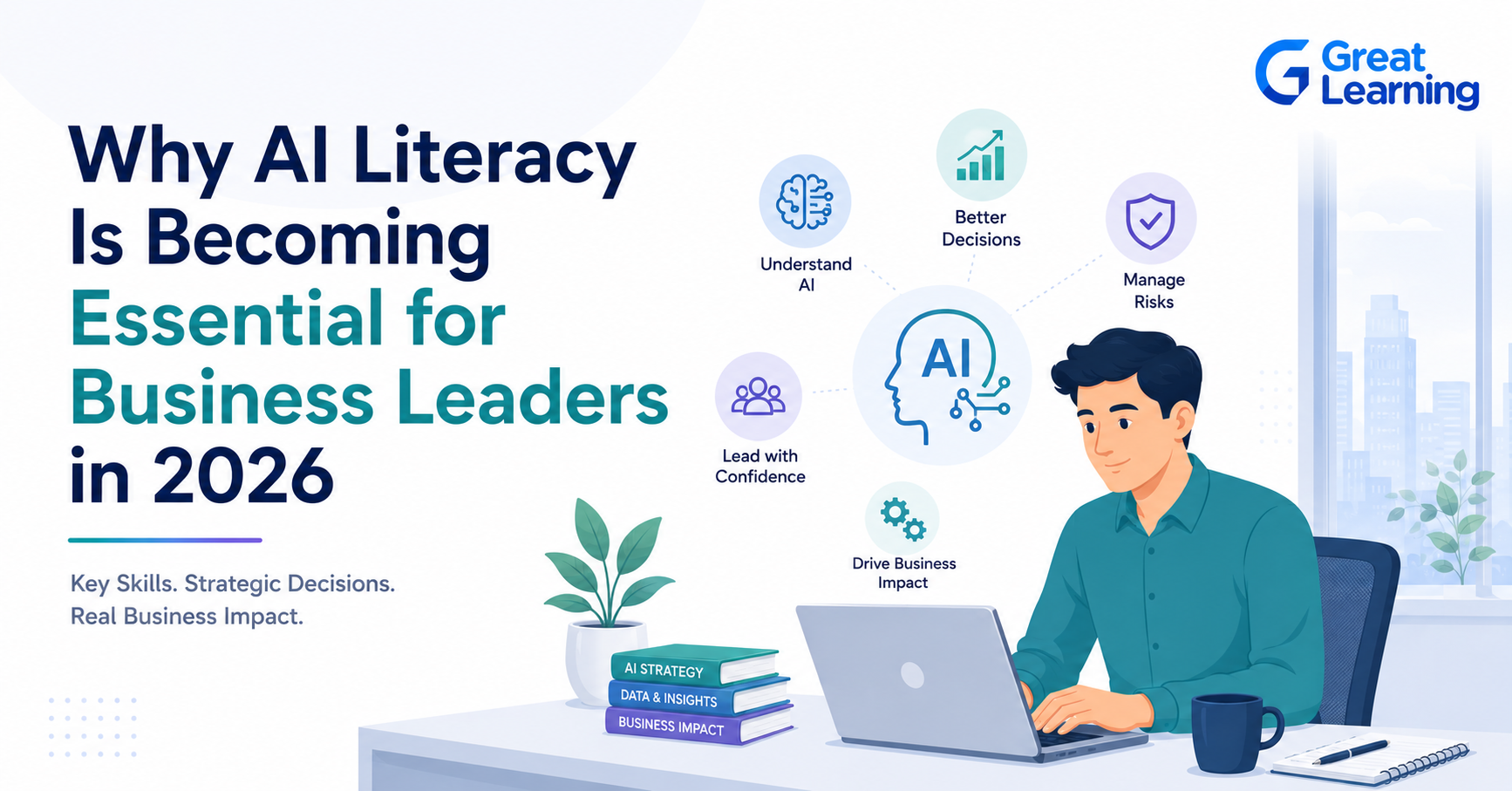
AI literacy for business leaders is the ability to understand AI concepts, evaluate business opportunities, make informed decisions about AI adoption, and lead AI initiatives without necessarily building AI systems themselves.
Being AI-literate does not mean becoming a data scientist or a machine learning engineer. Instead, it means having enough knowledge to ask the right questions, assess risks, collaborate with technical teams, and ensure AI investments align with business objectives.
The rise of no-code AI platforms has made AI more accessible than ever. Business leaders can now evaluate AI tools, experiment with business use cases, and focus on strategic outcomes without writing a single line of code.
AI-literate leaders understand:
- What AI can and cannot do
- Where AI creates business value
- The importance of data quality
- Ethical and governance considerations
- How AI supports business strategy
- The risks associated with AI implementation
For example, a retail executive evaluating an AI-powered demand forecasting solution does not need to build predictive models.
However, they should understand how the model uses historical data, what factors influence its predictions, and how its recommendations affect inventory planning and customer satisfaction.
This level of understanding helps leaders make informed decisions while avoiding unrealistic expectations about AI capabilities.
Why AI Literacy for Business Leaders Is Becoming Essential in 2026
AI literacy enables business leaders to make informed strategic decisions, identify valuable AI opportunities, and guide responsible AI adoption across their organizations.
Organizations are rapidly integrating AI into customer service, supply chain management, financial planning, marketing, cybersecurity, and product development.
According to Gartner's 2026 CEO Survey, 80% of CEOs expect AI to significantly reshape their organizations' operational capabilities.
As AI becomes embedded in everyday operations, leaders who understand its business impact are better equipped to drive innovation, evaluate AI investments, and manage associated risks with confidence.
By automating routine tasks with AI, organizations can practically realize its value and allow teams to dedicate more time to strategic, high-impact initiatives.
AI literacy is becoming essential because it helps leaders:
- Identify high-impact AI use cases
- Evaluate AI investment opportunities
- Improve operational efficiency
- Make data-informed decisions
- Collaborate effectively with technical teams
- Strengthen AI governance and compliance
Consider a healthcare executive evaluating AI for patient scheduling. Rather than focusing solely on automation, an AI-literate leader can assess how the solution improves patient experience, reduces administrative workload, protects sensitive health data, and aligns with organizational goals.
This broader perspective allows leaders to approach AI as a business capability rather than simply another technology investment.
Core AI Literacy Skills Every Business Leader Should Develop
Business leaders need a balanced understanding of AI, data, business strategy, and governance to make confident decisions in an AI-driven environment.
Unlike technical specialists, leaders should focus on the concepts that influence business outcomes and organizational performance.
Key AI literacy skills include:
| Skill | Why It Matters |
| AI Fundamentals | Understand core AI concepts and terminology |
| Data Literacy | Make informed decisions using reliable data |
| AI Strategy | Align AI initiatives with business goals |
| AI Governance | Promote responsible and compliant AI adoption |
| Business Analysis | Identify high-value AI opportunities |
| Risk Assessment | Evaluate technical, legal, and operational risks |
| Change Management | Support AI adoption across teams |
| Decision-Making | Balance innovation with business priorities |
For example, a marketing leader introducing AI-powered personalization should understand how customer data is collected, how recommendations are generated, and how privacy regulations influence implementation.
These skills help leaders move beyond AI hype and focus on measurable business outcomes.
How AI Literacy Helps Business Leaders Make Better Strategic Decisions
AI literacy enables leaders to evaluate opportunities objectively, ask better questions, and make decisions that balance innovation with business value.
Many organizations struggle with AI projects because decision-makers either overestimate what AI can achieve or underestimate the organizational changes required for successful implementation.
AI-literate leaders approach decisions by considering:
- The business problem being solved
- Data availability and quality
- Implementation costs
- Expected business outcomes
- Ethical implications
- Long-term scalability
For instance, before investing in an AI-powered customer support platform, a business leader should evaluate whether customer inquiries are repetitive enough for automation, whether existing systems can integrate with AI tools, and how success will be measured after deployment.
This structured decision-making process reduces implementation risks while improving the likelihood of achieving meaningful business results.
Common AI Challenges Business Leaders Should Understand
Understanding AI challenges is just as important as understanding AI opportunities. Leaders who recognize potential risks can make better decisions and build more responsible AI strategies.
Skills remain one of the biggest barriers to AI adoption. According to the OECD, around 40% of employers in manufacturing and finance cite AI skills shortages as the primary challenge, highlighting why AI literacy is becoming a leadership priority.
While AI offers significant business benefits, successful implementation depends on addressing technical, operational, and organizational challenges. Ignoring these factors can lead to poor adoption, compliance issues, or projects that fail to deliver measurable value.
Some of the most common challenges include:
- Poor data quality
- Unclear business objectives
- Employee resistance to AI adoption
- Privacy and security concerns
- AI bias and fairness
- Regulatory compliance
- Integration with existing systems
- Measuring AI return on investment (ROI)
For example, an organization may invest in an AI-powered customer service platform expecting immediate cost savings. However, if historical customer data is incomplete or inconsistent, the AI system may generate inaccurate responses, leading to lower customer satisfaction instead of improved efficiency.
Recognizing these challenges early enables leaders to create realistic implementation plans and allocate resources more effectively.
Why AI Governance and Responsible AI Matter for Business Leaders
AI governance ensures that AI systems are developed and used responsibly and ethically, and aligned with business goals and regulatory requirements.
As AI becomes part of critical business processes, leaders must ensure that AI-supported decisions are transparent, fair, and accountable. Strong governance helps organizations reduce risks while building trust among customers, employees, and stakeholders.
Business leaders should understand:
- Responsible AI principles
- Data privacy and security
- AI ethics
- Regulatory compliance
- Human oversight
- Risk management
- AI performance monitoring
Consider a financial institution using AI for loan approvals. Without appropriate governance, biased training data could lead to unfair lending decisions. Establishing governance policies and regular model reviews helps organizations identify and address such issues before they affect customers.
Responsible AI is no longer just a technical concern—it is a leadership responsibility that directly influences business reputation and long-term success.
How Business Leaders Can Build AI Literacy Effectively
Building AI literacy requires a combination of foundational knowledge, practical business applications, and continuous learning rather than deep technical specialization.
Many leaders begin by exploring articles, industry reports, webinars, and executive briefings. While these resources provide valuable insights, understanding how AI fits into business strategy often requires a more structured learning approach.
An effective learning pathway should include:
- AI fundamentals
- Machine learning concepts
- Generative AI applications
- AI strategy and business transformation
- Data-driven decision-making
- AI governance and ethics
- Industry use cases
- Executive-level AI implementation frameworks
Learning through real business case studies also helps leaders understand how organizations successfully adopt AI while managing operational and regulatory challenges.
For executives seeking a structured learning experience, the Artificial Intelligence course by Texas McCombs offers an executive-focused curriculum that helps leaders understand AI from strategic and business perspectives.
Post Graduate Program in AI & Machine Learning: Business Applications
Master in-demand AI and machine learning skills with this executive-level AI course—designed to transform professionals into strategic tech leaders.
Rather than focusing on coding or algorithm development, the program explores how AI can drive innovation, improve decision-making, support digital transformation, and create long-term business value across industries.
Leadership Benefits of AI Literacy for Business Leaders
AI literacy helps business leaders make better decisions, lead innovation, and prepare their organizations for an increasingly AI-driven future.
Developing AI literacy creates value beyond technology initiatives. It strengthens strategic thinking, improves collaboration with technical teams, and enables leaders to evaluate AI investments with greater confidence.
Professionals with AI literacy often contribute to initiatives such as:
| Leadership Area | How AI Literacy Creates Value |
| Business Strategy | Identify AI opportunities that align with organizational goals |
| Operations | Improve efficiency through intelligent automation |
| Customer Experience | Support AI-driven personalization and service improvements |
| Innovation | Evaluate emerging AI technologies for competitive advantage |
| Risk Management | Balance innovation with governance and compliance |
| Digital Transformation | Lead organization-wide AI adoption initiatives |
As organizations continue investing in AI, leaders who understand both business strategy and AI fundamentals will be better positioned to guide transformation initiatives and make informed decisions that deliver sustainable value.
Build AI Leadership Skills Through Executive Education
While self-learning through books, reports, and industry events is valuable, many business leaders benefit from a structured Artificial Intelligence course that combines AI fundamentals with strategic business applications.
If you're looking to strengthen your understanding of AI from a leadership perspective, the Artificial Intelligence course by Texas McCombs is one option to consider.
This Artificial Intelligence course is designed for executives and business professionals; the program explores AI strategy, machine learning fundamentals, generative AI, business transformation, governance, and real-world industry applications.
By combining academic insights with practical business case studies, it helps leaders develop the confidence to evaluate AI opportunities and lead AI-driven initiatives within their organizations.
Final Thoughts
Artificial intelligence is no longer just a technology initiative—it has become a strategic business capability. As AI continues to influence decision-making, operations, customer experience, and innovation, leaders who understand its potential and limitations will be better equipped to guide their organizations through change.
Developing AI Literacy for Business Leaders is about making informed decisions, asking the right questions, evaluating opportunities critically, and leading the responsible adoption of AI.
It enables executives to bridge the gap between business strategy and technology, ensuring AI investments create measurable value rather than simply following market trends.
As AI becomes a standard part of business strategy, leaders who build AI literacy today will be better positioned to drive innovation, manage risk, and create long-term competitive advantage in an increasingly AI-powered economy.
Frequently Asked Questions
1. What AI literacy skills should every business leader have?
Business leaders should understand AI fundamentals, data literacy, AI governance, business strategy, risk management, and how to identify high-impact AI use cases. These skills enable leaders to evaluate AI opportunities, collaborate effectively with technical teams, and make informed strategic decisions without requiring advanced technical expertise.
2. Does AI literacy require coding knowledge?
No. AI literacy does not require coding knowledge. Instead, it focuses on understanding AI capabilities, limitations, governance, and business applications. While technical knowledge can be helpful, business leaders benefit most from learning how AI supports decision-making and organizational strategy.
3. How is AI literacy different from AI fluency?
AI literacy is the ability to understand AI concepts, evaluate business use cases, and make informed decisions about AI adoption. AI fluency goes a step further by enabling professionals to work confidently with AI tools, interpret AI outputs, and integrate AI into everyday business processes.
4. How should leaders evaluate an AI business use case?
Leaders should start by identifying the business problem, assessing data quality and availability, estimating the expected business value, evaluating implementation costs, considering governance and compliance requirements, and defining measurable success metrics before investing in an AI solution.
5. Which questions should executives ask AI vendors?
Executives should ask how the AI solution works, what data it requires, how it protects privacy, how its outputs are evaluated, what governance measures are in place, how it integrates with existing systems, and how success will be measured after implementation.
6. How should organizations measure AI ROI?
Organizations should measure AI ROI using both financial and operational metrics, including cost savings, productivity improvements, revenue growth, customer satisfaction, decision-making speed, and process efficiency. Measuring business outcomes alongside technical performance provides a more complete picture of AI's impact.
7. What are the biggest risks of generative and agentic AI?
Some of the biggest risks include inaccurate or biased outputs, data privacy concerns, security vulnerabilities, regulatory compliance issues, and overreliance on AI-generated decisions. Strong AI governance, human oversight, and continuous monitoring help reduce these risks.
8. How long does building executive AI literacy take?
The time required depends on a leader's background and learning goals. Most executives can develop a solid understanding of AI fundamentals, business applications, and governance within a few weeks or months through structured learning and practical business case studies. Ongoing learning remains important as AI technologies continue to evolve.
9. Which AI course suits business leaders seeking hands-on experience?
Business leaders seeking practical AI knowledge should look for programs that combine AI fundamentals with business strategy, governance, and real-world applications. The Artificial Intelligence course by Texas McCombs is an option that helps executives evaluate AI opportunities, lead AI initiatives, and drive business transformation with confidence.