
- Why AI Skills Matter Before Specialising in AI
- Core Analytical Skills Working Professionals Need Before Learning AI
- Essential Data Skills That Build a Strong AI Foundation
- Programming Skills That Help Professionals Transition into AI
- Business and Problem-Solving Skills That Complement AI Expertise
- Why AI Fundamentals Matter Before Learning Machine Learning and Generative AI
- Communication and Collaboration Skills That Help Professionals Succeed in AI Projects
- Common Challenges Working Professionals Face When Building AI Skills
- How Working Professionals Can Build AI Skills Through Structured Learning
- Final Thoughts
- Frequently Asked Questions
Every company seems to be doing something with Artificial Intelligence now, approving loans faster, personalising recommendations, and automating support tickets.
As adoption expands, more working professionals are considering a transition into AI-related roles. However, for many working professionals, the hardest part of moving into AI is knowing what to learn first.
Jumping straight into advanced machine learning or generative AI without the right foundation can make the learning journey harder than it needs to be.
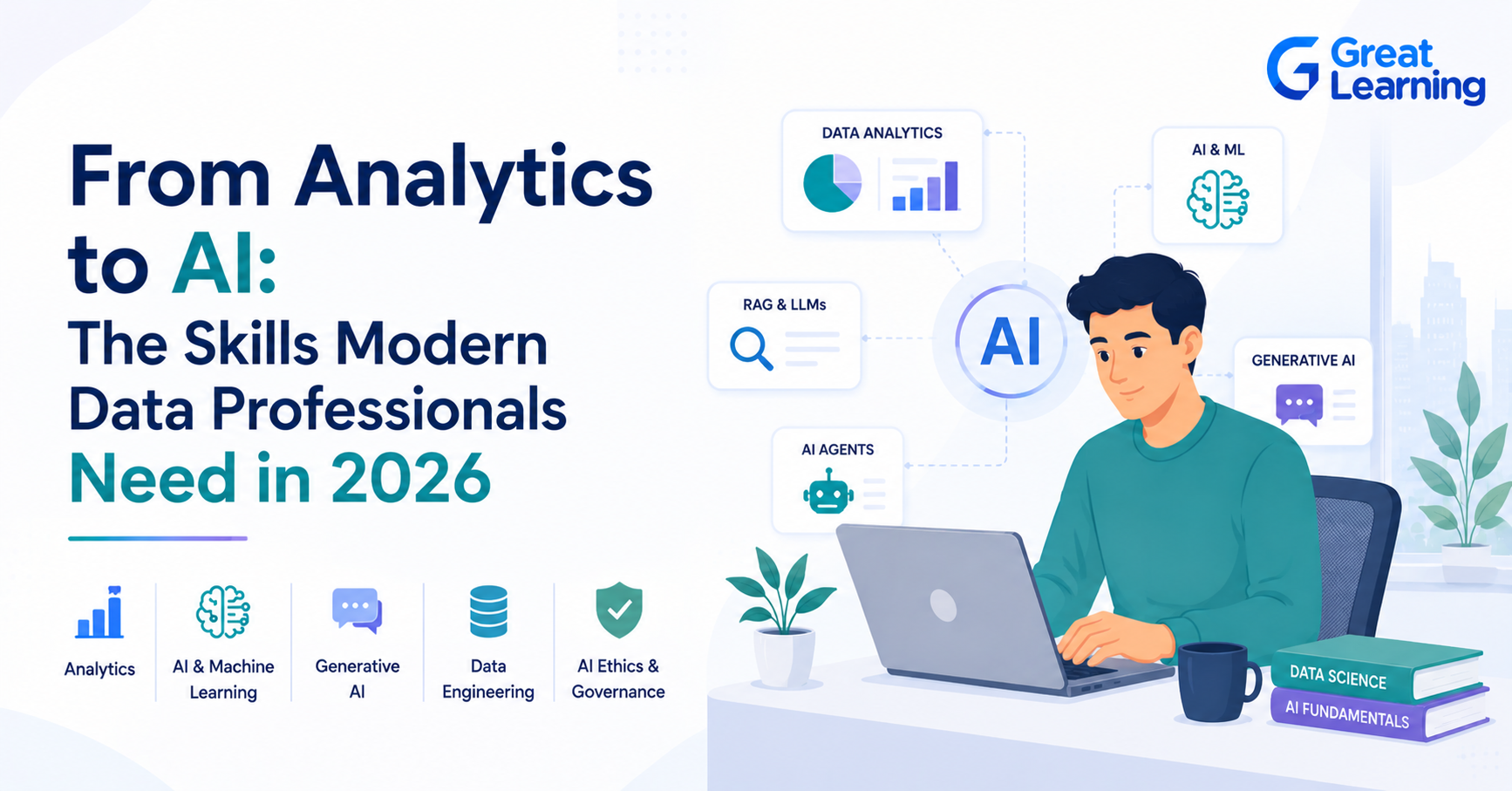
Building the right AI skills for working professionals starts with understanding the core competencies that support AI applications. Before moving into advanced machine learning, generative AI, or agentic AI, you need a foundation in analytical thinking, data literacy, basic statistics, Python, SQL, AI fundamentals, business problem-solving, responsible AI, and communication.
From analytical thinking and programming to data literacy and business problem-solving, these skills create a strong foundation for anyone looking to specialise in artificial intelligence.
This guide explains which AI skills working professionals should develop first and how to judge whether their foundation is strong enough for a specialisation.
Why AI Skills Matter Before Specialising in AI
Developing foundational AI skills helps working professionals understand how AI systems solve business problems, making it easier to learn advanced concepts and apply them effectively in real-world scenarios.
This isn't just anecdotal. Organisations increasingly want professionals who combine domain expertise with AI knowledge, and India's talent market already reflects that shift. Stanford's AI Index 2025 ranks India's AI skill penetration among the highest globally, well ahead of most economies.
Whether you work in finance, marketing, operations, healthcare, or IT, understanding how AI fits into business workflows is becoming a valuable career advantage.
According to the World Economic Forum, AI and big data rank among the fastest-growing skills through 2030. Analytical thinking, leadership, and collaboration remain important alongside these technical skills. The report also estimates nearly 40% of job skills will change by 2030.
Rather than focusing solely on algorithms, professionals who understand data, business objectives, and technology can identify where AI can create measurable impact, often leading to more successful implementations.
Not every professional needs to become an AI engineer. Domain professionals need enough knowledge of AI, data, and problem-solving to identify useful applications, question unreliable outputs, and work effectively with technical teams.
For example, a marketing manager with knowledge of customer analytics and AI fundamentals will understand how recommendation systems use customer data, where errors might arise, and which business measures should determine success.
Building these foundations makes advanced topics such as machine learning, deep learning, generative AI, and AI agents easier to understand and apply.
Core Analytical Skills Working Professionals Need Before Learning AI
Analytical thinking is one of the most important AI skills for working professionals because AI systems rely on structured problem-solving and data-driven decision-making.
Before learning complex AI models, professionals should be comfortable breaking large business challenges into smaller, measurable problems.
Important analytical skills include:
- Critical thinking and logical reasoning
- Problem decomposition
- Decision-making
- Business analysis
- Data interpretation
Consider a supply chain manager trying to reduce delivery delays. Instead of immediately applying an AI model, the first step is to understand root causes, identify relevant data sources, and define measurable outcomes.
Before selecting an AI tool or model, test the problem using five questions:
- What business outcome needs improvement?
- Which decision should AI support?
- Is reliable and relevant data available?
- How will success be measured?
- Would a simpler rule, dashboard, automation, or process change solve the problem?
This problem-first check reduces wasted effort and keeps the focus on measurable business value rather than the latest technology.
Strong analytical skills make it easier to determine whether AI is the right solution and how it should be implemented, and these abilities remain valuable regardless of which AI tools emerge in the future.
Essential Data Skills That Build a Strong AI Foundation
Data is the foundation of every AI system, making data literacy essential for professionals preparing to specialise in AI.
Data literacy means understanding where data comes from, how it is organised, what is missing, and whether it suits the intended task.
Working professionals should recognise both structured and unstructured data, common data-cleaning issues, labels, bias, privacy concerns, and the limits of dashboards and model outputs.
AI models learn from data, so understanding how data is collected, organised, cleaned, and analysed is critical.
Professionals don't need to become data engineers, but should understand the principles behind working with structured and unstructured data.
Key data skills include:
- Data collection and cleaning
- Data visualization
- SQL fundamentals
- Spreadsheet analysis
- Basic statistics
- Dashboard interpretation
Imagine an HR professional using AI to improve recruitment. If candidate data is incomplete or inconsistent, even the most advanced AI model will produce unreliable recommendations.
Understanding data quality helps professionals identify and address these issues before deploying AI solutions and builds confidence when communicating with data teams and evaluating AI outputs.
Programming Skills That Help Professionals Transition into AI
Programming requirements vary by role. For example, business leaders and functional experts mainly need to understand data inputs, APIs, model outputs, and technical constraints. Analysts and applied AI practitioners benefit from Python, SQL, Pandas, NumPy, data visualisation, file handling, and API basics.
Programming isn't mandatory for every AI-related role, but learning basic coding significantly expands the opportunities available to working professionals entering the field. Python remains the most widely used language for AI because of its simplicity and extensive ecosystem.
Professionals should focus on:
- Python fundamentals, variables, and data types
- Functions, loops, and conditional statements
- File handling
- Libraries such as NumPy and Pandas
- API basics
For most working professionals, the first practical goal is not advanced software engineering. The first goal is learning to clean a dataset, automate a small task, call an API, or test a simple model.
Business and Problem-Solving Skills That Complement AI Expertise
AI delivers the greatest value when it solves meaningful business problems, making business knowledge one of the most overlooked AI skills for working professionals.
Successful AI initiatives require more than technical expertise; professionals must understand organisational goals, customer needs, operational challenges, and performance metrics.
Important complementary skills include:
- Business communication and stakeholder management
- Project planning
- Process optimisation
- Change management
- Ethical decision-making
For instance, implementing an AI-powered customer support system involves balancing automation with customer experience, regulatory requirements, and operational efficiency.
Developing both technical and business skills prepares professionals to lead AI initiatives rather than simply participate in them.
Why AI Fundamentals Matter Before Learning Machine Learning and Generative AI
Understanding AI fundamentals before specialising helps working professionals build a stronger conceptual foundation.
Many learners are eager to explore machine learning, generative AI, or AI agents immediately. Still, these technologies are easier to understand once they grasp core concepts such as how AI systems make decisions, process data, and solve problems.
Before moving into a specialisation, understand these concepts:
- Artificial intelligence: Systems designed to perform tasks involving perception, prediction, language, reasoning, or decision support.
- Machine learning: Methods designed to learn patterns from data and produce predictions or classifications.
- Deep learning: A form of machine learning based on multi-layer neural networks.
- Generative AI: Models designed to produce text, images, code, audio, or other content.
- AI agents: Systems combining models, tools, memory, and instructions to complete multi-step tasks.
- Model evaluation: Checks used to assess accuracy, reliability, errors, and business usefulness.
- Responsible AI: Practices for managing bias, privacy, security, transparency, accountability, and human oversight. NITI Aayog’s Responsible AI principles emphasise safety and reliability, equality, inclusion and non-discrimination, privacy and security, transparency, accountability, and positive human values.
Understanding these differences helps professionals select an approach based on the problem rather than choosing a technology solely because it is new.
Communication and Collaboration Skills That Help Professionals Succeed in AI Projects
AI projects require collaboration across technical and business teams, making communication one of the most valuable AI skills for working professionals.
Data scientists, engineers, business leaders, product managers, and domain experts all contribute to successful AI implementation, and professionals who can translate technical concepts for stakeholders often play a critical role.
Important collaboration skills include:
- Presenting data-driven insights
- Cross-functional communication
- Stakeholder management
- Documentation and team collaboration
Consider a finance professional working with an AI team to automate fraud detection. While technical experts develop the model, the finance specialist provides business context, validates outputs, and ensures the solution aligns with regulatory requirements.
These skills become increasingly important as organisations integrate AI across multiple business functions.
Common Challenges Working Professionals Face When Building AI Skills
Learning AI while managing a full-time job can be challenging, but understanding these obstacles helps professionals build a more effective learning strategy.
One of the biggest challenges is deciding what to learn first, since professionals often jump between topics without a structured understanding of AI.
Other common challenges include:
- Limited study time
- Rapidly evolving AI technologies
- Balancing theory with practical application
- Choosing relevant tools and frameworks
- Building real-world projects and applying concepts to business problems
Each challenge needs a practical response:
- Limited study time: Set three to five study hours each week and focus on one skill at a time.
- Rapid changes in AI tools: Learn the underlying concepts before switching tools or frameworks.
- Too much theory: Apply each topic through a small work-related exercise.
- No project experience: Begin with one dataset, one business question, and one measurable outcome.
- Unclear direction: Select a target role before selecting advanced courses or certifications.
Working professionals do not need to study every AI topic. Their study plan should reflect the work they want to perform, such as using AI in a current role, analyzing data, leading AI projects, or building AI systems.
How Working Professionals Can Build AI Skills Through Structured Learning
Self-study works well when you know your target role, follow a consistent schedule, and assess your own projects.
Structured learning suits professionals who need an ordered curriculum, deadlines, mentor feedback, project reviews, or help connecting technical concepts with business applications.
Before choosing an AI and ML course, compare the curriculum with your current skill gaps. Look for coverage of Python, data analysis, machine learning, generative AI, responsible AI, practical projects, and deployment. Review the weekly commitment, technical depth, feedback process, and learner support.
A structured curriculum should ideally cover:
- AI fundamentals and machine learning concepts
- Data analytics and Python for AI
- Generative AI
- Business applications of AI
- Responsible AI practices
- Capstone projects
One option for professionals looking to build these capabilities is the Artificial Intelligence course by Texas McCombs and Great Lakes Executive Learning. The curriculum combines foundational AI concepts with practical learning, helping professionals understand how AI applies across business functions.
PG Program in AI & Machine Learning
Master AI with hands-on projects, expert mentorship, and a prestigious certificate from UT Austin and Great Lakes Executive Learning.
Instead of focusing only on algorithms, the Artificial Intelligence course emphasises solving real-world business problems through hands-on learning, making it suitable for professionals looking to transition into AI or strengthen their existing technical expertise.
Review the program curriculum against your target role, current knowledge, available study time, and preferred level of technical depth before making an enrolment decision.
Final Thoughts
Building AI skills starts with strong fundamentals, not advanced tools.
Before specializing in machine learning, generative AI, or AI agents, working professionals should develop analytical thinking, data literacy, Python, SQL, AI fundamentals, business problem-solving, responsible AI, and communication skills.
Whether you choose self-learning or a structured program such as the Artificial Intelligence course by Texas McCombs and Great Lakes Executive Learning, building a solid foundation will help you apply AI effectively and adapt as the technology continues to evolve.
Frequently Asked Questions
1. What are the most important AI skills for working professionals?
The most important skills include analytical thinking, data literacy, Python programming, AI fundamentals, machine learning basics, business problem-solving, and communication. Together, these provide a strong foundation for applying AI in real-world business scenarios.
2. Do I need a technical background to learn AI?
Not necessarily. Business leaders, product managers, and functional experts may begin with AI concepts, data literacy, output evaluation, and responsible AI. Analysts and technical practitioners need stronger Python, SQL, statistics, and model-building skills. The required technical depth depends on the role you want to perform.
3. How long does it take for working professionals to develop AI skills?
The timeline depends on prior experience and the time you can dedicate each week. Professionals who consistently combine theoretical learning with hands-on projects often build a solid foundation within a few months. Continuous learning is essential because AI technologies evolve rapidly.
4. Which industries are hiring professionals with AI skills?
AI skills are in demand across healthcare, finance, retail, manufacturing, education, technology, logistics, and consulting. Organisations increasingly seek professionals who can apply AI to improve business processes, enhance customer experiences, and support data-driven decision-making.
5. Do working professionals need to know coding before learning AI?
Not immediately. Many professionals start with AI fundamentals and data literacy, then add Python once they're ready to build or evaluate models directly. Coding depth depends on the role; a business leader needs far less than an AI practitioner.
6. Do I need advanced mathematics before learning AI?
Not for every role. Business leaders and functional professionals usually need a basic understanding of statistics, metrics, probability, and uncertainty. Applied AI and machine learning roles require stronger knowledge of statistics, probability, linear algebra, and optimisation.
7. How do I know when I am ready to specialise in AI?
You are ready when you understand core AI concepts, work with basic data, define a suitable problem, evaluate a simple output, identify major risks, and communicate findings clearly. Expert-level mastery of every foundation is not required before selecting a specialisation.