
Convolutional Neural Networks Free Course
Convolutional Neural Networks
 4.57
Intermediate level
4.5 learning hrs
4.57
Intermediate level
4.5 learning hrs
Enroll In Convolutional Neural Networks free course and get a completion certificate. Plus, access over 1,000 additional free courses with certificates—just sign up for free!
Instructor:
Prof. Mukesh Rao




About this course
Machine learning and deep neural networks are of increasing interest to engineers. The current research trend is to use convolutional neural networks (CNNs) to produce state-of-the-art results in various application areas. CNN’s have been around for a while, but they’ve only recently become popular.CNN’s are on the cutting edge of machine learning because they can be trained on more than one task at a time, provide state-of-the-art performance across many domains, and be more easily applied to new tasks than other types of neural networks.
Convolutional Neural Networks (CNNs) is a type of neural network that became popular in the 2010s. CNN’s are used for image recognition tasks, where they outperform other deep learning algorithms. CNN’s are composed of multiple layers of neurons, with each layer performing a convolution operation on the input. Convolutional Neural Networks (CNNs) are neural networks designed to learn and classify visual images efficiently. A CNN is a neural network with many layers, some of which are convolutions and others fully connected. They work by breaking down the images into perceptive features and then classify them based on these features. CNN can also be used for image recognition or speech recognition tasks. In this course, we will learn how CNNs work and some of the applications they have been used in.
In this course, we will talk about digital images, the convolution process, and pooling features such as max and average pooling. We will also uncover kernels and various filters along with feature maps in the Convolution process of CNN. There is a need of preparing the deep neural network with many layers as they are used to design the learning algorithms. So, We will discuss in this course Batch normalization, which is part of Deep Learning.
Check out our Top Courses in Artificial Intelligence Today.
Course outline
Get access to the complete curriculum once you enroll in the course
 4.57
4.57






What our learners enjoyed the most
Skill & tools
65% of learners found all the desired skills & tools
Our course instructor

Prof. Mukesh Rao
Senior Faculty, Academics, Great Learning
Artificial Intelligence Expert


Frequently Asked Questions
Will I receive a certificate upon completing this free course?
Is this course free?
Will I get a certificate after completing this Convolutional Neural Networks free course?
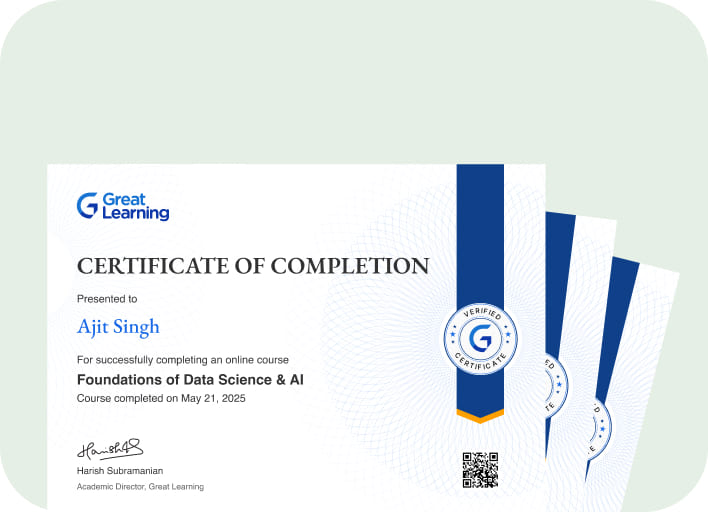
Yes, you will get a certificate of completion for Convolutional Neural Networks after completing all the modules and cracking the assessment. The assessment tests your knowledge of the subject and badges your skills.
How much does this Convolutional Neural Networks course cost?
It is an entirely free course from Great Learning Academy. Anyone interested in learning the basics of Convolutional Neural Networks can get started with this course.
Is there any limit on how many times I can take this free course?
Once you enroll in the Convolutional Neural Networks course, you have lifetime access to it. So, you can log in anytime and learn it for free online.
Can I sign up for multiple courses from Great Learning Academy at the same time?
Yes, you can enroll in as many courses as you want from Great Learning Academy. There is no limit to the number of courses you can enroll in at once, but since the courses offered by Great Learning Academy are free, we suggest you learn one by one to get the best out of the subject.
Why choose Great Learning Academy for this free Convolutional Neural Networks course?
Great Learning Academy provides this Convolutional Neural Networks course for free online. The course is self-paced and helps you understand various topics that fall under the subject with solved problems and demonstrated examples. The course is carefully designed, keeping in mind to cater to both beginners and professionals, and is delivered by subject experts. Great Learning is a global ed-tech platform dedicated to developing competent professionals. Great Learning Academy is an initiative by Great Learning that offers in-demand free online courses to help people advance in their jobs. More than 5 million learners from 140 countries have benefited from Great Learning Academy's free online courses with certificates. It is a one-stop place for all of a learner's goals.
What are the steps to enroll in this Convolutional Neural Networks course?
Enrolling in any of the Great Learning Academy’s courses is just one step process. Sign-up for the course, you are interested in learning through your E-mail ID and start learning them for free online.
Will I have lifetime access to this free Convolutional Neural Networks course?
Yes, once you enroll in the course, you will have lifetime access, where you can log in and learn whenever you want to.

Recommended Free AI courses
-
FREE

-
FREE
-
FREE
-
FREE
-
FREE
-
FREE
1 hr
-
FREE
-
FREE
 FREE
FREE


.jpg "Course thumbnail image")

.jpg "Course thumbnail image")


Similar courses you might like
-
FREE
-
FREE
-
FREE
-
FREE


Related Artificial Intelligence Courses

-
6 Weeks · Online · Weekend
Money Back GuaranteeKnow More
-
Johns Hopkins University
Certificate Program in AI Business Strategy10 weeks · Online
Know More
-
Walsh College
MS in Artificial Intelligence & Machine Learning2 Years · Online
Know More






Relevant Career Paths >


Other Artificial Intelligence tutorials for you
Convolutional Neural Networks
Convolutional layers process data in convolutional neural networks (CNNs), which are deep learning networks. CNNs recognize patterns, extract features from images and videos, and identify objects, making them particularly useful for image processing applications such as object detection, image classification, and segmentation.
Neurons with a unique set of weights and biases compose multiple layers in CNNs. The input layer is the first layer, which receives an image and passes it to the next layer. The second layer is the convolutional layer, which extracts features from the input image using convolutional filters that can generate multiple feature maps. The pooling layer, which reduces the size of the feature maps to improve computational complexity and network performance, is the next layer. The fully connected layer, which connects the neurons in the previous layers, is the fourth layer.
Supervised learning algorithms, such as backpropagation, train CNNs. During training, the weights and biases of the neurons in each layer are adjusted to minimize an error function, which measures how well the model performs on a given task. As training progresses, the model becomes more accurate in predicting results.
CNNs are widely used in computer vision, speech recognition, natural language processing, and autonomous driving, as well as medical image analysis, drug discovery, and text classification.
The ability of CNNs to learn complex patterns from data has contributed to their success. They can recognize images in various orientations and sizes and extract features from images that are too small to be seen by humans, making them ideal for image recognition tasks.
A free course on CNN
1. The free course on convolutional neural networks provides an in-depth introduction to the fundamentals of deep learning.
2. Participants will gain an understanding of the architecture of convolutional neural networks, as well as an understanding of the mathematics behind them.
3. The course will cover topics such as convolutional layers and pooling, activation functions, and network optimization.
4. The course will also provide hands-on experience through guided exercises and projects.
5. Upon completing the course, participants will receive a certificate to demonstrate their mastery of the material.