
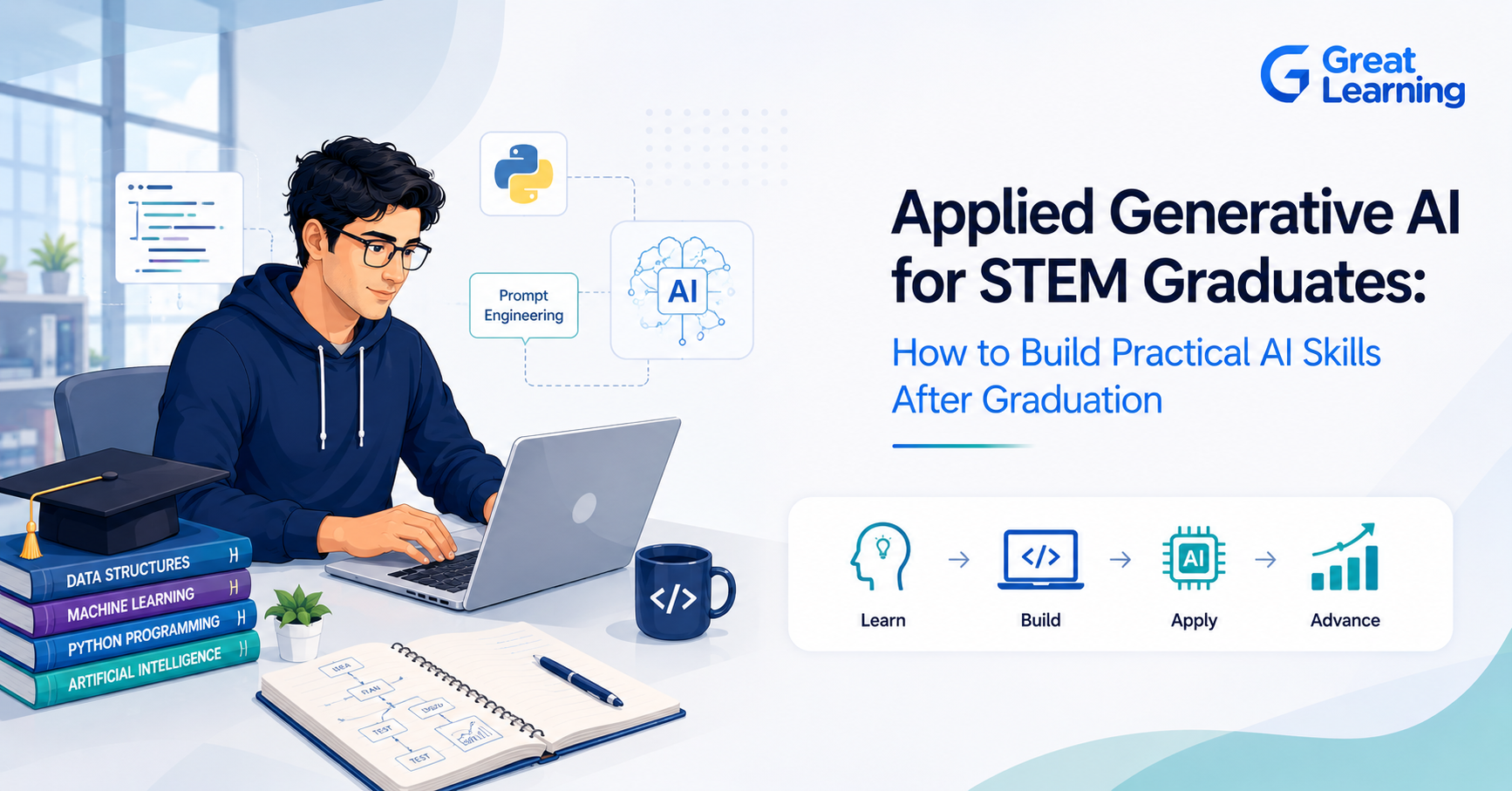
A STEM degree gives you a strong base in logic, problem-solving, and technical thinking. But in today’s job market, that is often not enough on its own. According to the Upskilling Trends Report 2025-26, 69% of professionals feel AI is disrupting their roles, with Gen Z being the most affected at 74%. Employers now expect graduates to understand how to seamlessly integrate AI into real workflows.
This is where Applied Generative AI becomes important. It helps STEM graduates turn technical knowledge into practical AI skills they can use in jobs, projects, and everyday work. Instead of only learning what AI is, graduates need to learn how to build, test, and apply it to real problems.
As Generative AI becomes part of software development, data analysis, research, customer support, and automation, the graduates who know how to work with these tools will have a clear advantage.
Why Practical AI Skills Matter After Graduation
AI is changing how work gets done across industries. Teams are using AI to write code, summarize information, analyze data, automate repetitive tasks, and improve decision-making. In fact, 60% of professionals already use GenAI frequently at their jobs, and 80% use it to learn new skills.
For STEM graduates, this creates a major opportunity. You do not need to become an AI researcher to stay relevant. With 82% of professionals currently in job-search mode and 51% actively looking to switch roles, finding a way to stand out is critical. You do need to understand how to use AI tools in a practical way. That includes knowing:
- How to write better prompts
- How to use Python with AI tools
- How to build simple AI-powered applications
- How to evaluate AI outputs
- How to work with LLMs, RAG, and AI agents
These are the kinds of AI skills after graduation that can help you move from classroom learning to job-ready capability.
Start With the Right Foundation
Before jumping into advanced tools, STEM graduates should build a strong foundation in the basics of Generative AI.
A good starting point includes:
- Generative AI fundamentals
- Large Language Models (LLMs)
- Python programming
- Prompt engineering
- Data handling
- Machine learning basics
- Responsible AI concepts
The data shows that 81% of professionals currently plan to upskill, with 44% specifically focusing on AI and Machine Learning. This reflects the growing demand for AI skills across industries.
You do not need to master everything at once. The goal is to understand how different AI concepts and technologies fit together. Once you build a strong foundation, it becomes much easier to learn new tools, frameworks, and workflows.
Many learners also benefit from structured, project-based learning. Since 64% prefer upskilling programs lasting 6 weeks to 6 months, these programs can offer a practical, manageable way to build expertise.
For STEM graduates seeking a structured pathway into Generative AI, the Applied Generative AI and Agentic AI program from Johns Hopkins University and Great Learning combines hands-on projects, industry mentorship, and practical training in modern AI systems.
Certificate Program in Applied Generative AI
Master the tools and techniques behind generative AI with expert-led, project-based training from Johns Hopkins University.
Key Technical Pillars for STEM Grads
Learn Python for Real AI Work
Python is one of the most useful skills for STEM graduates exploring generative AI. It is widely used for automation, data work, model integration, and AI application development.
With Python, you can:
- Clean and analyze data
- Connect to AI APIs
- Automate tasks
- Build small AI apps
- Test outputs and improve workflows
Even basic Python knowledge can make a big difference. You do not need to be an expert developer to start building. You just need enough skill to turn ideas into working solutions.
If you are learning Python specifically for AI applications, a practical way to get started is through hands-on exercises that combine coding with GenAI workflows. The free Python for Generative AI course is a useful resource for understanding how Python fits into modern AI development.
Master Prompt Engineering
Prompt engineering is one of the easiest ways to begin working with AI. It is the skill of giving clear, structured instructions so the model gives better results.
Good prompts can improve:
- Accuracy
- Consistency
- Tone
- Format
- Usefulness
For STEM graduates, prompt engineering is more than writing clever questions. It is about learning how AI responds, how to guide it, and how to refine its output for practical use.
This is one of the most important practical AI skills because it applies across roles and industries.
Move Beyond Chatbots
Many beginners think Generative AI is only about chatbots. In reality, applied GenAI is much broader.
Modern AI systems can:
- Retrieve information
- Summarize content
- Generate code
- Analyze documents
- Support decisions
- Automate multi-step workflows
This is where concepts like Retrieval-Augmented Generation (RAG) and AI workflows become useful. These approaches help AI systems produce better, more grounded, and more useful results.
One technique that is becoming increasingly important in production AI systems is Retrieval-Augmented Generation (RAG), which helps models access relevant information before generating responses.
If you would like to understand this concept in more depth, you can explore our guide on Retrieval-Augmented Generation (RAG) or take the free RAG course by Great Learning Academy for a more hands-on introduction.
For STEM graduates, learning these ideas is valuable because it shows how AI can be used in real business settings, not just in demos.
Understand AI Agents and Agentic AI
Another important area is Agentic AI. This refers to AI systems that can plan, act, and complete tasks with less human involvement.
Instead of waiting for one prompt at a time, AI agents can:
- Break down tasks
- Use tools
- Make decisions
- Follow workflows
- Coordinate actions
This is a growing area in the AI industry and a useful topic for anyone exploring AI workforce skills. As companies seek greater automation and smarter systems, graduates who understand AI agents will be better prepared for new roles.
For readers who want to see how these concepts work in practice, the Agentic AI with ChatGPT course by Great Learning Academy provides an introduction to autonomous AI systems and workflow automation.
Build Projects to Learn Faster
The best way to learn applied generative AI is by building small projects.
Projects help you:
- Practice what you learn
- Solve real problems
- Improve debugging skills
- Understand AI limits
- Create proof of your abilities
Some good beginner project ideas include:
- An AI research assistant
- A document summarizer
- A resume review tool
- A customer support chatbot
- A meeting notes assistant
- A data analysis helper
These projects do not need to be perfect. They just need to show that you can apply AI to solve a problem.
Learn How to Evaluate AI Outputs
One of the most important skills in applied GenAI is evaluation.
AI can be useful, but it is not always correct. It may give wrong answers, miss context, or produce biased output. That is why STEM graduates should learn how to test, compare, and improve AI responses.
Strong evaluation means looking at:
- Accuracy
- Relevance
- Consistency
- Safety
- Bias
- Hallucinations
This is a key part of building trustworthy AI systems. It also shows employers that you understand more than just the surface level of the tool.
Combine AI With Your STEM Background
The greatest career advantage comes from combining AI knowledge with your existing STEM background.
For example:
- A computer science graduate can build AI tools
- An engineering graduate can automate technical workflows
- A data science graduate can improve analysis using AI
- A mathematics graduate can support modeling and optimization
- A science graduate can use AI for research and documentation
This is why practical AI skills matter so much. They make your STEM background more valuable and more flexible.
Build a Portfolio That Shows Your Skills
If you want to stand out after graduation, do not just list AI skills on your resume. Show them.
A strong portfolio can include:
- GitHub projects
- Short case studies
- Workflow diagrams
- AI prototypes
- Prompt examples
- Documentation of results
A portfolio gives employers something real to review. It proves that you can do more than talk about AI. It shows that you can use it.
Keep Learning as the Field Grows
Generative AI changes quickly. New models, tools, and workflows appear all the time. That is why continuous learning is part of the journey.
You can keep growing by:
- Following AI updates
- Building new projects
- Experimenting with tools
- Reading about AI use cases
- Learning from real workflows
The graduates who keep learning and building will stay ahead.
Conclusion
Despite rapid changes in the job market, 78% of professionals remain optimistic about AI’s potential to enhance their careers. This highlights the growing importance of AI skills across industries.
For STEM graduates, the best way to stay competitive is to build practical AI skills. This includes learning the fundamentals, using Python, practicing prompt engineering, and exploring technologies such as RAG and AI agents.
Building real-world projects is equally important. Practical experience helps learners apply their knowledge and showcase their capabilities to employers.
Many learners also benefit from structured, project-based learning. Such programs provide exposure to industry workflows, portfolio projects, and emerging AI tools. For those looking to strengthen their GenAI expertise, the prompt engineering course by Great Learning Academy offers hands-on learning opportunities.
Learn about Generative AI and how to apply it for creating art, generating content, and exploring endless possibilities. Perfect for anyone eager to dive into the future of technology.
Applied Generative AI is no longer just a trend. It is becoming a core requirement for the modern workforce.
Frequently Asked Questions
1. What is Applied Generative AI?
Applied Generative AI is the practical use of AI tools and models to solve real-world problems. It focuses on building useful solutions, not just learning theory.
2. How can STEM graduates learn Generative AI?
STEM graduates can start with Python, prompt engineering, LLM basics, and small AI projects. A structured learning path makes it easier to build practical skills step by step.
3. What AI skills are most useful after graduation?
Some of the most useful skills include prompt engineering, Python, AI workflows, RAG, AI agents, model evaluation, and responsible AI practices.
4. Is Generative AI a good career path for STEM graduates?
Yes. Generative AI is creating opportunities in software, data, research, automation, healthcare, finance, and many other fields.
5. What are the best practical AI projects for beginners?
Good beginner projects include chatbots, document summarizers, research assistants, content helpers, and simple automation tools.
6. How long does it take to learn Generative AI?
You can learn the basics in a few weeks, but building job-ready skills usually takes a few months of practice, projects, and hands-on learning.