- What Is the Difference Between a Forward Deployed Engineer and a Software Engineer?
- How Do Their Responsibilities Differ on a Real Project?
- How Do Their Technical Skills and Tools Compare?
- What Does a Typical Workday Look Like in Each Role?
- Which Role Better Matches Your Engineering Career Goals?
- Choosing Between the Two Roles
- Frequently Asked Questions
A software company is building an AI assistant for enterprise customers. One engineer develops the underlying APIs and retrieval services.
Another works with a customer to connect the assistant to internal databases, configure access controls, and make the application work within existing business processes.
Both write code. Both solve technical problems. But their responsibilities look different.
Software engineering roles differ in how engineers build, implement, and maintain technology solutions.
While some focus on developing software products, others work directly with customers to implement technology in complex business environments.
This distinction is important when comparing a Forward Deployed Engineer (FDE) with a Software Engineer (SWE).
Although both roles require programming and problem-solving skills, they differ in their responsibilities, customer interactions, and approach to delivering software solutions.
In this guide, we'll explore the key differences between Forward Deployed Engineers and Software Engineers, including their responsibilities, technical skills, daily workflows, and career paths.
What Is the Difference Between a Forward Deployed Engineer and a Software Engineer?
The primary difference between a Forward Deployed Engineer (FDE) and a Software Engineer (SWE) is the scope of their engineering responsibilities.
An FDE typically works directly with customers to develop, integrate, and deploy solutions within their business environments. An SWE often focuses on building and maintaining applications, platforms, or services designed for a broader user base.
Both roles require software development expertise. The distinction is usually whether the engineer primarily owns a customer-specific implementation or a shared product capability.
| Factor | Forward Deployed Engineer | Software Engineer |
|---|---|---|
| Primary Focus | Solving customer-specific technical problems | Building and improving software products |
| Requirements | Often gathered through direct customer interaction | Often defined through product requirements and technical specifications |
| Customer Interaction | Usually frequent and direct | Varies by team and organization |
| Development Work | Integrations, custom applications, and deployment | Product features, backend services, frontend applications, and infrastructure |
| Technical Scope | Often spans multiple systems and technologies | Often focuses on a product, platform, or technical specialization |
| Success Measures | Customer outcomes and successful implementation | Product quality, reliability, performance, and delivery goals |
These differences are not absolute. Software Engineers may participate in customer discovery, while Forward Deployed Engineers can contribute reusable components and improvements to core products.
For example, a Software Engineer might develop an API that supports thousands of applications.
A Forward Deployed Engineer could integrate that API with a customer's existing systems and build the additional components needed to solve a specific business problem.
For a detailed introduction to the role, read what is Forward Deployed Engineering.
How Do Their Responsibilities Differ on a Real Project?
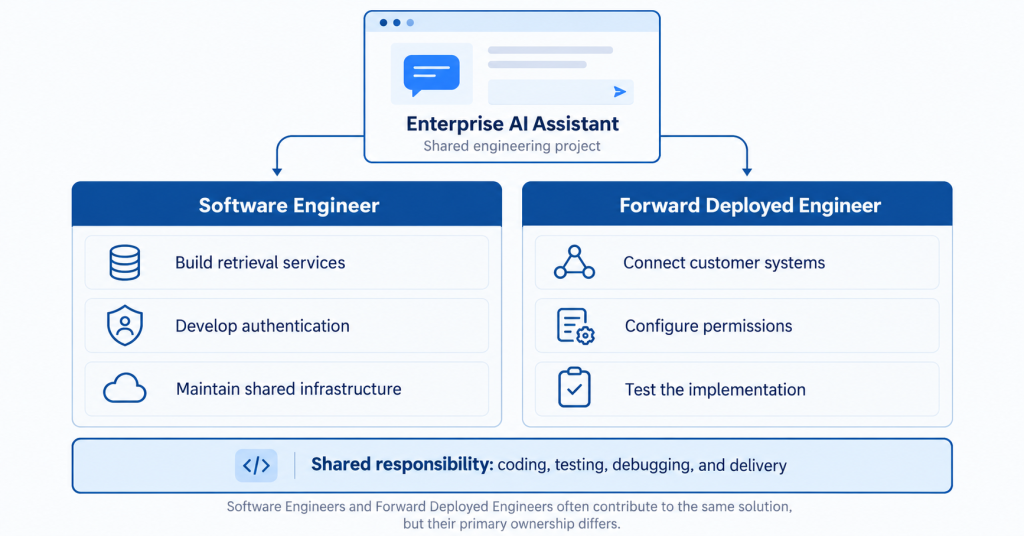
Consider the enterprise AI assistant introduced earlier. The company wants employees to retrieve information from internal documents and customer records without switching between multiple systems.
A Software Engineer working on the underlying product might develop the retrieval service, implement authentication mechanisms, and build evaluation tools that support multiple customers.
A Forward Deployed Engineer might work with the customer to understand employee workflows, connect approved data sources, configure permissions, and integrate the assistant with existing applications. The FDE also tests whether the implementation performs as expected in the customer's environment.
The distinction becomes clearer when something goes wrong. A defect in the shared retrieval service might require a product engineering fix. An issue involving a customer's data permissions or application integration might require the FDE to investigate the deployment, often in collaboration with the product team.
Both engineers write, test, and debug software. Their ownership differs primarily in the context of the problem and the scope of the solution.
How Do Their Technical Skills and Tools Compare?
Forward Deployed Engineers and Software Engineers share many technical skills, including programming, databases, APIs, testing, and debugging. The main difference is how they use these skills.
Forward Deployed Engineers focus on connecting technologies and implementing solutions for specific customers, while Software Engineers often focus on building and improving software products.
Key Technical Skills Compared
| Skill area | Forward Deployed Engineer | Software Engineer |
| Programming | Uses Python, JavaScript, or TypeScript to build applications, integrations, and automation workflows. | Uses programming languages suited to the product, such as Python, Java, JavaScript, or C++. |
| APIs and integration | Connects existing applications, APIs, and data sources to solve customer problems. | Builds, maintains, and improves APIs and software components. |
| Databases | Connects customer databases, transfers data, and resolves data compatibility issues. | Designs databases, writes queries, and improves data storage and retrieval performance. |
| Cloud and deployment | Deploys solutions in customer environments and configures access, monitoring, and integrations. | Builds and maintains applications, cloud services, and deployment pipelines. |
| AI technologies | May integrate LLMs, RAG pipelines, vector databases, and AI agents into business workflows. | May develop AI features, model-serving systems, or the infrastructure supporting AI applications. |
| Testing and debugging | Tests integrations and fixes problems that occur in customer environments. | Tests software components and fixes bugs, performance issues, and reliability problems. |
| Communication | Works directly with customers to understand requirements and explain technical decisions. | Works primarily with engineering, product, and design teams, depending on the role. |
How Do These Skills Differ in Practice?
The technologies required depend on the role. An FDE implementing AI applications may need experience with LLM APIs, retrieval-augmented generation (RAG), and AI agents.
An FDE working on enterprise systems may focus more on APIs, databases, and cloud infrastructure. Similarly, Software Engineers choose tools based on their product and technical specialization.
Forward Deployed Engineers working on AI solutions can benefit from understanding how AI systems are built, deployed, and scaled in production.
Professionals looking to strengthen their expertise in distributed computing, AI infrastructure, and machine learning operations can explore the AI Engineering course by IIT Bombay, which focuses on building and managing scalable AI systems.
IIT Bombay Certificate in AI Engineering and MLOps
Build, scale, and manage AI systems with hands-on training in AI engineering, MLOps, distributed computing, and production AI workflows.
What Does a Typical Workday Look Like in Each Role?
A Software Engineer's day might involve reviewing code, developing product features, debugging applications, improving performance, or working with product and design teams on upcoming releases.
A Forward Deployed Engineer's day is often shaped by customer implementation needs. Tasks might include discussing requirements with stakeholders, investigating integration issues, adapting existing software, testing applications, and supporting deployment.
The work environments also differ. Depending on the organization, FDEs might visit customer sites, collaborate across time zones, or work alongside enterprise technical teams. Software Engineers typically collaborate with internal product and engineering teams, although customer-facing work also exists within software development roles.
These responsibilities often intersect. Product Engineers sometimes own features from discovery through deployment, while FDEs sometimes work with core engineering teams to turn recurring customer requirements into reusable product improvements.
The day-to-day differences can include:
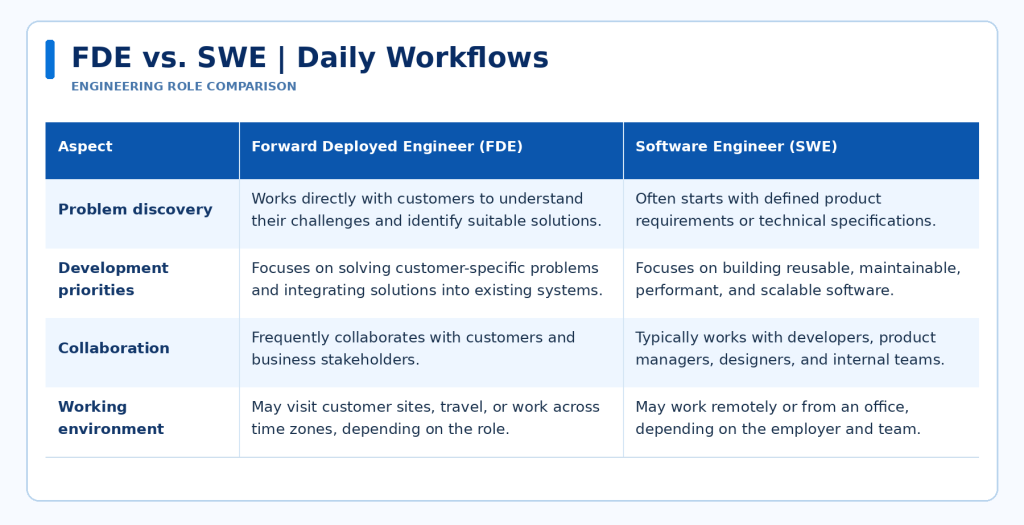
These differences depend on the organization. Product Engineers may own features from discovery through deployment, while Forward Deployed Engineers may work closely with internal product teams to turn recurring customer requirements into reusable capabilities.
Which Role Better Matches Your Engineering Career Goals?
Neither role is inherently better. The right choice depends on the type of problems you want to solve, the technical depth you want to develop, and how much direct customer interaction you prefer.
A Forward Deployed Engineer role may suit you if you enjoy:
- Solving ambiguous business problems and translating them into technical solutions.
- Working across APIs, databases, cloud services, and application layers.
- Integrating AI tools and enterprise software into existing workflows.
- Collaborating directly with customers and explaining technical trade-offs.
- Adapting to different systems, requirements, and implementation constraints.
A Software Engineer role may be a better fit if you prefer:
- Building and maintaining products, applications, or platforms.
- Developing deeper expertise in a particular technical area.
- Working on system architecture, scalability, performance, or reliability.
- Collaborating primarily with internal engineering, design, and product teams.
- Improving software used by a broad and growing user base.
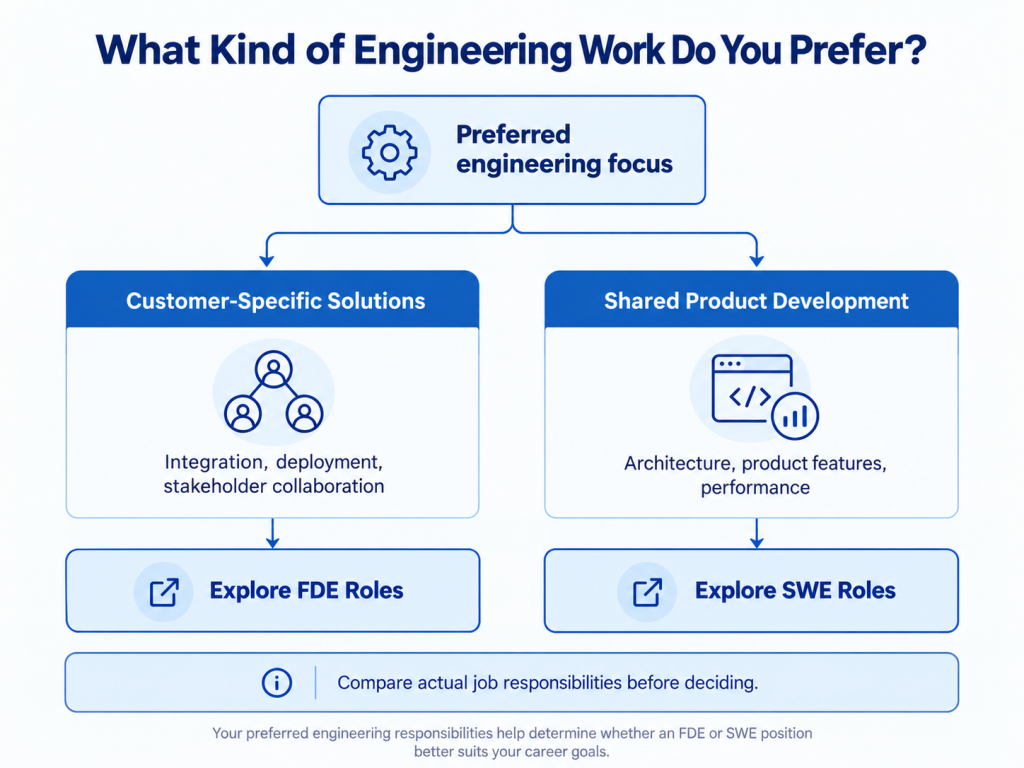
These preferences are guidelines rather than strict boundaries. Software Engineers can work directly with customers, and Forward Deployed Engineers can develop deep expertise in architecture, infrastructure, and AI systems.
Before choosing between the two roles, examine what the employer expects you to own.
Look beyond the job title. Does the position involve substantial coding? Will you work directly with customers? Are you responsible for deploying solutions, maintaining shared product infrastructure, or both?
Also consider how performance is measured. Some roles emphasize successful customer implementations, while others prioritize product reliability, technical quality, and long-term development. The actual responsibilities should guide your decision more than the title alone.
If you are interested in the FDE career path, read How to Become a Forward Deployed Engineer to understand the technical capabilities and practical experience you can develop.
As AI-powered applications become more common in enterprise environments, Forward Deployed Engineers and Software Engineers can benefit from learning how to develop, deploy, and maintain production-ready AI solutions.
The Artificial Intelligence Engineering course by JHU explores production AI systems, agentic AI, MLOps, LLMOps, and cloud-based deployment workflows.
JHU Certificate Program in AI and Agentic AI Engineering
Designed for software developers, data and AI professionals seeking hands-on technical expertise in building, deploying, and scaling AI and Agentic AI systems using MLOps, LLMOps, and cloud platforms.
Choosing Between the Two Roles
The most useful question is not which engineering role is better, but which problems you want to take responsibility for.
If you enjoy working directly with customers, connecting systems, and adapting software to business requirements, Forward Deployed Engineering deserves consideration.
If you prefer developing shared software capabilities and improving product architecture, performance, or reliability, traditional Software Engineering might be a stronger fit.
Before applying, assess the engineering depth, customer involvement, deployment responsibilities, and success measures described in each role. These details reveal more about the work than the job title.
Frequently Asked Questions
1. Is a Forward Deployed Engineer the same as a Software Engineer?
No. Both roles involve software development, but Forward Deployed Engineers typically focus on customer-specific implementations, while Software Engineers often build and maintain shared products, platforms, and services.
2. Do Forward Deployed Engineers write code?
Yes. Forward Deployed Engineers write, test, and debug code for integrations, custom applications, automation workflows, and other solutions deployed in customer environments.
3. Which role involves more customer interaction?
Forward Deployed Engineers generally interact more directly with customers to understand requirements and implement solutions. Software Engineer roles vary, and some involve substantial customer research and collaboration.
4. Are the technical skills for both roles similar?
Yes. Both require programming, APIs, databases, testing, debugging, and software design. Forward Deployed Engineers may need broader systems integration and deployment experience, depending on their projects.
5. Can a Software Engineer become a Forward Deployed Engineer?
Yes. Software Engineers can build on their existing development experience by gaining practical skills in systems integration, cloud deployment, requirements analysis, and customer-focused implementation.