- What Does It Take to Become a Forward Deployed Engineer?
- Which Technical Skills Should You Learn First?
- How Can You Build AI and Systems Integration Skills?
- Which Projects Should You Build for an FDE Portfolio?
- What Does a Forward Deployed Engineer Career Path Look Like?
- Where Should You Start?
- Frequently Asked Questions
A company builds an AI assistant to help its customer support team. The prototype works, but deployment raises new questions. How will the assistant access customer records? Who approves its actions? What happens when an integration fails?
These are the kinds of problems Forward Deployed Engineers (FDEs) help solve. They work closely with customers to turn software capabilities into applications that fit existing systems and business workflows.
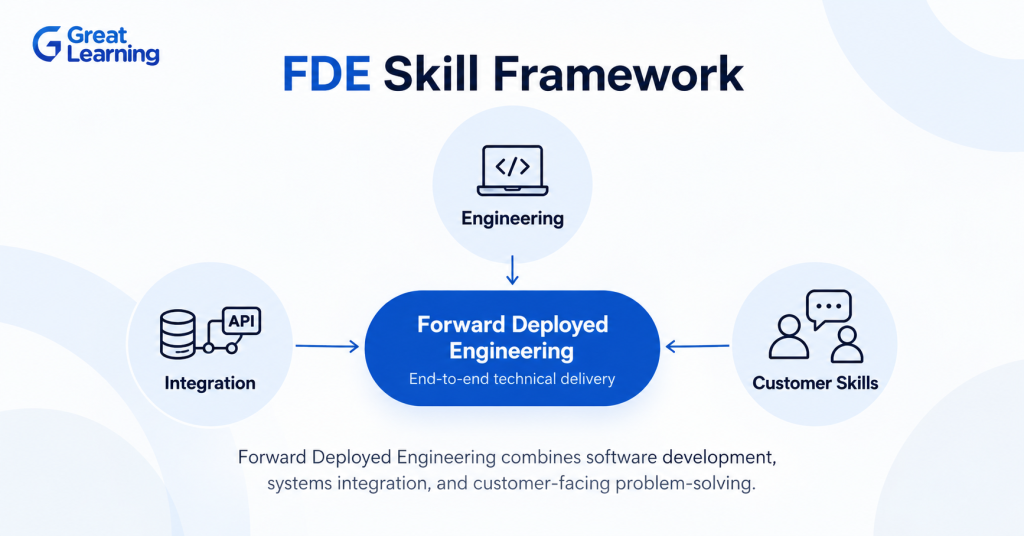
A Forward Deployed Engineer (FDE) combines software development with hands-on implementation in customer environments.
What Does It Take to Become a Forward Deployed Engineer?
To become a Forward Deployed Engineer, you need strong software engineering skills, experience connecting systems, and the ability to work directly with customers. The role extends beyond developing features. You help define requirements, make technical decisions, deploy applications, and address problems after implementation.
Relevant backgrounds include backend development, full-stack engineering, data engineering, AI engineering, and technical consulting.
There is no single educational qualification or career path that applies to every FDE position. Employers generally look for evidence that candidates can understand a problem, develop a technical solution, integrate the necessary systems, and support deployment.
For example, a company might want to automate customer support using an AI assistant. The implementation could require an LLM, internal knowledge sources, a CRM integration, and appropriate access controls.
An FDE needs to understand how these components interact and how the application will fit into the customer's workflow.
Which Technical Skills Should You Learn First?
Start with software engineering fundamentals before moving to specialized frameworks. These skills help you build applications, integrate existing systems, and troubleshoot problems in real customer environments.
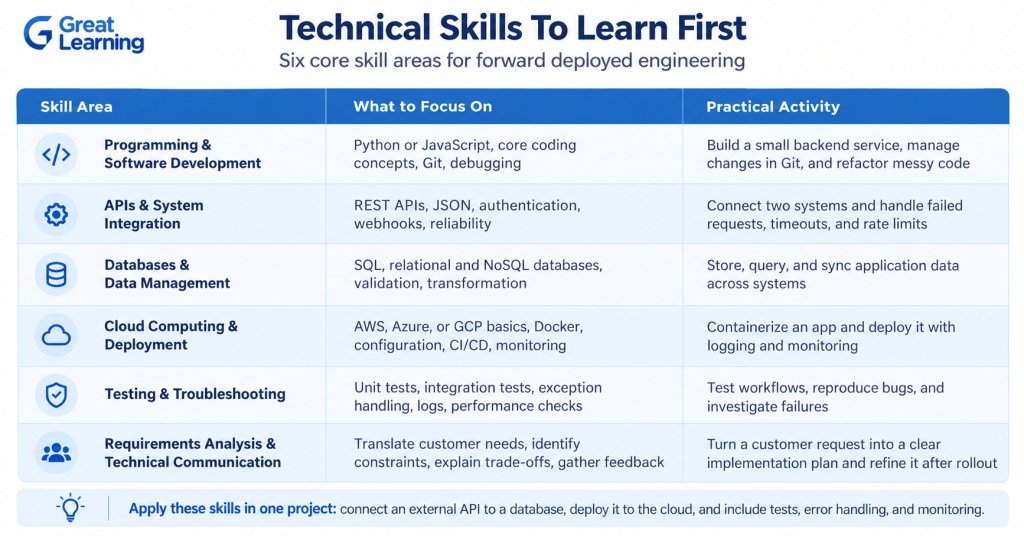
For example, a customer might request an automated order-processing system without defining how failed transactions should be handled. An FDE needs to clarify the expected behavior, design an appropriate solution, and confirm the requirements before implementation.
To apply these skills, build a project that connects an external API to a database and deploys the application to the cloud. Include tests, error handling, and monitoring.
This demonstrates that you can build and maintain a working solution, rather than just write code that runs locally.
How Can You Build AI and Systems Integration Skills?
After establishing your programming and deployment foundations, practise combining different technologies into complete applications.
AI development skills are increasingly relevant to enterprise AI deployments, but FDE requirements differ by employer and role. Some positions focus on software platforms, infrastructure, or data integration. Others require experience with LLM APIs, retrieval systems, AI agents, and evaluation. Start with integration fundamentals, then develop specialized skills aligned with the positions you want to pursue.
Systems integration is a practical starting point. Build an application that retrieves information from a database, calls an external API, and presents the results through a simple interface.
Include authentication, input validation, error handling, and logging so that you can investigate failures.
Next, explore AI application development. Learn to integrate an LLM API, generate structured responses, and connect a model to external information.
Retrieval-augmented generation (RAG) is useful for applications that need to answer questions using approved documents or internal knowledge sources.
You can then explore AI agents that use tools to perform multi-step tasks. For enterprise applications, understand how permissions, input validation, and human approval can control actions that affect business systems.
When testing your implementations, pay attention to practical reliability requirements:
- Test failed requests, response times, and data consistency.
- Evaluate AI answer accuracy, retrieval quality, latency, and cost where relevant.
- Protect credentials and apply suitable access controls.
- Record errors so you can identify recurring problems and improve the implementation.
These practices help establish whether a solution is suitable for its intended purpose.
To develop skills in production AI and agentic systems, explore the Johns Hopkins University’s Artificial Intelligence Engineering course. This 22-week online program covers Generative AI, AI agents, MLOps, LLMOps, cloud deployment, and responsible AI, with hands-on projects and industry mentorship.
JHU Certificate Program in AI and Agentic AI Engineering
Designed for software developers, data and AI professionals seeking hands-on technical expertise in building, deploying, and scaling AI and Agentic AI systems using MLOps, LLMOps, and cloud platforms.
For a deeper explanation of the role and its responsibilities, read what is Forward Deployed Engineering.
Which Projects Should You Build for an FDE Portfolio?
A strong portfolio demonstrates how you solve a business problem, integrate the necessary technologies, and deliver a usable application. Focus on two or three complete projects rather than building many disconnected demonstrations.
1. AI assistant for internal documents
Build an assistant that answers questions using product manuals, technical documentation, or sample business policies. Use an LLM API and retrieval system, and include source references, test questions, and a way to handle questions the available documents cannot answer.
This project demonstrates AI integration, application development, retrieval, and evaluation.
2. CRM or workflow automation
Create an application that processes a customer inquiry, retrieves relevant account information, and prepares a response for review. Include API integration, input validation, execution logs, and safeguards against unintended changes to customer records.
This demonstrates backend development, systems integration, and an understanding of business workflows.
3. Data integration dashboard
Combine information from two sources, such as inventory records and shipment updates, to identify potentially delayed orders. Include data validation, timestamps, and meaningful metrics. Sample datasets and simulated APIs are sufficient when real business data is unavailable.
This project demonstrates data handling, integration design, and practical problem-solving.
For every project, document the problem statement, architecture, technology choices, testing process, and limitations.
Publish the code in a repository and provide a working demonstration where possible. Report performance improvements or accuracy figures only when you have measured them.
A portfolio becomes more convincing when it explains why the solution was designed a particular way, how failures are handled, and what would need to change before deployment in a larger environment.
Practical advice: Present each project as an implementation case study. Explain the business problem, technical constraints, architecture, and decisions behind your solution. Show how you tested integrations, handled failures, and addressed security requirements.
Where possible, include a working demonstration, architecture diagram, and test results. The goal is to demonstrate how you approach a customer problem and deliver a reliable application, rather than simply showcase the technologies you used.
What Does a Forward Deployed Engineer Career Path Look Like?
Forward Deployed Engineers can enter the field from several technical backgrounds. A software developer may expand into systems integration and customer-facing implementation, while a data engineer may move toward integrated applications and AI-powered workflows.
How Do You Transition Into an FDE Role?
If you already work in software engineering, start by identifying gaps in your experience. Backend developers might focus on customer requirements and deployment ownership.
Data engineers might expand into application development and API integration. AI engineers might strengthen production monitoring, access controls, and enterprise system integration.
Look for opportunities to participate in customer-facing implementations, integration projects, or cross-functional technical delivery. Document your contributions, especially where you helped solve an operational problem or improve an existing workflow.
When applying, connect your experience to the responsibilities in each job description. Employers differ in their expectations, so evidence of end-to-end delivery matters more than following one prescribed career route.
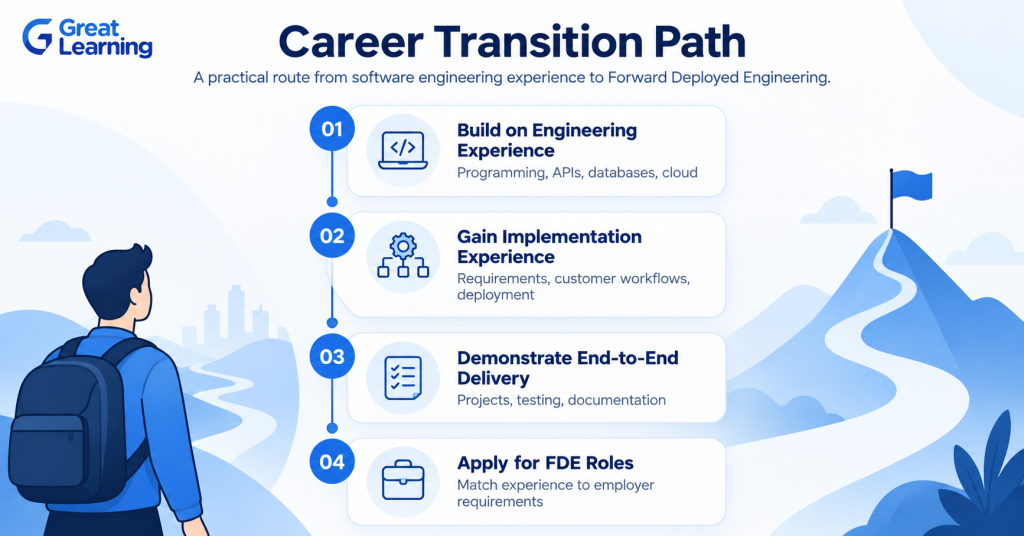
A practical route from software engineering experience to Forward Deployed Engineering
With experience, an FDE may pursue several directions:
- Senior or Lead Forward Deployed Engineer: Handles complex implementations, architecture decisions, and technical delivery.
- Forward Deployed Engineering Manager: Leads engineers, coordinates delivery, and develops implementation practices.
- Related technical roles: Moves into areas such as applied AI engineering, solutions architecture, platform engineering, or broader engineering leadership.
These are potential pathways rather than a fixed promotion ladder. Responsibilities and titles vary across employers, so career progression depends on the complexity of projects handled, technical expertise, and the ability to deliver reliable outcomes.
The most useful long-term goal is to become comfortable with the complete lifecycle of a solution: understanding a problem, designing the implementation, connecting systems, deploying the application, evaluating its results, and improving it through feedback.
Professionals looking to build expertise in AI infrastructure, distributed computing, and production deployment can explore IIT Bombay’s AI Engineering course. This five-month online program covers high-performance computing, distributed ML systems, large-model training, and enterprise MLOps.
IIT Bombay Certificate in AI Engineering and MLOps
Build, scale, and manage AI systems with hands-on training in AI engineering, MLOps, distributed computing, and production AI workflows.
For a detailed comparison of FDE responsibilities and conventional software development, read Forward Deployed Engineer vs Software Engineer.
Where Should You Start?
Start with one business problem that requires more than writing code. Build an application, connect the necessary systems, deploy it, and document how you handle errors, access controls, and user feedback.
If you already have software engineering experience, focus on developing the customer-facing and implementation skills missing from your current work.
A completed project with clear technical decisions and evidence of reliability is a practical starting point for an FDE career transition.
Frequently Asked Questions
1. What qualifications are required to become a Forward Deployed Engineer?
Requirements vary by employer. Software engineering, data engineering, AI engineering, or technical deployment experience can help, alongside strong programming and systems integration skills.
2. Do you need AI experience to become a Forward Deployed Engineer?
Not always. AI experience is useful for AI-focused positions, while other FDE roles emphasize enterprise software, data platforms, and systems integration.
3. Which programming language should you learn first?
Python is a practical starting point for backend development, automation, and AI applications. JavaScript or TypeScript is valuable for web and full-stack development.
4. Which projects are useful for an FDE portfolio?
AI knowledge assistants, CRM integrations, workflow automation, and data dashboards can demonstrate end-to-end implementation when supported by testing, deployment, and documentation.
5. Can a software engineer transition into Forward Deployed Engineering?
Yes. Software engineers can build on their existing experience by developing systems integration, cloud deployment, requirements analysis, and customer-focused problem-solving skills.