- How Does Forward Deployed Engineering Work?
- What Does a Forward Deployed Engineer Do?
- What Skills Does a Forward Deployed Engineer Need?
- What Are the Applications of Forward Deployed Engineering?
- When Does Forward Deployed Engineering Make Sense?
- The Real Value of Engineering Close to the Customer
- Frequently Asked Questions
Forward Deployed Engineering (FDE) is an engineering approach in which software engineers work closely with customers to design, build, integrate, and deploy technical solutions for specific business problems.
It combines software development with a practical understanding of customer workflows, infrastructure, and operational requirements.
A Forward Deployed Engineer (FDE) typically contributes throughout implementation, from understanding customer needs to deploying a solution and improving it through feedback.
The approach is especially useful when standard software cannot fully address an organization's technical or operational requirements.
The approach is associated with companies such as Palantir, which emphasizes solving operational problems through close collaboration with customers.
AI companies have also adopted this model to help organizations move AI applications from initial experimentation into production.
Consider a logistics company that wants to identify delayed shipments automatically. Its inventory records, supplier information, and delivery schedules may reside in separate systems.
An FDE can help connect these sources and develop an application that enables the operations team to identify potential delays.
What distinguishes Forward Deployed Engineering is the connection between customer needs and engineering decisions. FDEs address implementation problems directly while identifying recurring requirements that product teams might incorporate into future releases.
The goal is to solve the customer's immediate problem without treating every implementation as an entirely separate product.
How Does Forward Deployed Engineering Work?
Forward Deployed Engineering typically involves five connected stages:
- Scope the problem: Understand the customer's workflows, technical constraints, users, and expected outcomes.
- Integrate the systems: Connect relevant applications, APIs, databases, and infrastructure. Build or adapt software where standard configurations fall short.
- Evaluate the solution: Test functionality, data accuracy, access controls, performance, and failure scenarios against agreed requirements.
- Roll out the application: Introduce the solution into the customer's workflow, address deployment issues, and establish monitoring and operational responsibilities.
- Improve through feedback: Observe how employees use the application, investigate problems, and refine the implementation.
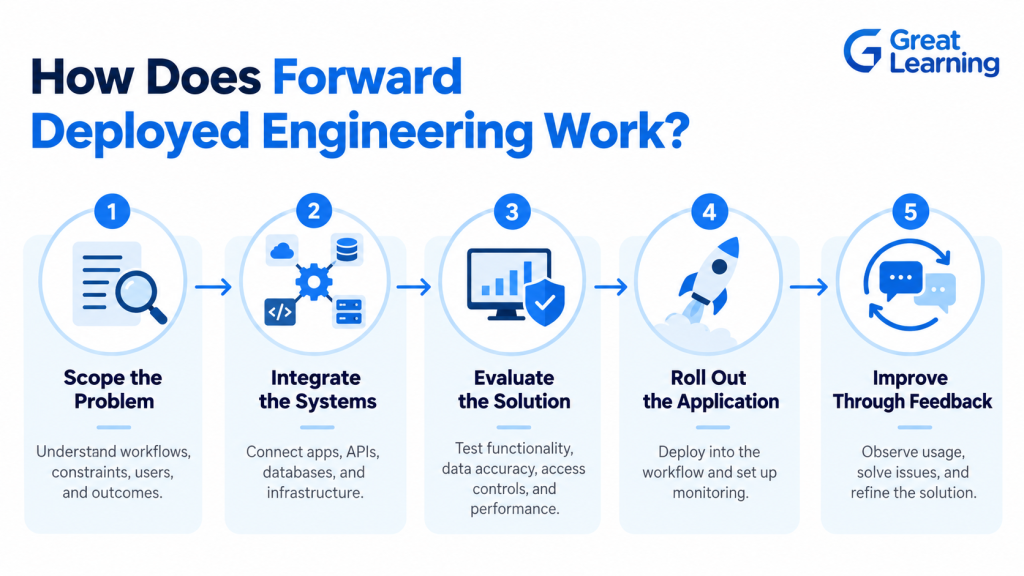
Forward Deployed Engineering connects implementation, evaluation, and continuous improvement.
These stages are iterative rather than strictly sequential. An issue identified during evaluation or employee testing might require changes to an earlier integration or design decision.
The FDE also works with customer teams to establish ownership of access permissions, production support, and future changes.
For example, a logistics company may struggle to identify delayed shipments. A Forward Deployed Engineer could connect inventory records, supplier details, and delivery schedules to build a system that flags potential delays.
They would test the integrations, verify the alerts, and improve the system using feedback from the operations team.
This process helps businesses turn prototypes into practical solutions that address real problems and adapt to changing requirements.
What Does a Forward Deployed Engineer Do?
A Forward Deployed Engineer translates business requirements into working technical solutions and supports their implementation in real-world environments.
Responsibilities typically cover requirements analysis, software development, systems integration, deployment, and continuous improvement.
Common Forward Deployed Engineer responsibilities include:
- Requirements analysis: Understand customer workflows, technical limitations, and expected business outcomes.
- Solution design: Plan application architecture, data flows, integrations, and implementation requirements.
- Software development: Build, test, debug, and maintain applications, services, and automation workflows.
- Systems integration: Connect APIs, databases, cloud services, and enterprise platforms.
- Deployment and troubleshooting: Resolve technical issues and move applications from prototypes into production.
- AI implementation: Where relevant, integrate large language models (LLMs), retrieval-augmented generation (RAG), or AI agents into business applications.
- Feedback and iteration: Improve deployed solutions and share useful implementation insights with product teams.
Consider a company deploying an AI assistant to answer employee questions using internal policy documents.
The prototype performs well with sample questions, but production introduces additional requirements.
Some employees should access only certain documents, policy updates need to appear in responses, and the application must handle questions without reliable supporting information.
An FDE works with the customer's teams to connect approved document sources, enforce access permissions, evaluate response accuracy, and define how the system should respond when information is missing.
Employee feedback then helps the team identify retrieval problems, update evaluations, and improve the application before expanding usage.
The work extends beyond writing code. The engineer must ensure that the solution fits the customer's systems, meets operational requirements, and remains reliable after deployment.
For a detailed comparison with conventional software development, read Forward Deployed Engineer vs Software Engineer.
What Skills Does a Forward Deployed Engineer Need?
Forward Deployed Engineers need strong software development, systems integration, troubleshooting, and communication skills.
AI engineering expertise becomes important when the role involves deploying language models, retrieval systems, or AI agents.
They must be able to build applications, connect existing systems, troubleshoot technical problems, and adapt solutions to real business requirements. The exact skills vary by organization, but the following areas provide a strong foundation.
Key technical skills include:
- Programming: Python, JavaScript, or TypeScript for building applications, backend services, scripts, and automation workflows. Engineers should understand data structures, error handling, debugging, and writing maintainable code.
- APIs and system integration: REST APIs, HTTP methods, JSON, authentication, webhooks, and API testing. These skills help engineers connect different applications and move data between business systems.
- Databases and data handling: SQL, relational databases, data modeling, and data transformation. Knowledge of MongoDB or other NoSQL databases can also help when working with unstructured data.
- Cloud and deployment: AWS, Azure, or Google Cloud, along with Docker, CI/CD pipelines, environment configuration, logging, and monitoring. These skills help engineers deploy and maintain reliable applications.
- AI and LLM integration: LLM APIs, retrieval-augmented generation (RAG), vector databases, AI agents, prompt engineering, and model evaluation for AI-focused roles.
Beyond technical expertise, Forward Deployed Engineers need problem-solving, communication, and stakeholder management skills.
They must translate business requirements into technical solutions, explain trade-offs clearly, and work closely with customers to resolve issues.
For example, deploying an AI assistant requires more than connecting an LLM API. Engineers must integrate relevant business data, control access, evaluate response quality, and handle failures.
Professionals looking to strengthen their AI infrastructure and deployment skills can explore IIT Bombay’s AI Engineering course, a five-month online program covering distributed ML systems, high-performance computing, large-model training, and enterprise MLOps.
IIT Bombay Certificate in AI Engineering and MLOps
Build, scale, and manage AI systems with hands-on training in AI engineering, MLOps, distributed computing, and production AI workflows.
What Are the Applications of Forward Deployed Engineering?
Forward Deployed Engineering is useful wherever organizations need technical solutions adapted to their systems, workflows, and operational constraints. Its applications extend beyond AI to enterprise software, data infrastructure, and specialized business applications.
Common applications include:
- Enterprise AI implementation: Integrating AI assistants and agents with internal documents, customer records, and business applications while addressing permissions, evaluation, and reliability.
- Data integration and analytics: Connecting information from CRM, ERP, inventory, and reporting systems to provide a unified view of business operations.
- Workflow automation: Automating repetitive tasks, data entry, and application handoffs while accounting for exceptions and approval requirements.
- Legacy-system modernization: Connecting older applications with modern cloud services through APIs and integration layers.
- Customer-specific applications: Developing software components tailored to specialized workflows, industry requirements, and proprietary data structures.
For example, a manufacturer might need to combine production schedules, inventory levels, and supplier information to identify operational delays.
An FDE can integrate the relevant data sources and build an application that helps teams make informed decisions.
Across these applications, the value of Forward Deployed Engineering comes from connecting technical implementation with practical business requirements. The goal is to deliver solutions that work reliably in the environments where they are needed.
Professionals interested in building production-ready AI applications can explore the Artificial Intelligence Engineering course by JHU. This 22-week online program covers Agentic AI, RAG, MLOps, LLMOps, cloud deployment, and responsible AI through hands-on projects and industry mentorship.
JHU Certificate Program in AI and Agentic AI Engineering
Designed for software developers, data and AI professionals seeking hands-on technical expertise in building, deploying, and scaling AI and Agentic AI systems using MLOps, LLMOps, and cloud platforms.
When Does Forward Deployed Engineering Make Sense?
Forward Deployed Engineering is most relevant when solving a customer's problem requires substantial engineering work beyond standard software configuration.
For example, an enterprise might need an AI application to interact with several internal systems, enforce customer-specific permissions, and support an existing approval process.
These requirements might demand ongoing collaboration between engineers and the employees using the application.
An FDE approach is worth evaluating when:
- Customer requirements involve complex or proprietary systems.
- Standard product capabilities do not meet important workflow needs.
- Implementation requires substantial custom development or integration.
- Engineers need regular feedback from customer teams.
- Deployment involves technical constraints that require continuing engineering involvement.
When Is a Standard Implementation Enough?
Not every software deployment needs Forward Deployed Engineering.
If a product already supports the required workflows through existing features, standard integrations, and configuration options, a conventional implementation process might be sufficient.
The decision depends on the complexity of the remaining engineering work, the level of customer collaboration required, and the cost of maintaining a specialized solution.
The Real Value of Engineering Close to the Customer
Forward Deployed Engineering addresses a challenge that conventional software development does not always resolve on its own: adapting technology to the environment in which people need to use it.
The approach is valuable when customer-specific requirements demand direct engineering involvement, continuous feedback, and careful integration with existing systems.
For organizations considering FDE, the central question is whether closer collaboration between engineers and customers will resolve implementation problems that standard product capabilities and support cannot adequately address.
Frequently Asked Questions
1. What is a Forward Deployed Engineer?
A Forward Deployed Engineer works closely with customers to understand technical needs, build tailored applications, integrate systems, and deploy solutions that address business problems.
2. What does Forward Deployed Engineering involve?
It involves understanding requirements, developing software, integrating systems, deploying applications, and improving solutions based on user feedback and operational results.
3. What skills does a Forward Deployed Engineer need?
Typical skills include programming, API integration, databases, cloud deployment, debugging, and communication. AI-focused positions may also require LLM, RAG, and AI agent expertise.
4. Is Forward Deployed Engineering used in AI?
Yes. FDEs help integrate AI models and applications into enterprise workflows while addressing data access, security, evaluation, reliability, and production requirements.
5. Which industries use Forward Deployed Engineering?
Financial services, manufacturing, healthcare, logistics, and enterprise technology can use FDEs to implement specialized software, data integrations, and AI-powered workflows.