
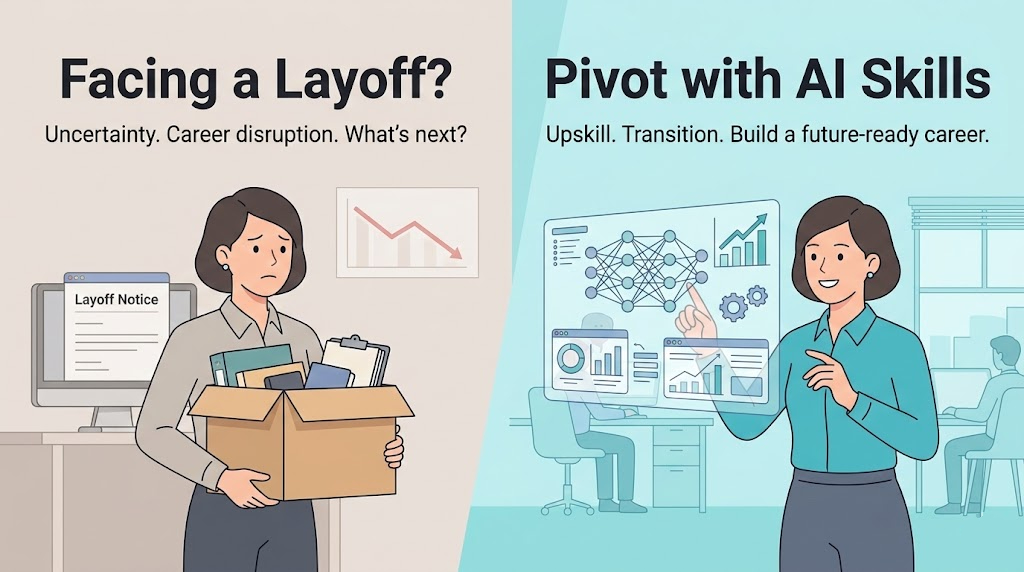
The technology sector is undergoing a profound structural shift. According to data compiled by Layoffs. fyi, nearly 30,000 global tech jobs were eliminated in just the first six weeks of 2026.
Moreover, in the first 40 days alone, major tech giants led a wave of restructuring: Amazon accounted for the single largest layoff by cutting 16,000 roles, while Salesforce quietly laid off nearly 1,000 employees. Alongside 25 other companies, these numbers paint a daunting picture for the modern workforce.
For many professionals, the initial reaction is fear. However, industry leaders and career coaches agree that workers today face a clear choice: either remain vulnerable to automation and restructuring, or actively acquire the skills driving the market forward.
Understanding what 2025 upskilling trends mean for 2026 career growth is no longer optional; it is a strategic necessity for long-term relevance and resilience.
The question for those navigating this layoff wave is simple: How do you pivot effectively, and what credentials actually matter?
In this blog, we break down the most in-demand skills, the domains seeing sustained hiring momentum, and the certifications and learning pathways that can help professionals future-proof their careers in 2026 and beyond.
The Growing Demand for AI Skills in 2026
Before diving into how to pivot after a layoff, it’s important to understand what employers are actually looking for in 2026.
The era of basic AI tool experimentation is over. Companies are no longer hiring professionals who can simply “use AI tools.” Instead, they are investing in talent that can build, deploy, optimize, and govern AI systems at scale.
To stand out in an increasingly competitive job market, mastering the most in-demand skills in artificial intelligence has become essential.
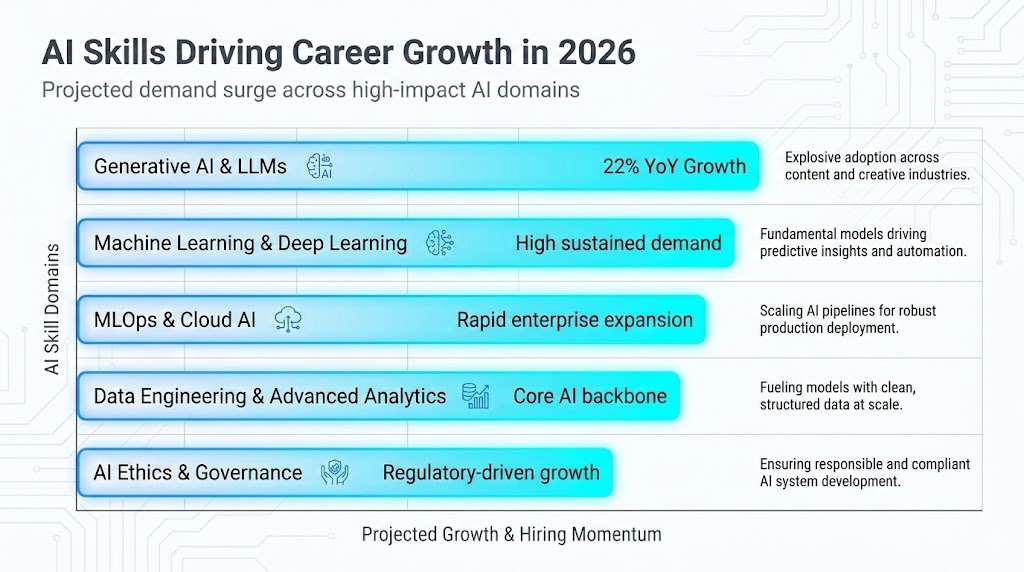
1. Generative AI & Large Language Models (LLMs)
Generative AI is no longer experimental; it’s being integrated into enterprise workflows across marketing, finance, product development, and customer service. Key in-demand competencies include:
- Designing effective prompt strategies for consistent and optimized outputs
- Building Retrieval-Augmented Generation (RAG) pipelines using vector databases
- Fine-tuning LLMs or open-source for domain-specific use cases
- Working with embeddings, semantic search, and knowledge retrieval systems
- Developing AI copilots, chatbots, and internal automation assistants
- Evaluating model outputs for accuracy, hallucination risk, and bias
Why is it critical?
- Generative AI programs are among the fastest-growing learning domains, expanding by 22% year-over-year.
- Organizations are actively building GenAI use cases internally rather than relying solely on third-party tools.
- Professionals who understand implementation, not just usage, command premium salaries.
2. Machine Learning & Deep Learning
Despite the GenAI wave, traditional Machine Learning remains the backbone of enterprise AI.
Core skills employers prioritize:
- Strong understanding of supervised and unsupervised learning algorithms
- Model evaluation techniques such as cross-validation and performance tuning
- Experience building predictive models for classification, regression, and clustering
- Knowledge of deep learning architectures like CNNs, RNNs, and Transformers
- Hands-on expertise with frameworks such as PyTorch and TensorFlow
- Feature engineering and model interpretability for explainable outcomes
Why is it critical?
- Machine Learning continues to be one of the most popular and stable upskilling domains.
- Businesses rely on predictive modeling for forecasting, fraud detection, personalization, and risk assessment.
- ML expertise provides long-term career resilience beyond short-term AI trends.
3. MLOps & Cloud AI
Building a model is only 20% of the job. Deploying and maintaining it at scale is where real business value is created. High-demand areas include:
- Designing scalable model deployment pipelines
- Implementing CI/CD workflows tailored for ML systems
- Monitoring model performance and detecting model drift in production
- Containerizing applications using Docker with Kubernetes
- Deploying AI solutions on cloud platforms such as AWS, Azure, and Google Cloud
- Managing version control, reproducibility, and model governance
Why is it critical?
- Companies need professionals who can bridge the gap between experimentation and production.
- Scalable AI infrastructure is now a core enterprise requirement.
- MLOps skills significantly increase employability for mid-career professionals transitioning into AI.
4. Data Engineering & Advanced Analytics
Data is the foundation of every AI system. Without high-quality data pipelines, even the best algorithms fail. In-demand competencies include:
- Cleaning, preprocessing, and transforming large structured and unstructured datasets
- Building ETL/ELT pipelines to automate data workflows
- Writing advanced SQL queries for efficient data retrieval
- Working with big data tools and distributed systems
- Creating dashboards and visualizations to communicate AI insights
- Ensuring data quality, consistency, and scalability
Why is it critical?
- Poor data quality leads to inaccurate AI outcomes.
- Organizations need professionals who can ensure AI systems generate reliable and actionable insights.
- Data-centric AI roles often serve as an accessible entry point for career pivoters.
5. AI Ethics, Governance & Safety
As AI systems become more embedded in decision-making, governance and accountability are becoming board-level priorities. Emerging high-demand areas include:
- Detecting and mitigating bias in training datasets and model outputs
- Implementing explainable AI (XAI) techniques for transparency
- Designing responsible AI frameworks aligned with regulatory guidelines
- Ensuring compliance with data privacy and AI regulations
- Strengthening AI systems against adversarial attacks and misuse
- Conducting AI risk assessments for enterprise deployment
Why is it critical?
- Governments and enterprises are tightening AI regulations.
- Organizations are prioritizing ethical AI to protect brand reputation.
- Professionals who understand governance alongside technical skills stand out in leadership roles.
In 2026, employers are not hiring “AI enthusiasts.” They are hiring professionals who can:
- Build AI systems
- Deploy them at scale
- Optimize performance
- Ensure compliance and safety
- Translate AI capabilities into business impact
For anyone navigating a layoff, understanding this demand shift is the first step toward making a strategic, future-proof pivot into AI.
How to Choose the Right AI Course After a Layoff?
Choosing the right course in today’s crowded education market can be challenging. Use the framework below to carefully evaluate and compare your options:
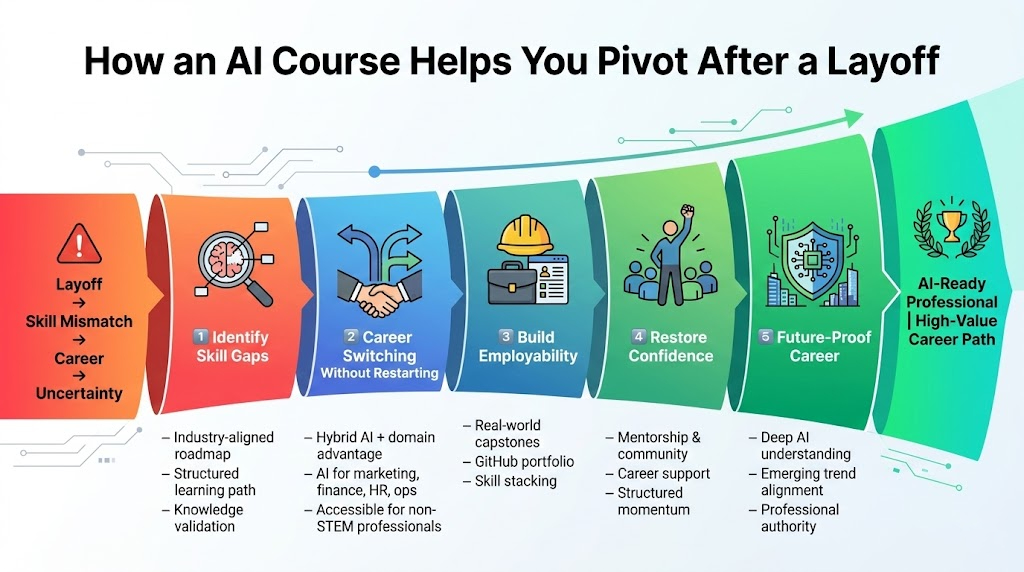
1. Identifying and Closing Skill Gaps
A layoff can often highlight an important reality: your existing skills may no longer fully match current market expectations, especially as AI continues to redefine professional roles.
An AI course can serve both as a diagnostic tool and a structured roadmap, helping you move beyond scattered online resources.
Instead of trying to guess what employers are looking for, a well-designed program aligns your learning directly with industry requirements.
It guides you step by step, beginning with foundational data literacy and progressing toward advanced practical applications.
- Targeted Learning Pathways:
One common challenge is getting stuck in endless, unstructured online tutorials that lack direction and continuity. An AI course provides a carefully designed curriculum with clear progression. It helps you understand how to build knowledge systematically and offers clarity on how to start and grow a career in artificial intelligence and machine learning.
- Mastering End-to-End Capabilities:
Today’s employers value professionals who understand complete AI workflows rather than just isolated tools. Comprehensive programs focus on developing end-to-end AI and Generative AI capabilities, teaching you how to apply algorithms within real business processes and deliver measurable impact.
- Validating Your Knowledge:
Quality courses include structured assessments, assignments, and practical evaluations. These elements ensure that you truly understand key concepts instead of simply learning terminology. Many programs also offer preliminary assessments, allowing you to test your baseline knowledge using available quizzes before committing to a deep dive.
To begin building foundational knowledge in this space, you can explore beginner-friendly programs such as the free Generative AI for Beginners course offered by Great Learning’s Academy.
Free Generative AI for Beginners
Enroll in our free Generative AI course for beginners, covering AI fundamentals, machine learning, neural networks, deep learning, and more. Dive into the world of Generative AI today!
2. Enables Career Switching Without Starting From Scratch
A common misconception about moving into AI is that you must abandon your previous experience and start over as a full-time programmer. In reality, your existing domain knowledge is a strong advantage.
As stated by How India Upskilled in 2025, a large share of professionals entering AI come from non-technical industries such as BFSI, healthcare, marketing, operations, and manufacturing. The key is not replacing your background, but enhancing it.
A structured AI course helps you apply machine learning to the business problems you already understand, creating a valuable hybrid professional profile.
- Marketing & Sales:
Professionals can shift from traditional campaign management to AI-driven decision-making. By learning predictive analytics, customer segmentation, and personalization models, they can forecast consumer behavior and improve campaign performance at scale.
- Finance & Operations:
Leverage your analytical background by learning predictive modeling for risk assessment, fraud detection, and automating routine tasks with AI to drastically streamline supply chains.
- Human Resources:
HR professionals can transition into talent analytics by using AI tools for unbiased candidate screening, predicting attrition, and improving workforce planning through data-backed insights.
- Accessibility for Non-STEM Professionals:
Many learners entering AI do not come from technical or engineering backgrounds. With expert-led and structured learning, the transition becomes practical and achievable rather than overwhelming.
If you are unsure where to begin, exploring Great Learning’s structured career guides and role-specific roadmaps can provide clear direction and help you plan your next steps with confidence.
3. Boosts Employability With Portfolio & Real-World Projects
After a layoff, hiring managers look for clear proof that you can deliver results. Listing theoretical knowledge on a resume is rarely enough. A strong AI course goes beyond concepts and requires you to build practical, real-world projects.
This transforms your resume from a summary of responsibilities into a results-driven portfolio aligned with current machine learning and AI job trends.
- Building a Verifiable GitHub Portfolio:
Quality programs guide you through writing code, training models, and deploying projects on platforms like GitHub. This gives recruiters visible proof of your technical skills, problem-solving ability, and understanding of data workflows.
- Solving Industry-Relevant Capstones:
Instead of relying on clean, textbook datasets, leading courses include capstone projects based on realistic business challenges. These experiences prepare you to handle messy data, ambiguity, and decision-making scenarios similar to real job environments.
- Intentional Skill Stacking:
Many professionals strategically combine complementary skills such as Python, data analysis, and prompt engineering to build a well-rounded profile. This targeted approach helps close specific employer skill gaps and increases job readiness.
If you want to start building a strong project portfolio but are unsure what to create or where to begin, exploring Great Learning’s Project Ideas can give you clear direction, helping you choose relevant topics and build practical, job-ready skills with confidence.
4. Restores Confidence and Provides Structured Direction
A layoff can take a serious emotional toll, often leading to self-doubt, anxiety, and uncertainty about the next step. Enrolling in an AI course introduces structure during this period of transition.
Instead of passively waiting for job responses, you actively develop in-demand skills and regain control over your professional journey. Today, upskilling is not optional; it is a core requirement for sustained career growth.
- Momentum and Routine:
A defined learning schedule, live mentor sessions, and project deadlines restore discipline and daily focus. This consistent routine builds momentum and keeps you moving steadily toward a clear objective.
- Community and Mentorship:
Career shifts can feel isolating, but structured programs connect you with peers and experienced industry mentors. Learning within a supportive ecosystem encourages collaboration, accountability, and renewed confidence.
- Dedicated Career Support:
Navigating how to find a job in a brand-new field is daunting. Many quality programs provide mock interviews, structured interview questions, and ATS-friendly resume builders, helping you craft keyword-optimized, professionally formatted resumes that pass applicant tracking systems and increase your chances of securing interview calls.
5. Future-Proofing Your Career Change and Building Authority
A layoff may push you to focus on immediate job security, but long-term growth requires strategic upskilling.
An AI course helps you think beyond short-term recovery and build a career that remains relevant in a rapidly evolving job market.
Instead of being impacted by automation, you position yourself to work alongside it or even drive it, opening up vast career options in AI that offer high leverage and longevity.
- Understanding the “Why” Behind the Tools
Instead of simply learning how to use AI platforms or write prompts, you gain a deeper understanding of core concepts such as machine learning models, neural networks, and data-driven decision-making. This strong foundation allows you to adapt confidently as tools and technologies evolve.
- Capitalizing on Emerging Trends
Structured learning keeps you aligned with industry shifts, enabling you to identify new applications of AI across sectors. Staying informed and skilled positions you as a forward-thinking professional who can contribute strategically rather than reactively.
- Building Professional Authority
Advanced AI learning also strengthens your credibility. By completing industry-relevant projects, earning certifications, and sharing insights through professional platforms, you gradually build a reputation as a subject-matter contributor and learn how leaders turn AI knowledge into recognized authority. This knowledge enhances not only employability but also leadership potential, consulting opportunities, and long-term career mobility.
Together, these elements ensure you are not just preparing for your next job but shaping a resilient and future-ready career path.
How to Choose the Right AI Course?
| Criteria | What to Look For | Why It Matters |
| Curriculum Depth | Covers fundamentals (Python, statistics, data handling) and advanced topics (ML, Deep Learning, GenAI). | Ensures you build both strong foundations and job-ready expertise. |
| Structured Learning Path | Step-by-step progression from basics to real-world applications. | Prevents confusion and helps you learn systematically instead of randomly. |
| Hands-On Projects | Includes capstone projects and real-world case studies. | Builds a strong portfolio that demonstrates practical capability to employers. |
| Industry Relevance | Updated syllabus aligned with current AI tools and market demand. | Keeps your skills aligned with real hiring trends and evolving technologies. |
| Mentorship & Support | Access to live sessions, doubt-clearing, and expert guidance. | Accelerates learning and provides clarity during complex topics. |
| Career Services | Mock interviews, interview prep resources, and an ATS-friendly resume builder. | Improves your chances of passing applicant tracking systems and securing interviews. |
| Flexibility | Self-paced + live learning options. | Allows you to balance learning with job search or other commitments. |
| Certification & Credibility | Recognized certification from a reputed institution. | Adds validation and strengthens your professional profile. |
If you are evaluating your next step against clear career-impact criteria, the Post Graduate Program in Artificial Intelligence and Machine Learning: Business Applications is a strong option to consider.
Post Graduate Program in AI & Machine Learning: Business Applications
Master in-demand AI and machine learning skills with this executive-level AI course—designed to transform professionals into strategic tech leaders.
Offered by the globally recognized McCombs School of Business at The University of Texas at Austin in collaboration with Great Learning, the program combines academic rigor with the flexibility of an online format.
How This Program Supports Your Career Pivot?
- Beginner-Friendly Foundation:
No prior coding background is required. The curriculum starts with Python fundamentals and gradually builds toward advanced AI applications, ensuring a smooth transition for non-technical professionals.
- Comprehensive, Industry-Relevant Curriculum:
The program covers Machine Learning, Deep Learning, Computer Vision, NLP, TensorFlow, and Generative AI, including practical exposure to tools like ChatGPT. It also includes advanced sessions on Agentic AI and Multimodal Generative AI to keep learners aligned with evolving industry trends.
- Hands-On, Application-Focused Learning:
Participants complete 7 industry-relevant projects and over 40 case studies. Weekly quizzes, assignments, and mentor-led sessions ensure consistent skill application and portfolio development.
- Structured Mentorship and Guidance:
Live weekend mentorship sessions with industry experts provide clarity on complex concepts. A dedicated Program Manager supports you throughout the journey, helping you stay on track with milestones.
- Dedicated Career Support:
Career transition services include 1:1 industry sessions, resume and LinkedIn profile reviews, interview preparation, and guidance on building a strong e-portfolio.
- Global Recognition:
Upon completion, you receive a Certificate of Completion from Texas McCombs, strengthening your professional credibility with globally recognized academic validation.
By combining technical depth, mentorship, and career services, the program equips professionals with the credibility and applied expertise needed to thrive in 2026 and beyond.
90-Day Action Plan to Pivot into AI
A successful career pivot requires clarity, structure, and disciplined execution. With a focused 90-day plan, you can move from foundational learning to job readiness in a practical and measurable way.
Month 1: Build the Foundation
Start with the basics. Learn Python, revise core statistics, and understand how data is collected, cleaned, and analyzed. Focus on building conceptual clarity rather than rushing into advanced tools.
Month 2: Machine Learning + Mini Projects
Shift to applied learning. Work with frameworks such as Scikit-Learn or TensorFlow and build small end-to-end projects like a customer churn prediction model or a simple recommendation system. Document your approach to demonstrate structured thinking.
Month 3: Capstone, Resume & Networking
Complete a comprehensive capstone project aligned with your target industry. Update your resume to highlight technical skills alongside domain expertise. Begin active networking through alumni groups, LinkedIn outreach, and professional communities.
Apply Strategically for Roles
Be realistic and targeted. If you do not have a traditional computer science background, avoid applying only for highly technical “AI Engineer” roles.
Instead, focus on AI-augmented positions such as Data-Driven Marketing Strategist, Business Analyst, or Operations Analyst roles where your prior experience, combined with AI skills,s creates a strong competitive advantage.
This structured approach ensures you move from learning to execution with confidence and direction.
Conclusion
The 2026 job market is not just cutting roles; it is redefining value. While layoffs create uncertainty, they also signal where demand is accelerating: AI, machine learning, data infrastructure, and responsible innovation.
The biggest risk today is not automation, it is staying static. With the right skills, structured learning, and strategic execution, you can shift from reacting to disruption to benefiting from it.
In a market shaped by AI, proactive upskilling is no longer an option;l it is your strongest long-term career advantage.