- Why is the pharmaceutical industry creating new career opportunities?
- What are the emerging career opportunities in the pharmaceutical industry?
- What skills do professionals need for emerging pharma careers?
- How can professionals prepare for emerging pharmaceutical career opportunities?
- Frequently Asked Questions About Pharmaceutical Careers
For decades, pharmaceutical careers followed a relatively defined path: sales, research, manufacturing, and quality control. However, the business of developing and delivering medicines has become more complex. Pharmaceutical companies now rely on data analytics, regulatory expertise, digital technologies, market intelligence, and supply chain strategy to compete and operate effectively.
This shift is changing the industry's talent requirements. As India's healthcare ecosystem expands and pharmaceutical companies adopt new technologies and operating models, career opportunities are emerging across functions that extend well beyond conventional pharma roles.
Why is the pharmaceutical industry creating new career opportunities?
Three major developments are driving this change.
Digital transformation: AI, automation, and advanced analytics are influencing how pharmaceutical companies discover medicines, conduct clinical trials, manage operations, and engage with patients. PwC identifies AI-enabled research, integrated data systems, and intelligent operating models as important capabilities shaping the future of pharma.
These developments also increase the need for professionals who can manage technology investments, lead digital transformation, and align innovation with business objectives.
Expansion of India's healthcare ecosystem: India's healthcare and pharmaceutical sector is projected to create 2–2.5 million jobs by 2030. This growth extends across pharmaceuticals, life sciences, diagnostics, clinical research, and digital health. The sector is also expected to require reskilling for 30–35% of its workforce.
As companies expand their operations, they also need professionals to oversee business development, workforce planning, financial performance, and organizational growth.
Increasing regulatory and operational complexity: Pharmaceutical companies operating across global markets must manage drug safety, quality standards, regulatory submissions, and increasingly complex supply chains. The expansion of India's CDMO and CRDMO ecosystem is expected to increase hiring across regulatory affairs, quality assurance, and supply chain management.
What are the emerging career opportunities in the pharmaceutical industry?
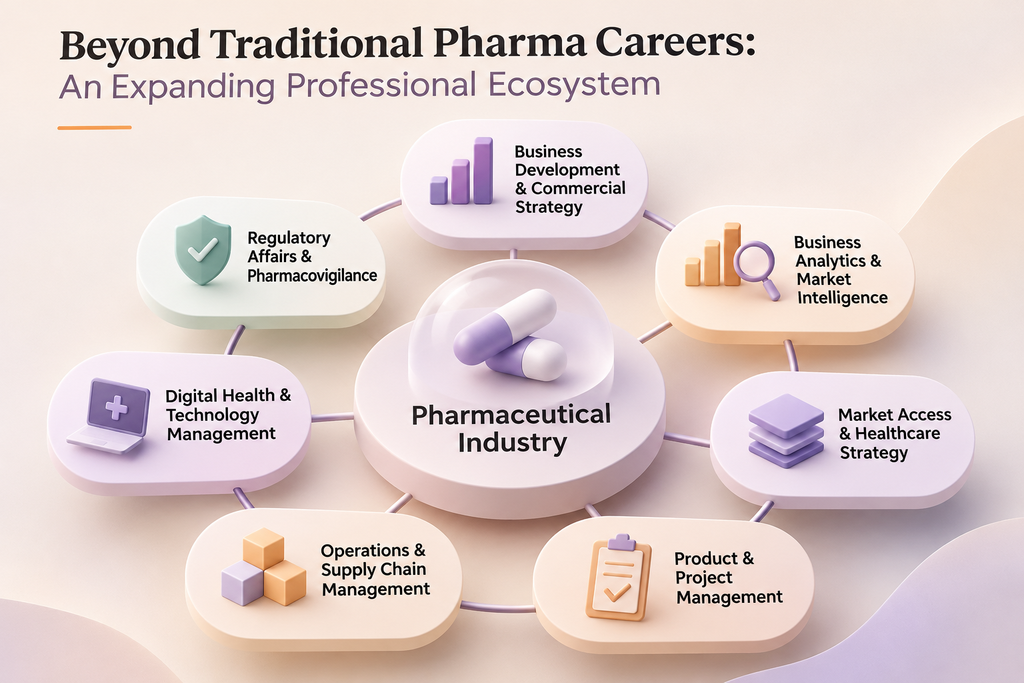
As pharmaceutical businesses become more multidisciplinary, opportunities are emerging across business management, commercial strategy, technology, and specialized support functions.
1. Pharmaceutical Business Development and Commercial Strategy
Pharmaceutical companies need professionals who can identify growth opportunities, evaluate markets, and build strategic partnerships. This creates opportunities for Business Development Managers, Commercial Strategy Managers, and Strategic Partnerships Managers. An Online MBA in Pharmaceutical Management can help professionals develop the business, marketing, and strategic management skills relevant to these roles.
SRMIST Online MBA in Pharmaceutical Management
Advance your career with SRMIST's UGC-entitled Online MBA in Pharmaceutical Management. Master pharmaceutical regulations, digital health, and supply chain management to prepare for leadership roles across pharma, healthcare, and life sciences.
Professionals can also evaluate management programs based on their industry relevance, practical projects, and opportunities to apply business concepts to pharmaceutical challenges. Read our guide on how to find a Pharma MBA with meaningful industry exposure to understand what to look for when choosing a program.
2. Pharmaceutical Business Analytics and Market Intelligence
Pharmaceutical companies increasingly rely on data to analyze market trends, evaluate commercial performance, and guide business decisions. This creates opportunities for Pharma Business Analysts, Commercial Analytics Specialists, and Market Research Analysts.
3. Market Access and Healthcare Strategy
Pharmaceutical companies need to ensure that patients can access medicines through healthcare providers, insurers, and reimbursement systems. Market Access Specialists, Pricing Analysts, and Healthcare Strategy Consultants evaluate drug pricing, reimbursement policies, healthcare economics, and market-entry strategies.
4. Product and Project Management in Pharmaceuticals
Pharmaceutical product development involves coordinating teams, budgets, timelines, and regulatory milestones. Pharmaceutical Product Managers, Clinical Project Managers, and Program Managers oversee these activities, ensuring projects meet business objectives and operational requirements.
5. Pharmaceutical Operations and Supply Chain Management
Pharmaceutical companies need professionals to manage procurement, inventory, distribution, and operational efficiency. Pharma Operations Managers, Procurement Managers, and Supply Chain Analysts oversee resources, supplier relationships, and distribution networks. India's expanding CDMO and CRDMO ecosystem is further increasing the importance of these functions.
6. Digital Health and Technology Management
AI and digital platforms are transforming pharmaceutical operations, patient engagement, and data management. This creates opportunities for Digital Health Product Managers, Healthcare Technology Consultants, and AI Business Analysts, who help implement technology solutions and align them with business objectives.
7. Regulatory Affairs and Pharmacovigilance
Regulatory affairs and pharmacovigilance professionals help pharmaceutical companies maintain compliance and monitor drug safety. Regulatory Affairs Specialists, Pharmacovigilance Associates, and Drug Safety Analysts manage regulatory submissions, track adverse drug reactions, and support safety monitoring throughout a medicine's lifecycle.
What skills do professionals need for emerging pharma careers?
Emerging pharmaceutical careers increasingly require professionals to combine industry knowledge with business and digital capabilities.
Some important skills include:
- Business and analytical skills: Market research, business analytics, financial analysis, strategic planning, and problem-solving.
- Digital capabilities: AI fundamentals, data analytics, automation, and digital health platforms.
- Pharmaceutical domain knowledge: Regulatory compliance, clinical research, drug safety, quality management, and pharmaceutical operations.
- Professional skills: Communication, critical thinking, project management, and cross-functional collaboration.
The growing emphasis on interdisciplinary capabilities means that professionals who understand both pharmaceutical operations and business management can explore opportunities across commercial, strategic, and operational functions.
How can professionals prepare for emerging pharmaceutical career opportunities?
Professionals interested in exploring these career paths should identify roles that align with their educational background and experience. Life sciences graduates can build on their domain knowledge with business analytics, project management, or regulatory skills, while management and technology graduates can explore business development, healthcare analytics, product management, and digital health roles.
Targeted management education can also help professionals develop the capabilities needed for these transitions. You can consider the Online MBA degree from SRM Institute of Science and Technology, which offers multiple specializations, allowing learners to develop expertise in areas such as business analytics, healthcare management, and related business functions. Its industry-relevant curriculum, live online sessions, practical projects, and flexible learning format can help working professionals strengthen their management capabilities and prepare for cross-functional responsibilities.
Advance your career with SRMIST's UGC-entitled Online MBA. Choose from 11 industry-focused specializations including Finance, Marketing, HR, AI & Data Science, Healthcare & Hospital Management and more.
Frequently Asked Questions About Pharmaceutical Careers
What are the emerging career opportunities in the pharmaceutical industry?
Emerging opportunities include pharmaceutical business development, commercial strategy, business analytics, market access, product management, operations management, digital health, regulatory affairs, and pharmacovigilance.
Can non-pharmacy graduates work in the pharmaceutical industry?
Yes. Graduates from management, biotechnology, life sciences, engineering, and technology backgrounds can explore suitable pharmaceutical roles. Eligibility depends on the specific position and its qualification requirements.
What skills are in demand in the pharmaceutical industry?
Employers increasingly value business analytics, AI and digital literacy, regulatory knowledge, clinical research expertise, supply chain management, and communication skills.