
Measures of Central Tendency Free Course
Measures of Central Tendency
 4.43
Beginner level
2.25 learning hrs
4.43
Beginner level
2.25 learning hrs
Enroll in this Measures of Central Tendency course to master statistical techniques for solving Data Science problems. Learn different mathematical measures like Mean, Mode, Median, dispersion, range, deviation, and variation.
Instructor:
Mr. Bharani Akella





About this course
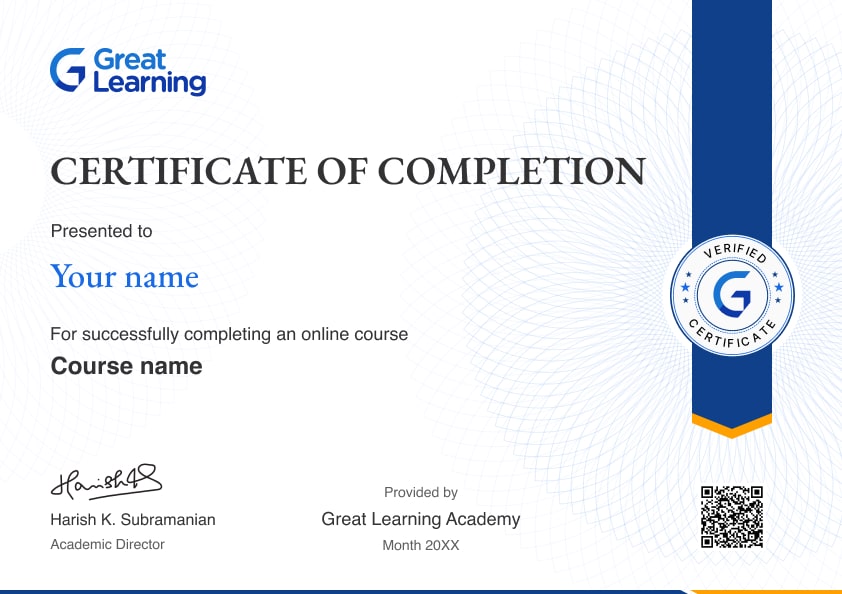
This course intends to cover Central Tendency concepts for Data Science. The course begins with helping you understand the importance of statistics. It then continues with topics such as types of statistics and data, then elaborates on central tendency and measures of dispersion. In the later part, the course comprehends a case study on measures of central tendency. There is an assessment to evaluate your gains at the end of the course. Complete the course for free and avail your certificate. We can also study the attached materials for reference.
After this free, self-paced, beginner's guide to Measures of Central Tendency, you can enroll in the Data Science course, embark on your career with the professional Post Graduate certificate, and learn various in-depth concepts with millions of aspirants across the globe!
Course outline
Types of Data
This section introduces you to different types of data by helping you understand their graphical representations. It also explains its different components.
Measures of Dispersion
This section describes the standard deviation by formulating to solve for it. It explains the relative tendency towards the most accurate solution through the derived observation. You will also learn to work with code in the Jupyter notebook to understand this better. You will also learn to graphically represent the observation, about data, and metadata in the later part of this section.
Importance of Statistics
You will understand the technical relevance of statistics and its importance at the beginning of this section. Later, you will understand big data and its importance in today’s growing technology.
Type of Statistics
You will learn differential statistics and inferential statistics in this section. It also comprehends how and why they are used in data analysis.
Central Tendency
The section begins by defining what central tendency is with an example. The speaker then explains different measures of central tendency in the latter part of the section.
Case Study for Measures of Central Tendency
This section gives you better hold on the subject by delivering a case study on a Telecom company dataset.
Get access to the complete curriculum once you enroll in the course
 4.43
4.43












Our course instructor

Mr. Bharani Akella
Data Scientist
Data Science Expert


Frequently Asked Questions
Will I receive a certificate upon completing this free course?
Is this course free?
What prerequisites are required to learn the Measures of Central Tendency course?
Measures of Central Tendency is a beginner-level course. Before you begin with this course, you will have to do a little homework on data science since the subject is explained to be understood with the same context if you do not have a thorough understanding of it.
Will I have lifetime access to this free course?
Yes, once you enroll to learn Measures of Central Tendency, you will have lifetime access to this Great Learning Academy's free course. You can log in and learn at your leisure.
What are my next learning options after I complete Measures of Central Tendency?
Once you complete learning Central Tendency in Statistics concepts, you can opt for a Master's in Data Science that will aid in advancing your career growth in this leading field.
Is it worth learning Measures of Central Tendency?
Yes, it is beneficial to learn Central Tendency concepts. It is applied in many fields, including medical sciences. It predicts a normal or an average for a dataset. It condenses the entire dataset to a single representative value that can be valuable while working with a dataset pool.
What are Measures of Central Tendency used for?
Measures of central tendency describe the normal for a dataset. The three measures of central tendency include Mean, median, and mode. The mean and median can be used while working with numerical data, but the mean is more responsive to outliers than the median.
Why is Central Tendency so popular?
Measures of central tendency include the values in the dataset to calculate the measures and measure changes in scores that affect the mean value. The central tendency is a concept but not limited to data science and is applied in various fields in computer science or otherwise, like in medical sciences.
Will I get a certificate after completing this free Measures of Central Tendency course?
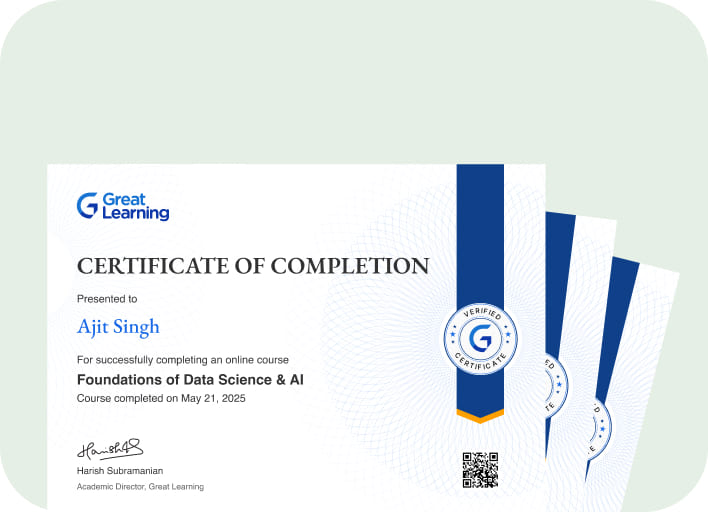
Yes, you will get a completion certificate for the Data Mining course after completing all the modules and cracking the assessment/quiz. All the assessment tests your knowledge and badges your skills.
What knowledge and skills will I gain upon completing this course?
The course helps you understand the importance of statistics and big data, their use, and applications. It also imbibes the skills to work on various statistical methods to solve data science problems and represent them graphically. Enroll in the course today and train yourself on the essential tool for data analysis purposes.
How much do this Measures of Central Tendency course cost?
It is an entirely free course from Great Learning Academy. Anyone interested in learning central tendency concepts can get started with this course, and you can also refer to the attached materials for additional knowledge.
Is there any limit on how many times I can take this free course?
Once you enroll in the Measures of Central Tendency course, you have lifetime access to it. So, you can log in anytime and learn it for free online at your convenience.
Can I sign up for multiple courses from Great Learning Academy at the same time?
Yes, you can enroll in as many courses as you want from Great Learning Academy. There is no stricture to the number of courses you can enroll in at once, but since the courses offered by Great Learning Academy are free, we suggest you learn one by one to get the best out of the subject.
Why choose Great Learning Academy for this Measures of Central Tendency course?
Great Learning is a global educational technology platform committed to developing skilled professionals. Great Learning Academy is a Great Learning project that provides free online courses to assist people in succeeding in their careers. Great Learning Academy's free online courses have helped over 4 million students from 140 countries. It's a one-stop destination for all of a student's needs.
This course is free and self-paced and also includes solved problems, presents examples, and demonstrates case study to help you comprehend the numerous areas that fall under the subject and awards you a certificate to showcase your skills. The course is conducted by topic experts and carefully tailored to cater to beginners and professionals.
Who is eligible to take this course?
Anybody interested in learning the Central Tendency concepts and techniques for data science can take up the course. So, enroll in our Data Mining course today and learn it for free online.
What are the steps to enroll in this Measures of Central Tendency course?
Enrolling in Great Learning Academy's Measures of Central Tendency course is a simple and straightforward approach. You will have to sign-up with your E-Mail ID, enter your user details, and then you can start learning at your own pace.

Recommended Free Data Science courses
-
FREE
 2.5 hrs
 -
FREE
-
FREE
-
FREE
-
FREE
-
FREE
-
FREE
-
FREE
 FREE
FREE





Similar courses you might like
-
FREE
-
FREE
-
FREE
-
FREE


Related Data Science Courses

-
12 weeks · Online
Know More
-
MIT Professional Education
Applied AI and Data Science Program15 Weeks · Live Online · Weekdays & Weekend
Know More
-
Deakin University
Master of Data Science (Global) Program24 Months · Online
Top 1% UniversityKnow More






Popular Topics to Explore
Relevant Career Paths >

Other Data Science tutorials for you
Measures of Central Tendency
Statistics introduce Measures of Central Tendency. It is used in almost all the processes that we do daily. An Analyst must have a sound knowledge of Statistics as it helps them make effective decisions related to business plans. Data Science usually depends on the Measures of Central Tendency. If you tend to become a fine Data Scientist, you must be thorough with all the Measures of Central Tendency. Central Tendency is defined as the descriptive summary of the collected data set where a single value represents the whole data. Measures of Central Tendency come into the picture when you require representing your data collection into a single value.
For Example,
Here is a scorecard,
|
Sr.No |
Subjects |
Marks |
|
1 |
English |
92 |
|
2 |
Mathematics |
74 |
|
3 |
Statistics |
80 |
|
4 |
Data Science |
86 |
The Central Tendency of the above example is:
92+74+80+864= 83
Hence, the Central Tendency is 83.
Central Tendency is also known as the Measures of Center. It plays a vital role in plotting the data among the frequency distribution. It indicates the general shape of the distribution and provides a better idea of how the numbers are grouped. You can use several Statistics methods to represent the center of the distribution. Through Central Tendency Statistics, you will see the distribution of the data with the involvement of the dispersion or variability. Thus, the width of the bell curve is the source that gives you an idea of the amount of dispersion in your data. This process allows you to determine whether the data has a strong or weak Central Tendency. Hence, dispersion and the general shape of your curve play an essential role in deciding the Central Tendency of your data.
Central Tendency can be calculated over three types of series.
-
Individual Series : It is a series of data consisting of single values.
-
Discrete Series : It is a series of data that includes values and the frequency of the values given.
-
Continuous Series : It is a series of values that continually have frequencies.
There are three main types of Measures of Central Tendency:
- Mean: The mean is the most popularly used Measure of Central Tendency. It is the ratio of the sum of the terms to the numbers of the terms. In terms of Data Science, for ungrouped data that have not been grouped in the intervals, the arithmetic mean here is the sum of all the values in the population data divided by the number of all the values present in the population data. For grouped data, the mean is calculated by an approximation using the midpoints and the frequencies of the distribution.
-
Median : Median divides the distribution into halves, and it is also known as the value at the 50th percentile in the distribution. The median location can be found by the formula (N+1)/2, where N is the number of data present. Suppose N is 7, and according to the formula, the median will be 4. Suppose N is 6, then according to the formula, the median is 4.5, which means the median lies between 4 and 5. Median distributes the data in such a manner where an equal amount of data lies on either side of the median and sometimes indicates the value of the data set, which can be extremely high or low. You will find this result while working on the non-normal data.
-
Mode : Mode is the frequently used Measure of Central Tendency. It is also the common score in the distribution that corresponds to the highest point on the distribution. If you find multiple highest frequencies, then the distribution is said to be multimodal. For example, in the distribution 22,44,66,44,88, the most frequently appeared number is 44, which becomes the mode of your data. In terms of Data Science, the mode will help you recognize the frequently occurring value from the entire population data set. It is not always necessary that the mode value should always appear at the center of the data set. Suppose there is no frequently occurring value. It indicates that there is no mode for that particular data set. The mode can also be multimodal, like a bimodal or a trimodal. Mode is often utilized as the only central value by the experts for analysis purposes.
You can get in-depth knowledge on Measures of Central Tendency by enrolling in the free Measures of Central Tendency course Great Learning offers. It will help you understand the importance of Measures of Central Tendency in Data Science and how it affects Machine Learning algorithms. Get a brief introduction to these concepts through this free course. Complete the course to attain free Measures of Central Tendency certificate. Enroll Today!