
- 1. Why Agentic AI Is Creating a New Skills Gap
- 2. The Core Technical Skills Missing in Today’s AI Engineers
- 3. The Overlooked Skills: Evaluation, Reliability, Security, and Observability
- 4. What Employers Actually Need From Agentic AI Engineers
- 5. How AI Engineers Can Close the Agentic AI Skills Gap
- Final Thoughts
- Frequently Asked Questions
Artificial intelligence engineering is moving beyond systems that simply predict, classify, or generate responses. With Agentic AI, systems can plan tasks, use tools, retrieve information, maintain context, make decisions, and execute multi-step workflows with varying levels of autonomy.
This shift is changing what organizations need from AI engineers. Skills such as Python, machine learning, prompt engineering, large language models (LLMs), and Retrieval-Augmented Generation (RAG) remain important, but they are no longer enough on their own.
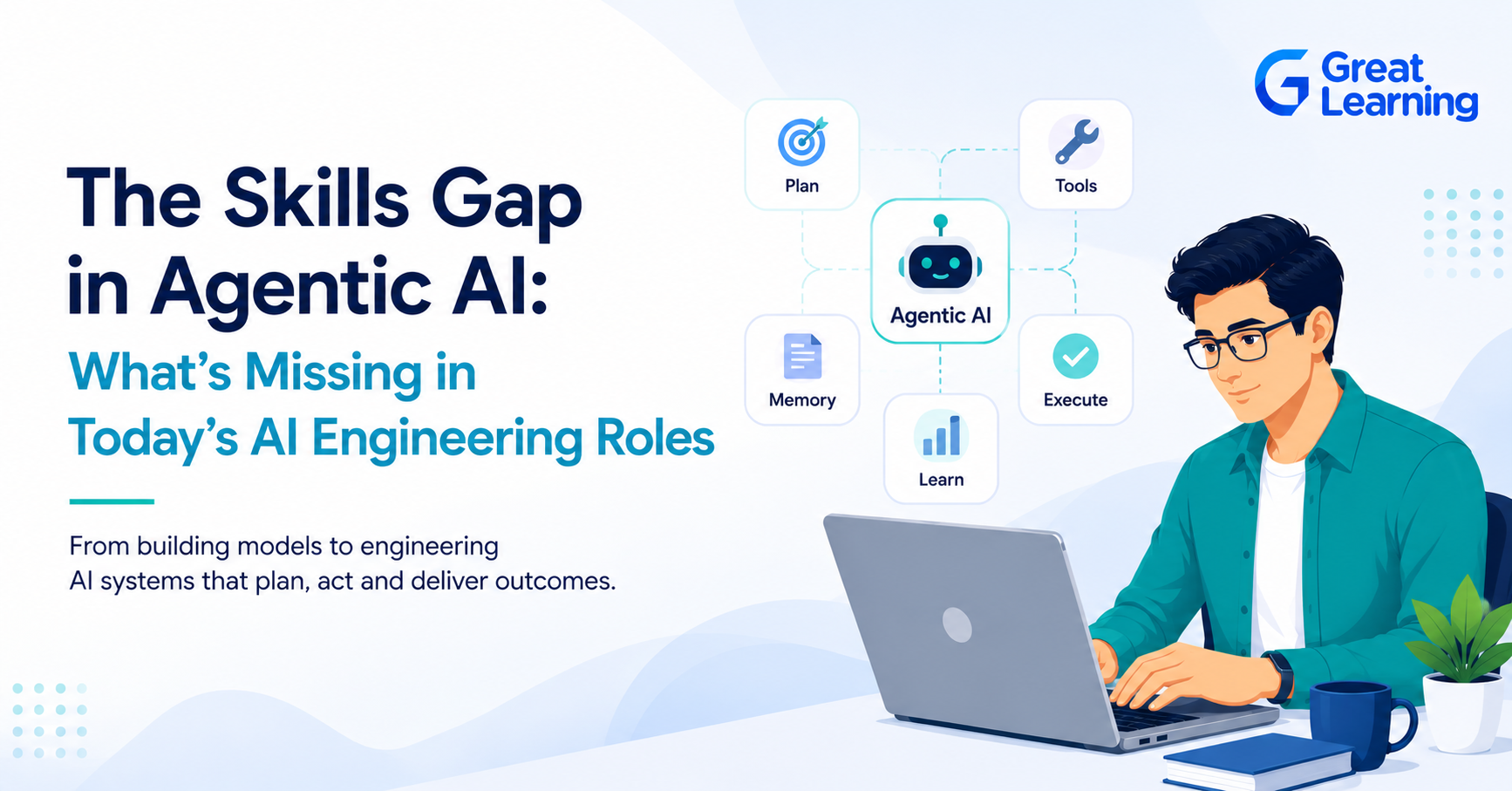
The emerging skills gap is about moving from building AI models and LLM applications to engineering AI systems that can reliably plan, act, interact with external tools, and recover from failures.
1. Why Agentic AI Is Creating a New Skills Gap
Traditional AI engineering has largely focused on models. Engineers prepare data, train or integrate models, evaluate outputs, build APIs, and deploy AI capabilities within applications.
Generative AI expanded this role by introducing LLM APIs, prompt engineering, embeddings, vector databases, RAG pipelines, and conversational applications.
Agentic AI adds another layer.
Instead of receiving a prompt and generating a response, an AI agent may need to understand a goal, break it into smaller tasks, choose appropriate tools, retrieve information, execute actions, evaluate intermediate results, and adjust its approach.
Consider an AI research assistant. A conventional LLM application might answer a question using information supplied through a prompt or RAG pipeline. An agentic system could create a research plan, search multiple sources, compare findings, identify missing information, conduct additional searches, and compile the final analysis.
The engineering model therefore changes:
Traditional AI: Data → Model → Prediction
Generative AI: Prompt → LLM → Response
Agentic AI: Goal → Plan → Tools → Actions → Feedback → Outcome
Each additional step creates challenges around orchestration, memory, permissions, reliability, and system control.
This is where the skills gap becomes visible. Knowing how to call an LLM or build a basic RAG application does not necessarily prepare an engineer to build an AI system capable of taking reliable actions.
2. The Core Technical Skills Missing in Today’s AI Engineers
Agentic AI does not replace traditional AI engineering skills. It expands them.
Agent Architecture and Planning
AI engineers need to understand how agents turn goals into actions. This includes goal decomposition, task planning, tool selection, intermediate evaluation, and determining when a task is complete.
Engineers must also decide how much autonomy an agent should receive. Predictable operations may be better handled through deterministic software logic, while AI can manage tasks requiring reasoning or language understanding.
Tool and Function Calling
Agents become more useful when they can interact with databases, APIs, search systems, enterprise software, code environments, and other external tools.
Engineers therefore need to understand tool schemas, API integration, parameter validation, authentication, error handling, and permission management.
This creates an important distinction:
Chatbots generate information. Agents can perform actions.
Once an AI system can modify data, execute code, create tickets, or trigger business processes, safe tool use becomes a core engineering requirement.
Workflow Orchestration
Real-world agentic tasks often require multiple steps.
An agent may retrieve information, classify it, call another service, evaluate the result, request approval, and perform a final action.
Engineers need to design sequential tasks, conditional branches, dynamic routing, retries, fallback paths, human approval checkpoints, and termination conditions.
Poor orchestration can cause agents to repeat actions, select unnecessary tools, enter loops, or consume excessive resources.
Memory, State, and Context Engineering
Long-running agents need to remember what has already happened.
This can include completed tasks, retrieved information, previous decisions, failed actions, tool outputs, and remaining objectives.
Engineers must decide what information belongs in the immediate context, what should be stored externally, and what should be retrieved later.
This makes context engineering increasingly important. The challenge is not giving an agent as much information as possible, but providing the right information at the right stage.
Agentic RAG and Multi-Agent Systems
Basic RAG typically follows:
Query → Retrieval → Context → Response
Agentic RAG can dynamically determine what information is needed, generate searches, evaluate retrieved information, and retrieve again when necessary.
This requires knowledge of query decomposition, hybrid retrieval, reranking, retrieval evaluation, and multi-step search.
Some applications also use multiple specialized agents. Engineers then need to manage communication, delegation, shared context, and conflicting outputs without unnecessarily increasing cost and complexity.
The shift can be summarized as:
| Traditional AI/LLM Skills | Agentic AI Skills |
| Prompt engineering | Agent planning |
| Basic RAG | Agentic RAG |
| LLM APIs | Tool calling |
| Chatbots | Agentic workflows |
| Conversation context | Memory and state |
| Single AI applications | Multi-agent coordination |
| Model evaluation | Agent evaluation |
The key difference is that engineers must understand not only what the model generates, but what the entire system does next.
3. The Overlooked Skills: Evaluation, Reliability, Security, and Observability
Building an agent that works in a demo is different from operating one reliably in production.
Evaluation and Reliability
Traditional AI systems can often be measured using metrics such as accuracy, precision, and recall. Agentic systems require broader evaluation.
Useful measures include:
- Task completion rate
- Tool-selection accuracy
- Tool-call success rate
- Human intervention rate
- Latency
- Cost per completed task
Engineers must evaluate both the final result and the path the agent followed.
Reliability is equally important. APIs can fail, retrieved information can be incomplete, and models can select incorrect actions. Production agents therefore need retries, timeouts, validation layers, fallback mechanisms, and clear termination conditions.
Security and Human Control
Security becomes more important when AI can take actions.
Agentic systems can face prompt injection, excessive tool permissions, sensitive-data exposure, unsafe actions, and unauthorized access.
Engineers need to apply authentication, authorization, least-privilege access, tool restrictions, and sandboxing where appropriate.
High-impact actions may also require human-in-the-loop approval rather than unrestricted autonomy.
Observability
Agent failures can be difficult to diagnose because problems may occur anywhere within a multi-step workflow.
Engineers therefore need visibility into model calls, tool calls, retrieved information, state changes, errors, latency, and final outcomes.
Agent tracing and observability help teams determine why an agent made a particular decision and where a workflow failed.
4. What Employers Actually Need From Agentic AI Engineers
Employers increasingly need engineers who can build complete AI systems rather than isolated demonstrations.
Knowing an Agentic AI framework is useful, but framework knowledge alone does not demonstrate production readiness.
An engineer building an autonomous customer-support system, for example, should understand which customer information the agent can access, which tools it can use, which actions require approval, how failures are handled, and how performance is measured.
Employers may therefore look for engineers who can:
- Build end-to-end agentic workflows
- Connect agents with real APIs and tools
- Implement memory and state
- Design safe autonomy boundaries
- Evaluate agent behavior
- Debug failed workflows
- Monitor production agents
- Manage security, latency, and cost
Portfolio projects should reflect these capabilities.
A basic chatbot demonstrates LLM integration. A stronger Agentic AI project demonstrates an agent receiving a goal, creating a plan, retrieving information, using tools, maintaining state, handling errors, and producing a measurable outcome.
For professionals looking to translate these emerging capabilities into practical business applications, the AI Agents for Business course by Texas McCombs provides hands-on exposure to building AI workflows using LLMs, RAG, single- and multi-agent systems, tools, memory, and human-in-the-loop approaches.
UT Austin PG Program in AI Agents & Generative AI
Master GenAI, large language models, and multi-agent systems to automate business workflows. Learn to build and deploy intelligent AI agents with no coding background.
It can help bridge the gap between understanding Agentic AI concepts and applying them to real-world business workflows.
5. How AI Engineers Can Close the Agentic AI Skills Gap
AI engineers can build Agentic AI capabilities progressively rather than learning everything at once.
A practical learning path is:
AI/ML Fundamentals → LLMs → RAG → Tool Calling → Agent Architecture → Memory & State → Workflow Orchestration → Multi-Agent Systems → Evaluation → Security & Observability
Engineers already familiar with LLM applications can start by building a single agent connected to a small number of tools. They can then add memory, state, conditional workflows, retries, evaluation, and human approval mechanisms.
Projects such as research agents, coding agents, enterprise knowledge agents, data-analysis agents, and customer-support agents can provide practical experience.
The complete engineering lifecycle should demonstrate:
Goal → Plan → Retrieve → Decide → Act → Observe → Evaluate
Engineers should also avoid depending entirely on one agent framework. Tools will evolve, but fundamental skills such as orchestration, state management, evaluation, security, and observability will remain transferable.
For engineers who want to build deeper technical capabilities in this area, the Artificial Intelligence engineering course by Johns Hopkins University offers a structured path to developing Agentic AI expertise.
JHU Certificate Program in AI and Agentic AI Engineering
Designed for software developers, data and AI professionals seeking hands-on technical expertise in building, deploying, and scaling AI and Agentic AI systems using MLOps, LLMOps, and cloud platforms.
Learning areas such as agent architectures, multi-agent systems, Agentic RAG, observability, reasoning, and hands-on implementation can help engineers develop the skills needed to move from conventional AI development toward building more capable agentic systems.
Final Thoughts
The Agentic AI skills gap reflects a broader transition in AI engineering.
Traditional AI focused heavily on models. Generative AI introduced prompting, LLM integration, and RAG. Agentic AI adds planning, tool use, memory, state, orchestration, evaluation, security, and operational reliability.
The defining skill for the next generation of AI engineers will be the ability to move from building AI that generates answers to engineering AI systems that can reliably decide, act, evaluate results, and complete real-world objectives.
Explore Artificial Intelligence courses by Great Learning to gain hands-on experience with LLMs, generative AI applications, prompt engineering, AI agents, and real-world AI development, enabling you to confidently build and deploy next-generation AI solutions.
Frequently Asked Questions
1. What skills are required for an Agentic AI engineer?
Agentic AI engineers need Python, LLMs, APIs, RAG, agent architecture, tool calling, workflow orchestration, memory and state management, evaluation, security, and observability.
2. How is an Agentic AI engineer different from an AI engineer?
Traditional AI engineers primarily build and integrate AI models. Agentic AI engineers additionally design systems that can plan tasks, use tools, maintain state, perform actions, and adapt based on intermediate results.
3. Is prompt engineering enough to work with Agentic AI?
No. Prompt engineering is useful, but Agentic AI also requires skills in tool integration, workflow orchestration, memory, evaluation, security, failure handling, and monitoring.
4. What skills should AI engineers learn to build AI agents?
Engineers should learn LLM development, RAG, tool calling, agent architecture, context engineering, memory and state management, workflow orchestration, evaluation, security, and observability.
5. Do Agentic AI engineers need software engineering skills?
Yes. Agentic systems interact with APIs, databases, tools, authentication systems, and production infrastructure, making software engineering skills essential.
6. How can AI engineers prepare for Agentic AI jobs in 2026?
Engineers should move beyond basic chatbot projects and build end-to-end applications that demonstrate planning, retrieval, tool use, memory, error handling, evaluation, security, and observability.