Free AI with Python Course
Artificial Intelligence with Python
 4.54
Intermediate level
11.25 learning hrs
4.54
Intermediate level
11.25 learning hrs
Learn AI with Python, like neural networks, perceptrons, activation and loss functions, Keras, TensorFlow, and MNIST. Join this free Python with AI course to build and train ANN models for image classification and real AI tasks.
Instructor:
Prof. Mukesh Rao


What you'll learn


About this course
This Python with AI course provides a strong foundation in how neural networks work and how they are used to solve machine learning problems. You’ll learn the history behind neural networks, the link between biological and artificial neurons, and the core mechanics of perceptrons, dense networks, and ANN architecture. The course also covers activation functions, softmax, forward propagation, and loss functions, helping you understand how neural networks process data, make predictions, and measure error in both classification and regression tasks.
In this course, you’ll also learn back propagation and gradient descent so you can understand how neural networks improve model performance during training. In addition, you’ll work with Keras and TensorFlow 2.0 to implement neural network models in practice, and apply these concepts in a demo using the MNIST dataset in Jupyter Notebook. By the end of the artificial intelligence using Python course, you’ll be able to explain the structure and training process of neural networks, build basic ANN models with modern frameworks, and apply deep learning concepts to image classification and other real-world machine learning tasks.
Course outline
History behind neural networks
This module will introduce you to the history of neural networks, the early experiments, limitations, and how ANN evolved to build almost every technology that is in use today.
Relationship between biological neuron and artificial neuron
You will understand the supervised learning technique, ANN, and learn how it differs from the biological neural system. In this section, you will also learn why artificial neural networks are dependent on biological neurons to perform a few crucial tasks, along with understanding dense neural networks.
Perceptron and working mechanism
You will understand the mathematical model of biological neurons in this module. As you follow this module, you will also understand how an artificial neuron mimics the biological neuron and the mechanism to do so.
Architecture of artificial neural network
You will understand different elements in artificial neural networks, different layers, and their functionalities in this section. The section briefly discusses how each layer contributes to processing the data to produce accurate output.
Types of activation functions
At the beginning of this section, you will understand what classification is and why it is performed in ANN. You will then understand regression, ANN with respect to Perceptron, and the functions that make the building blocks of ANN as you follow the module.
Softmax function
You will understand the softmax function with multi-class classification in deep neural networks. You will learn the working mechanism of the softmax function with an example as you follow this section.
Forward propagation
This section discusses how the entire data set passes through the different layers of the neural network. You will understand forward propagation and its mechanism with matrix operation, how the process results in the error, and also understand the mechanism to fix this error.
Loss function
This section explains what error functions are, their properties, and the mathematics behind them with an example to help you understand what mean least loss is.
Demo using keras framework
You will understand what Keras is, its elements, features, and working in this section. You will also learn to work with Keras, an interface for Tensorflow, to reduce the cognitive load of ANN with demonstrated programming.
Back propagation and gradient descent
You will understand how an error is resolved using back propagation at the beginning of this section. Later, you will learn about vanishing gradients and exploding gradients concepts and their mathematical functioning to understand gradient descent.
Tensorflow 2.0
You will understand what Tensorflow is and why Keras is used for Tensorflow. You will learn about the tensors, features of the Tensorflow 2.0 version, syntax, and how all machine learning processes can be performed using Tensorflow.
Demo on MNIST data set
You will learn to work with the discussed concepts in the Jupyter notebook with the MNIST dataset in this section.
Get access to the complete curriculum once you enroll in the course
This course is ideal for
- Aspiring data scientists starting with Python.
- Python developers wanting to explore AI concepts.
- Computer science students building ML foundations.
- Tech professionals looking to understand predictive modeling.
 4.54
4.54
Level up with advanced skills & become job ready with Pro+
Subscribe to Pro+ today to build skills with 50+ Pro courses and prep for jobs with advanced AI tools.
 PRO
PRO


Practice exercises
Guided Projects
AI Resume Builder
AI mock interviews













Our course instructor

Prof. Mukesh Rao
Senior Faculty, Academics, Great Learning


Frequently Asked Questions
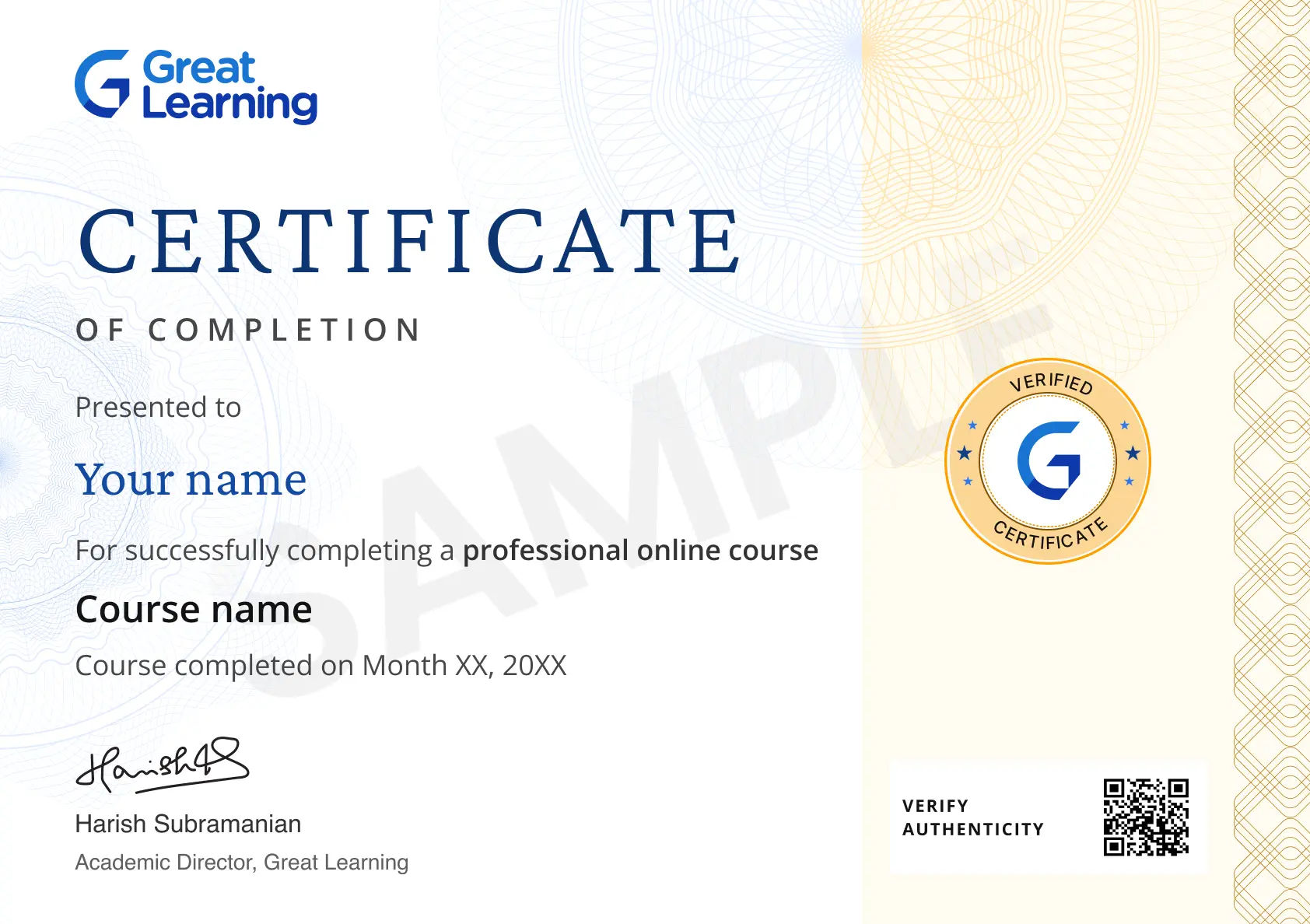
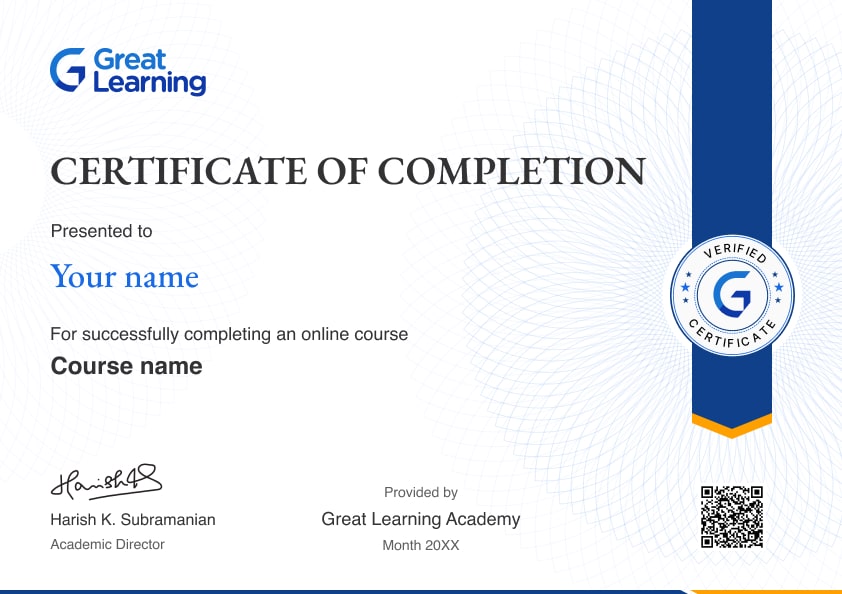
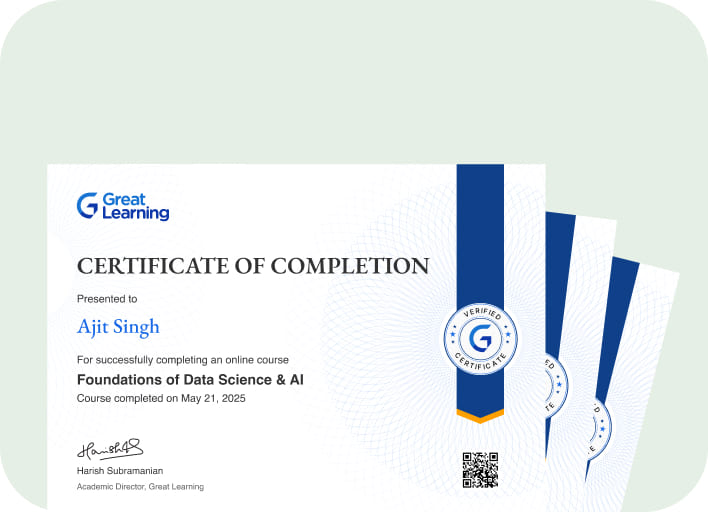
Will I receive a certificate upon completing this free course?
Is this course free?
What will I learn in this free Python with AI course?
In this free AI with Python course, you will learn how artificial neural networks work, starting with their history, perceptrons, ANN architecture, activation functions, softmax, forward propagation, loss functions, back propagation, gradient descent, Keras, TensorFlow 2.0, and the MNIST dataset.
Is this free Python AI course suitable for beginners
This artificial intelligence using Python course is listed at the intermediate level. It works best for learners who already know basic Python and want a stronger understanding of neural networks, model training, and deep learning concepts.
Do I need prior Python knowledge to learn AI with Python in this course?
Yes. This learn Python for AI path is better suited for learners who already have some comfort with Python and basic technical concepts, since the course moves into ANN structure, TensorFlow, Keras, and model implementation.
What topics are covered in this course?
You will learn Python for AI modules in this course:
History behind neural networks
Relationship between biological neuron and artificial neuron
Perceptron and working mechanism
Architecture of artificial neural network
Types of activation functions
Softmax function
Forward propagation
Loss function
Demo using keras framework
Back propagation and gradient descent
Tensorflow 2.0
Demo on MNIST data set.
What tools and frameworks are included in this AI with Python free course?
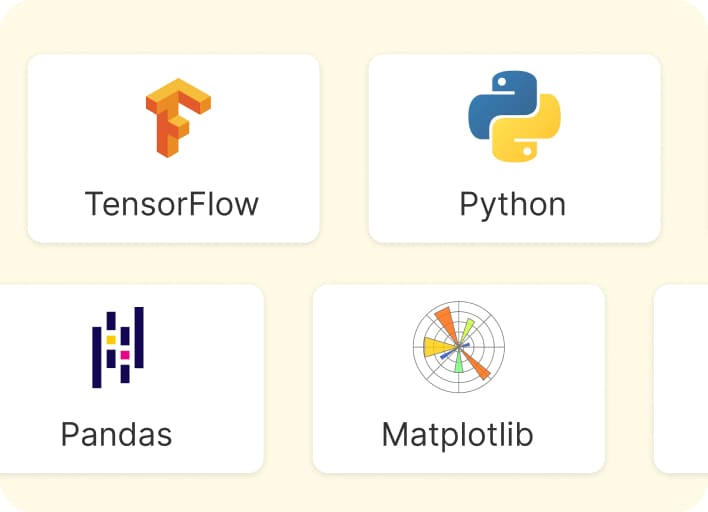
In this Python AI training, you will work with Keras, TensorFlow 2.0, Jupyter Notebook, and the MNIST dataset. These tools help you move from theory into practical ANN model building.
Does this learn Python with AI course explain the math behind neural networks?
Yes. This free Python AI course covers the mathematical side of perceptrons, forward propagation, loss functions, back propagation, and gradient descent, so you understand how neural networks learn and improve.
Will I study classification concepts in this free artificial intelligence using Python course?
Yes. If you want to learn AI with Python, this course covers classification, activation functions, and softmax for multi-class problems, along with practical examples that show how models make predictions
Is this AI with Python course mostly theoretical, or does it include demos
This learn Python with AI course includes practical demos. You will see a Keras-based example and a working implementation on the MNIST dataset in Jupyter Notebook, which helps connect concepts with coding practice.
What skills will I gain from this Python AI training?
The skills you will gain in this course are:
AI Fundamentals
Python for AI
Neural Networks Basics
Biological vs. Artificial Neurons
Perceptron Mechanism
ANN Architecture
Activation Functions
Forward Propagation
Loss Functions
Keras Framework
Gradient Descent
MNIST Application
TensorFlow
How long does it take to complete this Learn AI with Python course?
This AI with Python free course includes about 11.25 hours of learning content. Since it follows a self-paced format, you may complete it at your own pace.
Is this a good choice if I want to learn Python for AI and build real ANN models?
Yes. This Python with AI course moves from neural network foundations to Keras, TensorFlow 2.0, and a practical MNIST implementation, making it useful for learners who want both theory and hands-on ANN model building.
What are the steps to enroll in this Artificial Intelligence with Python course?
Enrolling in Great Learning Academy's AI with Python is a simple and straightforward approach. You will have to sign-up with your E-Mail ID, enter your user details, and then you can start learning at your own pace.
Who is eligible to take this course?
Anybody with basic knowledge of computer science, probability, calculus and a good hold on Python Programming, interested in learning ANN, Keras, and Tensorflow and understanding their working mechanism can take up the course. So, enroll in our AI with Python today and learn it for free online.
Why choose Great Learning Academy for this free Artificial Intelligence with Python course?
Great Learning is a global educational technology platform committed to developing skilled professionals. Great Learning Academy is a Great Learning project that provides free online courses to assist people in succeeding in their careers. Great Learning Academy's free courses have helped over 4 million students from 140 countries. It's a one-stop destination for all of a student's needs.
This course is not only free and self-paced, but it also includes solved problems, demonstrated codes, and presented examples to help you comprehend the numerous areas that fall under the subject. The course is conducted by topic experts and is carefully tailored to cater to both beginners and professionals.
.
Can I sign up for multiple courses from Great Learning Academy at the same time?
Yes, you can enroll in as many courses as you want from Great Learning Academy. There is no stricture to the number of courses you can enroll in at once. All the courses offered by Great Learning Academy are free, so we propound you learn one at a time to get the best out of the courses.
Will I have lifetime access to this free course?
Yes, once you enroll, you will have lifetime access to this Great Learning Academy's free course. You can log in and learn at your leisure.
What are my next learning options after this Artificial Intelligence with Python course?
Once you complete this free course, you can opt for a PG Program in Artificial Intelligence that will help advance your career growth in this leading field.
Will I get a certificate after completing this free Artificial Intelligence with Python course?
Is there any limit on how many times I can take this free course?
Once you enroll in this free Artificial Intelligence with Python course, you will have lifetime access to it. So, you can log in to the course anytime and learn it online at your leisure.
Recommended Free AI courses
 FREE
FREE



Similar courses you might like
.jpg "Course thumbnail image")


Related Masterclasses Courses

-

12 weeks · Online
Know More
-
MIT Professional Education
Applied AI and Data Science Program15 Weeks · Live Online · Weekdays & Weekend
Know More
-
Deakin University
Master of Data Science (Global) Program24 Months · Online
Top 1% UniversityKnow More