
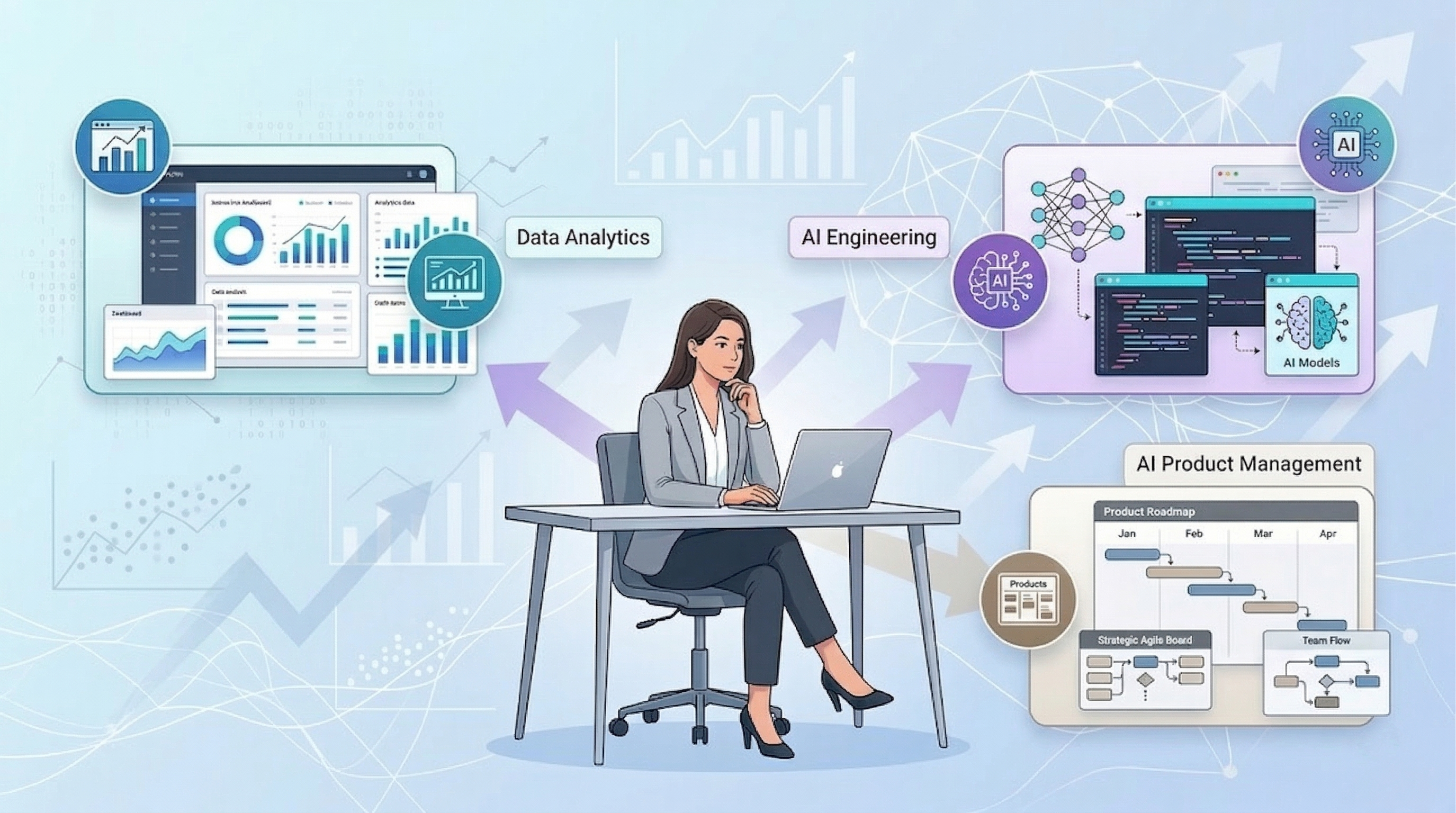
- Understanding the Three Career Paths
- What is Data Analytics?
- What is AI Engineering?
- What is AI Product Management?
- Skills Comparison – What Each Role Demands?
- Salary Trends and Market Demand
- Which Career Should You Choose Based on Your Background?
- Pros and Cons of Each Career Path
- Ideal Career Roadmap
- Conclusion
The definitive answer to which field offers the most long-term career stability is that there is no single "best" role, but rather a "best fit" based on your technical expertise.
For those seeking the highest growth in the current decade, AI Engineering currently offers the strongest option to pursue for high-demand, high-income stability, while AI Product Management provides the most stability for business-oriented leaders, and Data Analytics remains the essential foundational entry point for all data-driven careers.
Stability in the modern era is less about a specific job title and more about mastering the intersection of data literacy and AI-powered skills. Let’s now dive deeper into how each of these paths compares in terms of skills, growth, and long-term opportunities.
Understanding the Three Career Paths
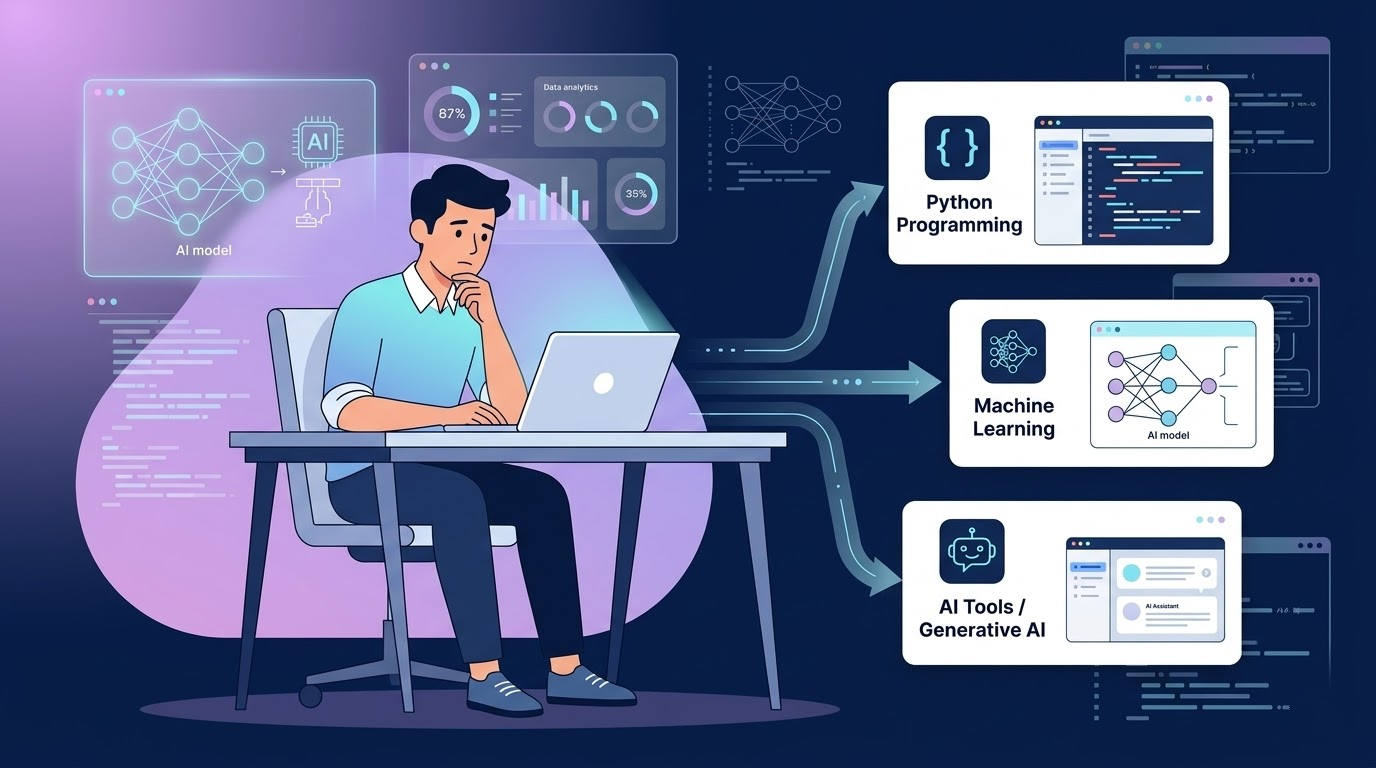
The field of data and artificial intelligence is expanding rapidly, and each role serves a unique purpose within an organization. Understanding the differences between these roles is the first step in making an informed decision about your future.
What is Data Analytics?
Data Analytics is the systematic process of examining raw datasets to find hidden trends and draw logical conclusions. It deeply involves tracking performance, growth, loss, and ROI metrics to help leaders make informed business decisions.
Tools To Learn: You will heavily use software like Excel, SQL databases, and visualization tools such as Tableau, which are required to build clear reports and dashboards for business leaders:
Main Responsibilities:
- Cleaning, formatting, and organizing massive datasets to ensure high data quality before conducting any formal analysis.
- Building interactive visual dashboards for stakeholders so they can easily digest complex information and metrics.
- Identifying key market trends and consumer behaviors to improve overall business efficiency and profitability.
For a deeper dive, the Master Data Analytics in Excel program provides an excellent starting point. By helping you learn univariate, bivariate, and multivariate analysis, it teaches pivot tables, advanced functions, and dashboard creation, equipping you with the hands-on practice needed to manage corporate numbers effectively.
Learn Excel for powerful data analysis and enhance your skills for better decision-making.
What is AI Engineering?
AI Engineering focuses heavily on developing and deploying machine learning models into real-world software applications. It requires exceptionally deep programming knowledge and logical structuring.
To understand the exact technical role, check out this comprehensive guide on becoming an AI engineer.
Tools and Models To Learn: You will constantly write code in Python, build systems using frameworks like TensorFlow or PyTorch, and use cloud platforms to store and scale large datasets.
At the same time, you will work with a wide range of machine learning models such as regression models, classification models, clustering algorithms, and deep learning architectures like neural networks.
Main Responsibilities:
- Training machine learning models using vast datasets while optimizing for speed and high predictive accuracy.
- Testing artificial intelligence models extensively to guarantee fairness, eliminate bias, and maintain ethical standards in outputs.
- Scaling computing architecture and software solutions so that global users can access AI tools without experiencing system lag.
To understand these core concepts, the Machine Learning Esssentials With Python and Foundations of AI courses help you grasp basic concepts and algorithms, giving you a clear overview of how machines learn, completely demystifying complex technical topics.
If you want to dive deeper into which skill you need to build first, the 5 Key Skills to Kickstart your Career in Artificial Intelligence video provides excellent visual explanations.
What is AI Product Management?
AI Product Management merges technical artificial intelligence knowledge with business product strategy and user experience design. It fundamentally ensures that the AI built actually solves real user problems. You can thoroughly learn the core conceptual frameworks by reading- How to Become an AI Product Manager: Skills, Career Path & Roadmap
Tools To Learn: You will use tools like Jira, Trello, and Asana for project tracking, platforms like Google Analytics for customer insights, and collaboration tools such as Slack to coordinate across teams. You will also rely on Agile and Scrum frameworks to keep development structured, efficient, and aligned with delivery timelines.
Main Responsibilities:
- Defining the target audience, understanding their specific pain points, and ensuring the AI solution actually resolves their problems.
- Setting strict project timelines, managing financial budgets, and mitigating technical risks throughout the product development lifecycle.
- Measuring the commercial success and user engagement of the artificial intelligence product post-launch to plan future updates.
For strengthening your expertise, the AI Product Manager Roles Skills and Responsibilities free course helps you understand exactly what functions this role performs daily.
Skills Comparison – What Each Role Demands?
| Skill Category | Data Analytics | AI Engineering | AI Product Management |
| Core Focus | Data interpretation and insights | Building and deploying AI/ML models | Defining, building, and scaling AI-driven products |
| Programming Skills | Basic to intermediate (Python, SQL) | Advanced (Python, Java, C++) | Basic understanding (Python/SQL preferred, not mandatory) |
| Mathematics & Statistics | Moderate (descriptive stats, probability) | Strong (linear algebra, calculus, probability, optimization) | Basic to moderate (understanding models, metrics) |
| Machine Learning Knowledge | Basic (model understanding, usage) | Advanced (model building, tuning, deployment) | Conceptual (use-case understanding, model limitations) |
| Tools & Technologies | Excel, SQL, Power BI, Tableau | TensorFlow, PyTorch, Scikit-learn, Docker, Kubernetes | Product tools (JIRA, Figma), analytics tools, dashboards |
| Data Handling Skills | Data cleaning, visualization, reporting | Data pipelines, large-scale data processing | Data-driven decision-making, KPI tracking |
| Business Understanding | Moderate | Low to moderate | Strong (market fit, ROI, user needs) |
| Problem-Solving Approach | Insight-driven | Algorithmic and system-driven | Strategy and outcome-driven |
| Entry Barrier | Low (beginner-friendly) | High (requires a strong foundation) | Moderate to high (needs experience) |
| Career Flexibility | High (can transition to ML, BI, Product) | Moderate (specialized role) | High (can move to leadership roles) |
| Typical Background | Freshers, non-tech, business grads | Engineers, developers, data scientists | Business, consulting, or experienced professionals |
Before committing to any one of these domains, it is often helpful to test your knowledge through quizzes to see which type of work feels most engaging to you.
Salary Trends and Market Demand
- Global Macro Trends: According to the WEF's Future of Jobs Report, Big Data Specialists, AI and Machine Learning Specialists, and Fintech Engineers are officially the top three fastest-growing jobs globally. The WEF projects that AI and data processing alone will create 11 million new roles by 2030.
- Indian Market Boom: India's tech industry has decisively shifted from AI experimentation to industrialization, with the sector projected to cross $315 billion in revenue in FY26.
- The AI Skill Premium: In the South Asian market, AI-related job postings have more than doubled to 6.5% of all vacancies. More importantly, the demand for AI skills is growing 75% faster than for non-AI roles, commanding an average wage premium of 28%.
2026 Salary Breakdown: United States
| Role | Average Annual Salary Range (US) | Market Context |
| Data Analyst | $64,991 - $108,060 | Entry-level averages sit near $65K, while specialized Data Analytics roles push past the $100K mark. |
| AI Engineer | $99,671 - $119,502 | Baseline engineering averages hover around $100K in the Midwest, scaling up to nearly $120K+ in tech hubs like California. |
| AI Product Manager | $144,679 - $180,132 | Highly lucrative intersection of leadership and tech. Averages sit tightly between $144K and $180K, depending on the coast. |
2026 Salary Breakdown: India
| Role | Average Annual Salary (India) | Market Context |
| Data Analyst | ₹572,293 | A solid entry-to-midpoint in tech. Senior Data Analysts see a significant jump to an average of ₹1,067,100. |
| Machine Learning / AI Engineer | ₹1,009,824 | Requires specialized Python, deep learning, and NLP skills, pushing the baseline well above standard software engineering. |
| AI Product Manager | ₹1,573,466 - ₹1,774,648 | Reflected under Software Product Management with AI skills, this role commands a high premium due to the blend of business strategy and technical execution. |
Which Career Should You Choose Based on Your Background?
Your previous experience is the best indicator of which path will provide you with the most stability and the shortest path to success.
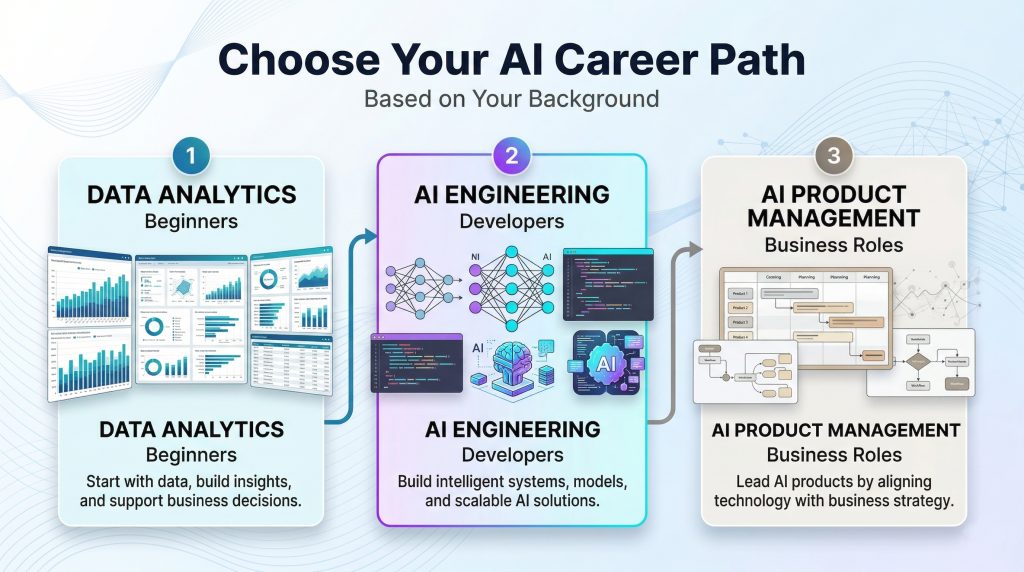
1. Data Analytics For Beginners / Freshers
Starting with data analytics is the most secure way to enter the ecosystem without getting overwhelmed by high-level math or complex software architecture.
- Why This Role Offers Stability: Every business requires data interpretation to function, ensuring a constant demand for entry-level talent who can handle SQL and Excel. This creates a safety net where skills are applicable across finance, healthcare, and retail sectors.
- Key Responsibilities: Your primary focus will be on cleaning datasets, creating visual reports for management, and performing basic statistical tests to identify trends. You will spend time ensuring data integrity so that the business makes decisions based on facts rather than guesses.
- Ideal For: This is the perfect path for fresh graduates or those transitioning from non-technical fields like marketing who want a structured entry into tech.
- Future Prospects: As you gain experience, you can naturally transition into data science or machine learning engineering. The foundational understanding of how data flows through a business will make you a much more effective senior leader in the future.
To kickstart your journey, the Data Analytics Essentials Certificate Program offered by the McCombs School of Business at The University of Texas at Austin serves as an excellent starting point.
Start with data analytics—no experience needed. Learn the fundamentals and make smarter decisions at work.
How The Program Helps You?
- Master In-Demand Tools: Over 5 months, you will learn to confidently use Excel, Python, RDBMS, Tableau, Power BI, and SQL.
- Structured Learning Path: Grasp the absolute fundamentals of data analysis, from descriptive statistics (central tendency and dispersion) to exploratory data analysis, Pandas, NumPy, and interactive dashboards.
- Hands-on Application: Apply theoretical concepts to real-world scenarios through industry-guided projects, such as analyzing restaurant customer order data or querying an SQL database to generate business insights.
2. AI Engineering For Developers / Tech Background
If you already possess a background in software development or computer science, moving toward AI engineering is the most logical way to future-proof your career.
- Why This Role Offers Stability: As traditional coding becomes more automated, the ability to build and maintain the AI systems that do the automating becomes an essential skill. Your ability to manage infrastructure and large-scale deployments ensures long-term job security.
- Key Responsibilities: You will be responsible for managing the lifecycle of AI models (MLOps), and optimizing code for cloud environments. Your work ensures that AI products are scalable, fast, and reliable for millions of users.
- Ideal For: This path is designed for software engineers, backend developers, and systems architects who enjoy solving complex technical puzzles. If you have an interest in machine learning and AI job trends, this is where you can have the most impact.
- Future Prospects: AI engineering offers one of the highest growth ceilings in the industry. As you gain experience, you can move into roles such as AI architect, ML lead, or even head of AI, working on cutting-edge systems that power large-scale products and platforms.
For those who want to reach the absolute highest levels of technical expertise required to engineer these systems, the e-Postgraduate Diploma in Computer Science & Engineering from IIT Bombay is an outstanding choice.
Become an IIT Bombay Postgraduate in CSE
Accelerate your tech career with IIT Bombay’s ePGD in CSE. Learn from top faculty, earn alumni status, and gain in-demand skills in AI, Security, and Blockchain.
How This Program Helps You?
- Elite Academic Instruction: Learn directly from India's leading CSE department, home to 47 faculty members and top achievers honored with accolades like the Padma Shri and the Infosys Prize.
- Advanced Algorithmic Mastery: Over 12 months online, dive deep into complex computer science paradigms, including dynamic programming, divide and conquer, greedy algorithms, network flow, and polynomial-time complexity.
- Comprehensive Software Foundation: Build a resilient technical toolkit covering Unix, C/C++, Python (NumPy and SciPy), and web programming (HTML, JavaScript, CSS).
- Future-Proof Engineering: Equip yourself with critical skills in software management tools, security and cryptography, and reliable AI-enabled programming to build secure, scalable, and cutting-edge systems.
3 AI Product Management For Business / Management Professionals
Those with experience in leadership, project management, or business strategy should look toward AI Product Management to remain relevant in a changing market.
- Why This Role Offers Stability: AI technology is often difficult to implement in ways that actually deliver products that solve real problems; companies desperately need people who can bridge that gap.
- Key Responsibilities: You will define the product vision, conduct market research, and work closely with engineering teams to ensure technical builds align with customer needs.
- Ideal For: This is best for current project managers, business analysts, or marketing leads who want to stay at the cutting edge of technology. You should consider why AI skills matter more than ever for leaders who want to guide technical teams.
- Future Prospects: The role of an AI PM is evolving into a central leadership position within most modern corporations. As companies become "AI-first," the demand for managers who understand both the business and the bot will continue to skyrocket.
Pros and Cons of Each Career Path
Every job has distinct advantages and disadvantages. Understanding these limits is crucial for your long-term mental and professional stability.
Data Analytics
- Quick entry point: You can start this career much faster than in engineering roles because the required tools are easier to learn and highly accessible to beginners.
- Stable job market: Every single business in the world needs people to read their sales numbers, making this a highly secure choice according to recent reports on job safety.
- Lower earning ceiling: Compared to advanced engineering jobs, the maximum data analyst salaries and trends suggest you might earn slightly less as you reach senior levels.
AI Engineering
- Massive earning potential: Because this job is extremely difficult to master, companies are willing to pay massive salaries to secure the best technical talent available.
- High impact creation: You actually build the tools that completely change how people work, meaning your daily tasks have a huge impact on the modern world.
- Constant stressful learning: The technology changes so fast that you must study new software constantly, which can cause severe burnout for many professionals over time.
AI Product Management
- Leadership opportunities: You get to make big business decisions and guide teams, which naturally prepares you for top company leadership roles later in life.
- Less coding required: If you understand business but hate writing computer code all day, this role lets you work in technology without getting stuck doing heavy programming.
- Extreme responsibility: You are highly responsible for managing the entire lifecycle of a product from ideation to launch and scaling, which makes the role impactful but also demanding, as every decision directly affects business outcomes and user experience.
Understanding these points helps answer will ai replace jobs; it will not replace those who continuously adapt their core skills.
Ideal Career Roadmap
To ensure long-term stability, you should follow a structured path that builds layers of expertise over time. This prevents you from becoming a "specialist in a tool that no longer exists."
- Build Foundational Data Literacy: Start by mastering SQL and Excel to understand how data is stored, retrieved, and cleaned; this is a universal skill that remains relevant regardless of which AI model is currently popular.
- Develop a "T-Shaped" Skill Set: Pick one area (Analytics, Engineering, or PM) to go deep in, while maintaining a broad understanding of the other two; this makes you indispensable in cross-functional teams.
- Engage in Continuous Practical Application: Regularly work on exercises and build a portfolio of real-world projects; a GitHub or a portfolio of product case studies is better than any single certificate.
- Prepare for the Interview Market: Once you have the skills, study interview questions specifically for your chosen path to understand how companies evaluate AI talent.
- Stay Updated: The AI field evolves rapidly, making it essential to commit to continuous learning through blogs, courses, and regular upskilling with free courses to stay relevant and competitive in your career.
Conclusion
In summary, finding the absolute perfect professional role requires matching your natural abilities with current market demand.
Data Analytics is highly ideal for visual thinkers and pattern seekers. AI Engineering is the absolute best fit for hardcore coders and math enthusiasts. AI Product Management is the top choice for strategic business leaders.
Long-term career stability is safely guaranteed if you build strong basics, adapt to new technologies, and continuously upskill. By following structured learning programs, you can confidently secure your permanent future in the tech industry.